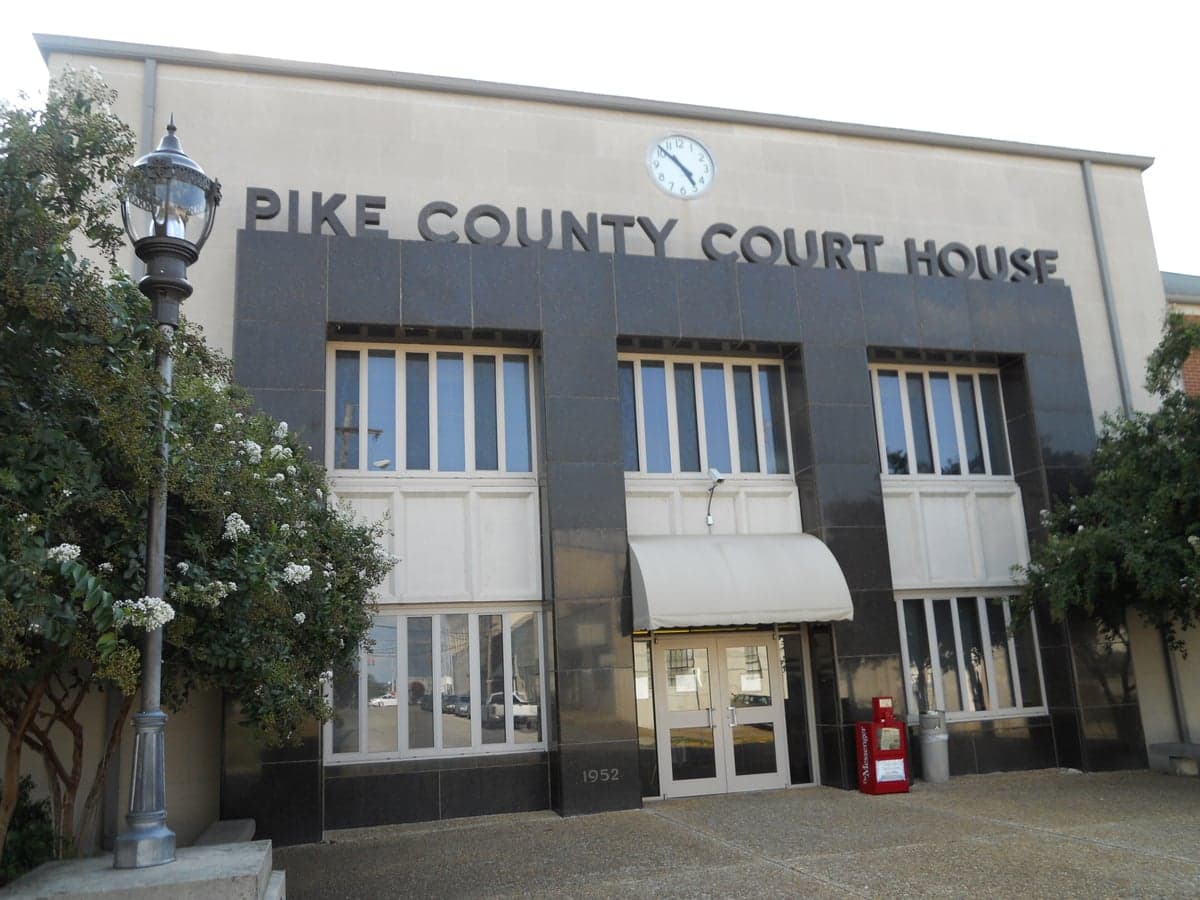
Photo: Wikipedia
Personal Sovereignty in Pike County
Viable for self-reliance. Generally workable, though some barriers may limit total independence.
What does Personal Sovereignty tell us?
Personal Sovereignty measures your capacity for self-reliance and independence with minimal government friction. Higher scores mean fewer barriers between you and the way you want to live... but it assumes you have the space you need and good neighbors.
What does this tell us?
Personal Sovereignty measures your capacity for self-reliance and independence with minimal government friction. Higher scores mean fewer barriers between you and the way you want to live... but it assumes you have the space you need and good neighbors.
State Policy
Energy independence: Importer (45% of energy produced in-state)
Personal Liberty
Homesteading

Personal Liberty Analysis
Pike County, Alabama, presents a distinctly high-autonomy environment for residents who prioritize personal sovereignty, largely shaped by Alabama's consistently conservative state-level governance, low tax burden, and strong protections for self-defense and parental rights. While the county as a whole leans heavily toward light-touch regulation, notable differences exist between the county seat of Troy, the smaller towns of Brundidge and Banks, and the rural unincorporated areas—particularly in terms of zoning enforcement, homesteading feasibility, and the pace of local rulemaking. For a single individual or family seeking maximum personal independence, Pike County generally delivers a regulatory climate that is permissive rather than prescriptive, with the surrounding countryside offering the fullest expression of self-reliant living.
Low tax burden and light-touch regulatory climate in Pike County
Alabama's overall tax burden ranks among the lowest in the nation, and Pike County aligns closely with that profile. The state's combined state and local sales tax rate in Troy is about 10%, which is standard for Alabama, but there is no county-level income tax—only the state's flat 2% to 5% income tax bracket. Property taxes are exceptionally low: the effective property tax rate in Pike County hovers around 0.38% of assessed home value, placing it well below the national average. For a $200,000 home, that works out to roughly $760 annually. The regulatory posture at the county level is similarly restrained. Unincorporated areas of Pike County operate with minimal zoning—essentially, a landowner can build a home, shed, or fence without going through a county permitting process, provided they meet state building codes for new construction. This stands in sharp contrast to more regulated metro areas like Birmingham or Montgomery. However, the city of Troy does maintain a zoning ordinance and a building permit requirement for new structures, meaning that within city limits, any large-scale project or addition will require a visit to city hall. Towns like Brundidge and Banks are far less formal in their enforcement, with many residents simply building as they please and only pulling permits when selling the property later. For a relocation-minded individual, the key takeaway: if you want the lightest regulatory touch, look at rural parcels outside the Troy city limits, especially south toward Goshen or west toward Spring Hill.
Self-defense and gun law specifics: Alabama's permissive framework in Pike County
Alabama is a constitutional carry state, meaning that as of 2022, any law-abiding adult 18 or older can carry a concealed handgun without a permit. Pike County generally sees strong support for these protections, and law enforcement in the county does not enforce any additional local restrictions beyond state law. Open carry is legal without a permit, and there are no gun-free zones beyond those mandated by state law (such as K-12 schools and certain government buildings). The sheriff's office in Troy and the smaller towns like Brundidge and Banks are known for a pro-Second Amendment posture; for example, the Pike County Sheriff's Office regularly issues permits to those who still want a permit for reciprocity in other states. Stand-your-ground laws apply in Alabama, so there is no duty to retreat before using deadly force in self-defense if you are in a place you have a legal right to be. Gun culture here is broadly accepted, with shooting ranges and private clubs found on the outskirts of Troy and in the unincorporated areas near Spring Hill. For a family or individual who prioritizes the ability to defend themselves without bureaucratic hurdles, Pike County offers one of the most permissive self-defense environments in the southeastern U.S.
Self-reliance and homesteading viability: lot sizes, zoning, and off-grid realism
For those looking to live off-grid or pursue a homesteading lifestyle, Pike County is a strong candidate—but the viability depends heavily on location. In unincorporated areas, there is no county-wide minimum lot size for residential use, so you can buy a 1-acre or 5-acre parcel and build a cabin, install solar panels, drill a well, and use septic without significant red tape. The county does not have a property maintenance code that would penalize a house that looks rustic or unfinished, so you can take years to build as you go. However, there are state-level health department regulations for septic systems and well water that must be followed, so you cannot simply dig a hole and call it a day—a permitted septic system is required if you plan to occupy the dwelling. Off-grid electricity options are unrestricted: solar panels, wind turbines, and battery storage are allowed without county-level permits, but you must be aware that Alabama Power has stated that residents are not allowed to completely disconnect from the grid unless you meet net metering requirements, which effectively means off-grid living is possible but requires careful legal structuring (some residents simply go off-grid informally and never connect to the grid, though technically, the state requires connection if you are within 300 feet of a power line—enforcement is sporadic). The town of Banks and the unincorporated area around Spring Hill are particularly well-suited for homesteading, with large tracts of cheap land available between $1,000 and $3,000 per acre. Within Troy city limits, however, zoning code prohibits the keeping of livestock like chickens, goats, or pigs in residential neighborhoods, though small gardens are fine. For a family wanting to raise animals, hunt, and grow food, the rural parts of Pike County—especially near Goshen or Brundidge—are far more accommodating than suburban or urban settings.
Personal liberties: parental rights, medical autonomy, speech, and property
Alabama law provides robust protections for parental rights, including a 2019 law that affirms parents' "fundamental right" to direct the upbringing, education, and healthcare of their children. In Pike County, this translates to school districts—such as Pike County Schools and Troy City Schools—generally deferring to parental decisions regarding curriculum objections and medical consent. Medical autonomy is similarly strong at the state level: Alabama has no vaccine mandate for adults (it ended emergency mandates in 2023), and the state's 2014 "Right to Try" law allows terminally ill patients to access experimental treatments without FDA approval. Medical freedom in Pike County itself is unremarkable—hospitals like Troy Regional Medical Center follow state law—but the county does not impose any local health ordinances beyond state code. Free speech is constitutionally protected, and there are no local restrictions on political expression or signs beyond standard zoning rules (e.g., no signs over a certain size in Troy's historic district). Property rights are well-guarded: Pike County does not have a county-wide property maintenance code that would dictate the color of your house or the height of your grass, though Troy city code does have a grass-height limit of 12 inches in residential areas. For those who value maximum personal choice—whether about healthcare decisions, what they teach their children, or how they use their land—the unincorporated parts of Pike County offer the least interference, while the small towns like Brundidge and Banks strike a balance between some community standards and genuine local control.
Overall, Pike County ranks well above the national average for personal sovereignty, particularly for those who choose to live outside the Troy city limits. The combination of constitutional carry, low taxes, minimal zoning in rural areas, and strong parental rights creates an environment where an individual or family can live largely as they see fit, with few barriers from local government. Compared to more heavily regulated states like California or even parts of the Northeast, Pike County offers a distinctly hands-off experience. For a conservative-leaning relocator who values the ability to own firearms, home-school or private-school children without interference, and build a self-sufficient homestead, Pike County—and especially its outlying hamlets like Spring Hill, Goshen, and Brundidge—provides one of the most genuinely autonomous bases in Alabama.

* Values derived from national, state, county, city and local statistics and may differ in a specific area. Last updated: 2026-07-03T08:00:46.000Z
Narrative content on this page is AI-generated and may contain mistakes. Verify any details that matter before acting on them.
ReloMaps may earn a commission from affiliate links at no extra cost to you.

