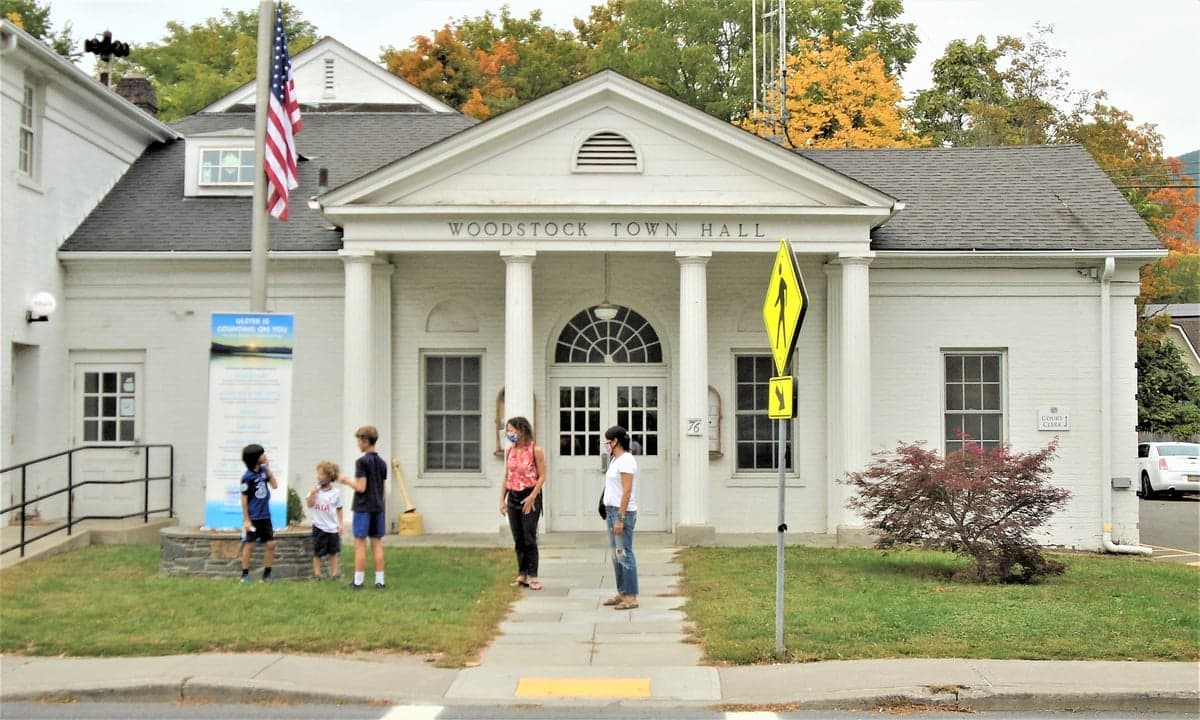
Photo: Wikipedia
Political ClimatePolitical Climate in Woodstock, NY
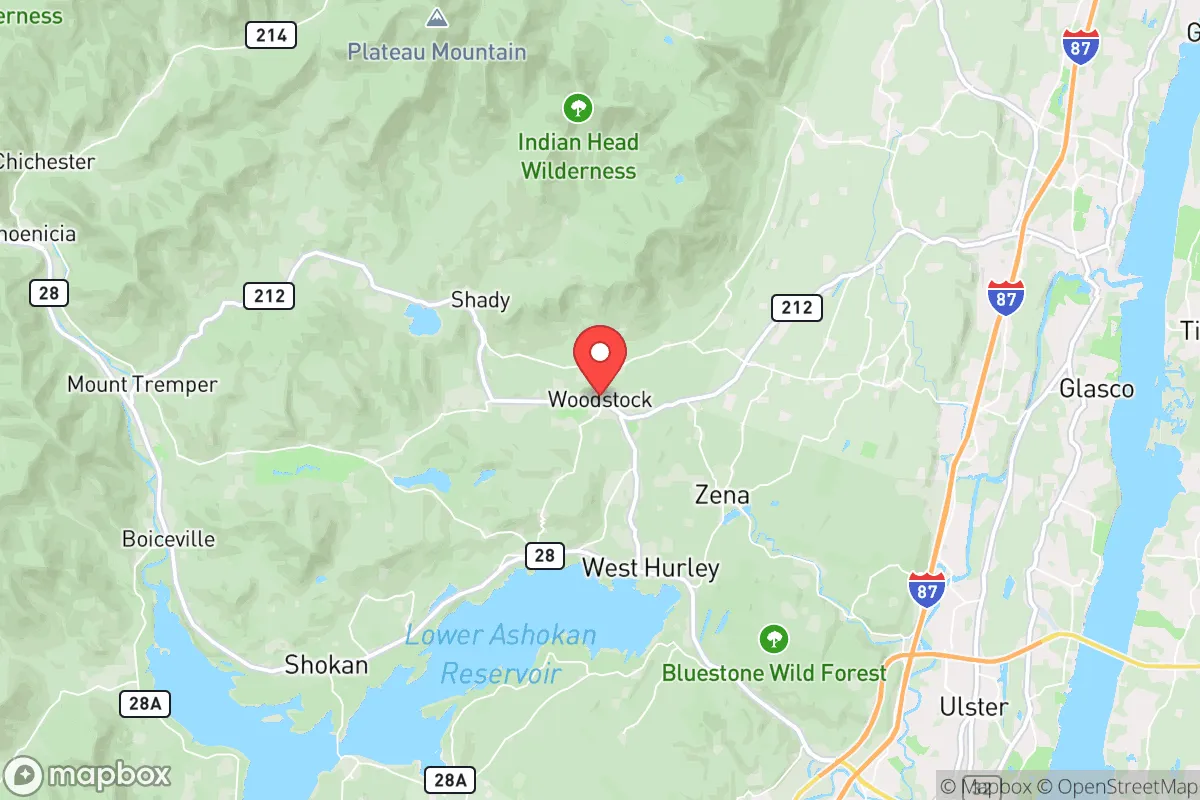
District shown is the primary district for this city’s centroid. Cities may span multiple districts.
Local Political AnalysisPolitical Analysis of Woodstock, NY
Woodstock, New York, has long been a byword for progressive counterculture, and its political climate today remains solidly liberal, though with a pragmatic, small-town flavor that sets it apart from the more hardline activism of its 1969 reputation. The town and surrounding Ulster County lean reliably Democratic, with a Cook Partisan Voting Index (PVI) of D+2, meaning the area votes about two points more Democratic than the national average. In practice, that translates to consistent Democratic wins in local, state, and federal races, but the margins aren't overwhelming—this isn't a deep-blue stronghold where Republicans are invisible. The political trajectory has been stable for decades, with a slow, steady drift leftward as new residents from the New York City metro area move in, drawn by the area's natural beauty and cultural cachet.
How it compares
Compared to New York, New York (Manhattan), Woodstock is notably less intense in its partisan divide. Manhattan's political energy is hyper-urban, with a dense concentration of progressive activism, high-profile fundraising, and a political machine that can feel impersonal. Woodstock, by contrast, is a village of roughly 6,000 people where local politics often revolve around land use, school board decisions, and the balance between tourism and preserving the town's character. The surrounding towns tell a more nuanced story: nearby Saugerties and Kingston lean Democratic but with a stronger working-class and union influence, while rural towns like Shandaken and Olive are more mixed, with conservative pockets that vote Republican in local races. The contrast is sharpest with the more conservative communities to the south and west, such as Liberty and Monticello in Sullivan County, where Trump won in 2020. In Woodstock, you'll find Bernie Sanders signs on lawns and "Coexist" bumper stickers, but you'll also see a live-and-let-live attitude that makes it less confrontational than the city.
What this means for residents
For liberal residents, Woodstock offers a comfortable political home where their views are the norm, and local government generally aligns with progressive priorities—environmental protections, support for the arts, and inclusive social policies. Conservative residents, while a minority, are not ostracized; they tend to be older, long-time locals who value the town's history and quiet lifestyle. They often find common ground with liberals on issues like opposing overdevelopment and preserving open space. The practical effect is a community where political disagreements are usually civil, and local elections are decided more by personality and local issues than by national party loyalty. The biggest friction point is often taxes: Woodstock's property taxes are high (among the highest in Ulster County), which can strain both liberal and conservative homeowners, and debates over school funding and town budgets cut across party lines.
Culturally, Woodstock stands apart from New York City in its deliberate smallness and resistance to commercialization. The town has strict zoning laws that limit chain stores and large-scale development, a policy that enjoys broad support across the political spectrum. The local arts scene is vibrant but community-focused, not the high-stakes commercial art world of Manhattan. Politically, this translates into a shared identity that values authenticity and local control, making Woodstock a place where the political climate is less about red vs. blue and more about how to keep the town true to its quirky, creative roots. It's a place where a Republican and a Democrat can agree that the biggest threat to their quality of life is a new strip mall, not the other party's candidate.

State Political ClimatePolitical Climate in New York
State Political AnalysisPolitical Environment in the State
New York State has been a reliable Democratic stronghold for decades, but the picture is far more complex than a simple blue label. The state’s overall partisan lean is driven overwhelmingly by New York City and its immediate suburbs, which deliver massive Democratic margins. Over the last 10-20 years, the trajectory has been one of deepening polarization: the city and its inner-ring suburbs have moved further left, while vast swaths of upstate New York have shifted sharply right. In 2024, Kamala Harris won the state by roughly 12 points, down from Joe Biden’s 23-point margin in 2020, signaling a realignment that is reshaping the political map. For a conservative-leaning relocator, the key takeaway is that your experience will depend almost entirely on where in the state you land.
Urban vs. rural divide
The political map of New York is a study in contrasts. New York City’s five boroughs—Manhattan, Brooklyn, Queens, the Bronx, and Staten Island—cast about 40% of the state’s vote, with the first four delivering margins of 70-85% Democratic. The inner-ring suburbs of Westchester County, Nassau County on Long Island, and parts of Rockland County are also reliably blue, though Nassau has shown some rightward drift in local races. Drive an hour north or west, and the landscape changes dramatically. The Hudson Valley counties like Dutchess, Orange, and Ulster are competitive swing areas, with Orange County trending red in recent cycles. The Capital Region around Albany leans Democratic but is tempered by rural towns. The real conservative strongholds are the Southern Tier (counties like Steuben, Chemung, and Allegany), the North Country (St. Lawrence, Jefferson, and Clinton counties), and the Finger Lakes interior (Ontario, Yates, and Seneca counties). These areas routinely vote 60-70% Republican. The divide is not just geographic but cultural: upstate rural voters feel increasingly alienated from downstate policy priorities, a sentiment that has fueled a growing "secession" chatter in some counties.
Policy environment
New York’s policy environment is among the most progressive in the nation, with a tax structure that reflects that. The state has a progressive income tax with rates from 4% to 10.9% on income over $25 million, plus a separate NYC income tax for city residents. Property taxes are among the highest in the country, particularly in upstate school districts where rates can exceed 3% of assessed value. The regulatory posture is dense: strict rent control laws in NYC, a statewide ban on natural gas hookups in new construction starting in 2026, and some of the nation’s toughest environmental regulations. Education policy is dominated by the state’s powerful teachers’ unions, with per-pupil spending among the highest nationally. Healthcare is heavily regulated, with a state-run health insurance exchange and strong Medicaid expansion. Election laws are relatively liberal: no-excuse absentee voting, early voting, and automatic voter registration are in place, though voter ID is not required. For a conservative relocator, the tax burden and regulatory climate are the most immediate practical concerns.
Recent policy direction
The last five years have seen a flurry of legislation that signals a clear leftward trajectory. On gun and self-defense law, the state passed the Concealed Carry Improvement Act (CCIA) in 2022 after the Supreme Court’s Bruen decision, requiring "good moral character" for permits and banning firearms in sensitive locations like Times Square and subways. This law is currently being challenged in federal court. On parental and education rights, the state has expanded "sanctuary" policies for transgender students, allowing them to use preferred names and pronouns without parental consent in some districts, a flashpoint in conservative suburbs. Medical and bodily autonomy is protected by a 2019 law codifying abortion rights up to viability, and the state has become a destination for out-of-state patients. Property rights have been constrained by the 2019 Housing Stability and Tenant Protection Act, which weakened rent decontrol and made evictions harder for landlords. Taxation remains high, though the state has not raised the top rate since 2021. Voting and ballot access expanded with early voting and no-excuse absentee, but the state’s strict campaign finance laws remain in place. For a relocator, the CCIA and tenant protections are the most likely to affect daily life.
Civil unrest & political movements
New York has a long history of political activism, and recent years have been no exception. The 2020 Black Lives Matter protests in NYC were among the largest in the nation, with widespread property damage and a subsequent debate over police funding. The state’s sanctuary policies are a major flashpoint: New York is a "sanctuary state" under a 2017 executive order and subsequent laws, limiting cooperation between local law enforcement and federal immigration authorities. This has led to tensions in upstate counties like Erie County (Buffalo) and Monroe County (Rochester), where some sheriffs have publicly refused to comply. The election integrity debate has been less intense than in swing states, but the 2020 and 2022 cycles saw allegations of fraud in NYC’s absentee ballot processing, leading to a state Board of Elections investigation. The most visible political movement on the right is the "New York State of Mind" secession push, with several upstate counties passing resolutions to explore leaving the state, though it remains a symbolic gesture. On the left, the Working Families Party and Democratic Socialists of America have gained influence in NYC council races, pushing for defunding police and rent control expansion.
Projection
Over the next 5-10 years, New York’s political trajectory points toward continued polarization. Demographic trends favor the Democrats: NYC continues to attract young, diverse, and college-educated residents, while upstate’s population is aging and slowly declining. However, the 2024 results suggest a ceiling on Democratic dominance—the party’s margin shrank even in some blue suburbs like Westchester and Nassau, driven by concerns over crime and taxes. In-migration from other states is net negative, with many relocators heading to Florida, Texas, and the Carolinas, which further concentrates the remaining population in blue areas. The state’s fiscal health is a wild card: a projected budget deficit of $4-6 billion by 2027 could force tax increases or spending cuts, which would likely accelerate out-migration. For a conservative moving in now, expect to find a state where your vote matters most in local and state legislative races, not presidential ones. The upstate-downstate divide will likely deepen, with more counties exploring autonomy measures. A decade from now, the state may look like a smaller, more intensely blue core surrounded by a redder, more frustrated periphery.
For a new resident, the bottom line is this: New York offers world-class amenities, natural beauty, and economic opportunity, but it comes with a high price tag in taxes, regulation, and cultural friction if you lean conservative. If you’re moving to Buffalo or Rochester, you’ll find a more moderate, union-friendly environment with lower costs. If you’re headed to Manhattan or Brooklyn, you’re signing up for a progressive urban machine. The smartest move is to research the specific county and town—your experience in Chautauqua County will be nothing like your experience in Westchester. Visit, talk to locals, and check the school board and county legislature races. That’s where the real political action is.
* Values derived from national, state, county, city and local statistics and may differ in a specific area. Last updated: 2026-08-03T15:47:55.000Z
Narrative content on this page is AI-generated and may contain mistakes. Verify any details that matter before acting on them.
ReloMaps may earn a commission from affiliate links at no extra cost to you.

