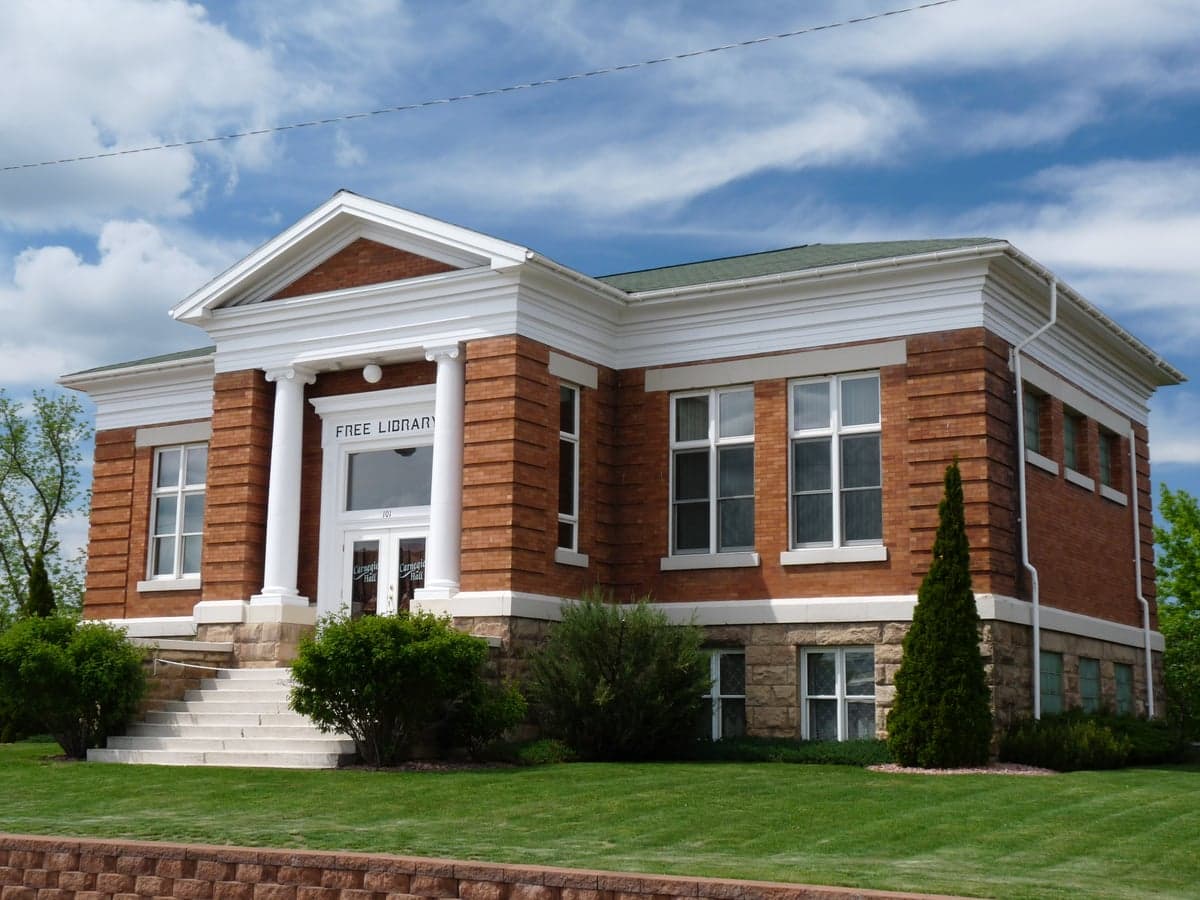
Photo: Wikipedia
Political ClimatePolitical Climate in Rusk County
Showing district-level results — no local-only data available.
Local Political AnalysisPolitical Analysis of Rusk County
Rusk County, Wisconsin, is a reliably Republican stronghold with a Cook Partisan Voting Index of R+11, meaning it votes about 11 points more Republican than the national average. This stands in stark contrast to the state of Wisconsin as a whole, which is a pure toss-up with a Cook PVI of EVEN. The county has trended redder over the past decade, driven by rural cultural shifts and a declining Democratic base in its few union-heavy pockets, though the shift has been slower than in some neighboring counties.
How it compares
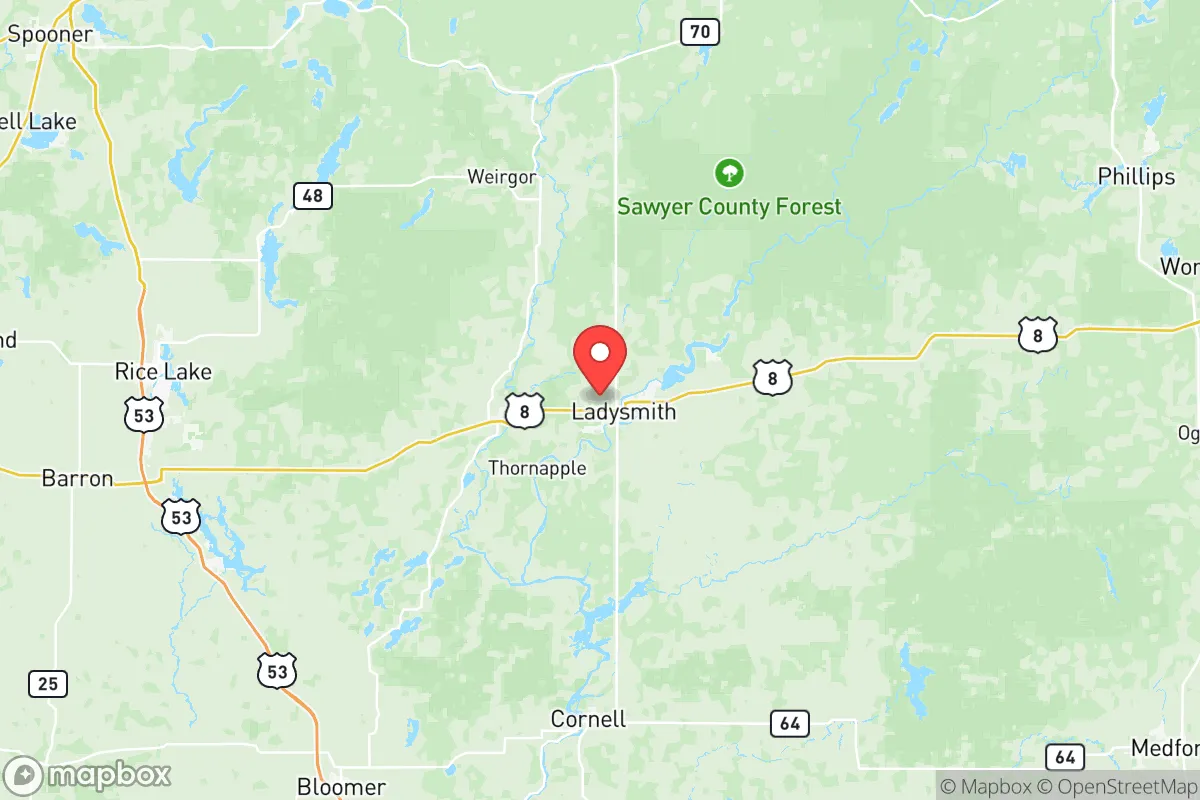
Wisconsin’s statewide EVEN rating reflects its razor-thin margins in presidential races—think 2020’s 20,000-vote difference out of 3.3 million cast. Rusk County, by contrast, routinely delivers 60-65% of its vote to Republican candidates. The gap is most visible in the county’s geography. Ladysmith, the county seat and largest town (pop. ~3,200), is the lone blue-leaning precinct, often voting Democratic by single-digit margins thanks to its older union households and a small but active public-sector workforce. Drive ten miles south to Bruce or Hawkins, and you’ll find precincts that go 70% Republican or higher. Glen Flora and Tony are swing towns—they track closer to the county average, with margins of 55-60% Republican, making them the precincts to watch for any shift. The rural townships of Stubbs, Marshall, and Willard are deep red, often exceeding 75% Republican turnout. This isn’t a county that’s flipping anytime soon; the Democratic base is concentrated in Ladysmith and a few scattered households near the Flambeau River, and it’s aging out.
What this means for residents
For conservative residents, the political climate feels comfortable and affirming. Local government—county board, school boards, town councils—is dominated by Republicans, and policy debates tend to focus on property taxes, road maintenance, and Second Amendment rights. Conservative voters here don’t feel like they’re fighting a cultural war; they feel like they’re running the show. For liberal residents, it’s a different story. They’re a clear minority, and they know it. Socially, it can be isolating—you’re unlikely to find a local Democratic Party office or a progressive book club in Bruce. But politically, it’s not hostile. The county’s small size (pop. ~14,000) means most people know each other, and partisan disagreements rarely escalate beyond friendly barstool arguments. The real tension is generational: younger residents, especially those who’ve moved back from Eau Claire or Minneapolis, tend to be more liberal, but they’re vastly outnumbered by retirees and long-time farming families.
Culturally, Rusk County stands apart from Wisconsin’s liberal urban corridors like Madison or Milwaukee. There’s no craft brewery scene or farmers market with kombucha stalls—instead, you’ll find deer hunting, snowmobiling, and church suppers. The county’s policy priorities reflect this: it’s a stronghold for local control over land use, with minimal zoning regulations, and it’s one of the few places in Wisconsin where you can still shoot a gun on your property without raising eyebrows. The trajectory is toward continued Republican dominance, but with a caveat: if Wisconsin’s statewide politics ever shift decisively left, Rusk County will likely become even more Republican in response, digging in as a rural redoubt. For now, it’s a place where the political temperature is warm but not boiling—a solid R+11 community in a state that can’t make up its mind.

State Political ClimatePolitical Climate in Wisconsin
State Political AnalysisPolitical Environment in the State
Wisconsin is the ultimate swing state, with a Cook PVI of EVEN that perfectly captures its knife-edge political balance. Over the past 20 years, the state has lurched from reliably blue (voting for Democrats in every presidential election from 1988 to 2012) to a dead-even battleground where margins of less than 1% decide the state in 2016, 2020, and 2024. The dominant coalitions are a shrinking but still potent Democratic base in the urban crescent (Milwaukee, Madison, and the college towns) versus a growing, energized Republican majority in the exurbs, small towns, and rural north and west. The trajectory is a slow, grinding realignment: the old "Blue Wall" of unionized manufacturing towns is cracking, while the WOW counties (Waukesha, Ozaukee, Washington) around Milwaukee have become some of the most reliably Republican suburbs in the nation.
Urban vs. rural divide
The political map of Wisconsin is a story of two states. Milwaukee County delivers roughly 250,000-vote margins for Democrats, while Dane County (Madison) adds another 100,000. These two counties alone are the entire Democratic firewall. Meanwhile, the WOW counties — Waukesha, Ozaukee, and Washington — are the Republican counterweight, producing margins of 150,000+ votes. The real battleground has shifted to the Fox Valley (Appleton, Green Bay, Oshkosh) and the Driftless Region in the southwest. Brown County (Green Bay) flipped from Obama to Trump and has stayed red, while La Crosse and Eau Claire remain competitive swing areas. The rural northwoods counties — Vilas, Oneida, Lincoln — have moved sharply right as Democratic-leaning seasonal residents are outnumbered by year-round conservative retirees and outdoor recreation voters.
Policy environment
Wisconsin's policy environment is a study in divided government. The state has a flat income tax of 4.4% (down from 7.65% in 2011), and the sales tax is 5% with local options (Milwaukee County adds 0.5%). Property taxes are moderate — about 1.6% of assessed value — but vary wildly by school district. The state is a right-to-work state (since 2015) and has a Republican-controlled legislature that has consistently passed constitutional carry (2011), voter ID laws (2011), and school choice expansion (the Milwaukee Parental Choice Program is the oldest in the nation). Education policy is a flashpoint: the state funds public schools through a complex formula that favors rural districts, but the legislature has capped revenue increases for decades, leading to perennial budget fights. Healthcare is a mixed bag — Wisconsin expanded BadgerCare under the Affordable Care Act, but the state has not adopted a state-based exchange.
Recent policy direction
The last five years have seen Wisconsin lurch right on several fronts. In 2023, the legislature passed Act 12, which overhauled shared revenue for Milwaukee and other cities, tying funding increases to police staffing levels — a clear win for law-and-order conservatives. Gun laws have been loosened: the state already had preemption of local gun ordinances, and in 2024, a bill to allow concealed carry without a permit (constitutional carry) passed the legislature but was vetoed by Governor Tony Evers. Parental rights have been a major theme: the 2023-24 session saw bills requiring schools to notify parents of curriculum changes and allowing parents to opt children out of library materials. Election integrity remains the hottest issue: the legislature passed a bill banning private grant money for election administration (after the 2020 Zuckerberg-funded grants), and the Wisconsin Supreme Court, now with a 4-3 liberal majority, struck down the state's legislative maps as unconstitutional in 2024, ordering new maps that are expected to shift the Assembly and Senate toward competitiveness. Medical freedom is a live issue: the state banned COVID-19 vaccine mandates for state employees and contractors, but has not passed a broad medical freedom bill. Property rights are generally strong — Wisconsin has a robust "takings" law — but local zoning battles in growing areas like Kenosha and Racine are common as farmland converts to subdivisions.
Civil unrest & political movements
Wisconsin has a history of intense political activism. The 2011 Act 10 protests against public union bargaining restrictions drew 100,000 people to the Capitol and sparked a recall election against Governor Scott Walker (which he survived). The 2020 Kenosha unrest after the Jacob Blake shooting saw two nights of rioting, arson, and the killing of two protesters by Kyle Rittenhouse, whose acquittal in 2021 became a national flashpoint for self-defense and Second Amendment debates. Immigration politics are less visible than in border states, but the issue flared in 2024 when the legislature passed a bill requiring local law enforcement to cooperate with ICE (vetoed by Evers). Election integrity remains a live wire: the 2020 election saw Trump challenge the results in court, and the 2024 election is expected to be equally contentious. The Wisconsin Supreme Court has become a partisan battleground, with liberal Justice Janet Protasiewicz winning a 2023 election after campaigning on abortion rights and calling the current legislative maps "rigged." The state has no secession or nullification movement of note, but the Wisconsin Republican Party has adopted a platform plank calling for a convention of states to propose constitutional amendments.
Projection
Over the next 5-10 years, expect Wisconsin to remain a toss-up, but with a slight rightward drift. The in-migration pattern is key: the state is gaining population from Illinois (especially the Chicago exurbs), and those newcomers tend to be moderate-to-conservative, moving for lower taxes and housing costs. The Milwaukee suburbs are diversifying and becoming more Democratic, but the Fox Valley and northwoods are solidifying as Republican strongholds. The new legislative maps (ordered by the state Supreme Court in 2024) will likely produce a more competitive Assembly and Senate, meaning the state will have divided government for the foreseeable future — a Republican legislature and a Democratic governor. This gridlock will prevent major policy shifts in either direction. The abortion issue will remain central: the 1849 abortion ban was struck down in 2023, but the legislature has not passed a new law, leaving the issue to the courts. Expect continued fights over election administration, school funding, and local control. For a new resident, the bottom line is that Wisconsin is a state where your experience depends heavily on where you live — a liberal bubble in Madison or Milwaukee, a conservative stronghold in the WOW counties or the northwoods, or a genuine swing community in the Fox Valley. The state's politics are exhausting but stable: no one party will dominate, and every election will feel like a national referendum.
For a conservative relocator, Wisconsin offers low taxes, strong gun rights, school choice, and a Republican legislature that will block most progressive initiatives. The trade-off is living in a state where the governor and the courts are often hostile to conservative priorities, and where the two largest cities are deeply liberal. For a liberal relocator, the state offers a vibrant progressive community in Madison and Milwaukee, a strong labor history, and a governor who has vetoed conservative bills. The trade-off is a legislature that has been gerrymandered to the right for a decade, and a political culture that is intensely polarized. Either way, you'll be living in a state that decides presidential elections — and that means every local election, every school board race, and every Supreme Court contest will feel like a national fight.
* Values derived from national, state, county, city and local statistics and may differ in a specific area. Last updated: 2026-09-15T00:10:32.000Z
Narrative content on this page is AI-generated and may contain mistakes. Verify any details that matter before acting on them.
ReloMaps may earn a commission from affiliate links at no extra cost to you.

