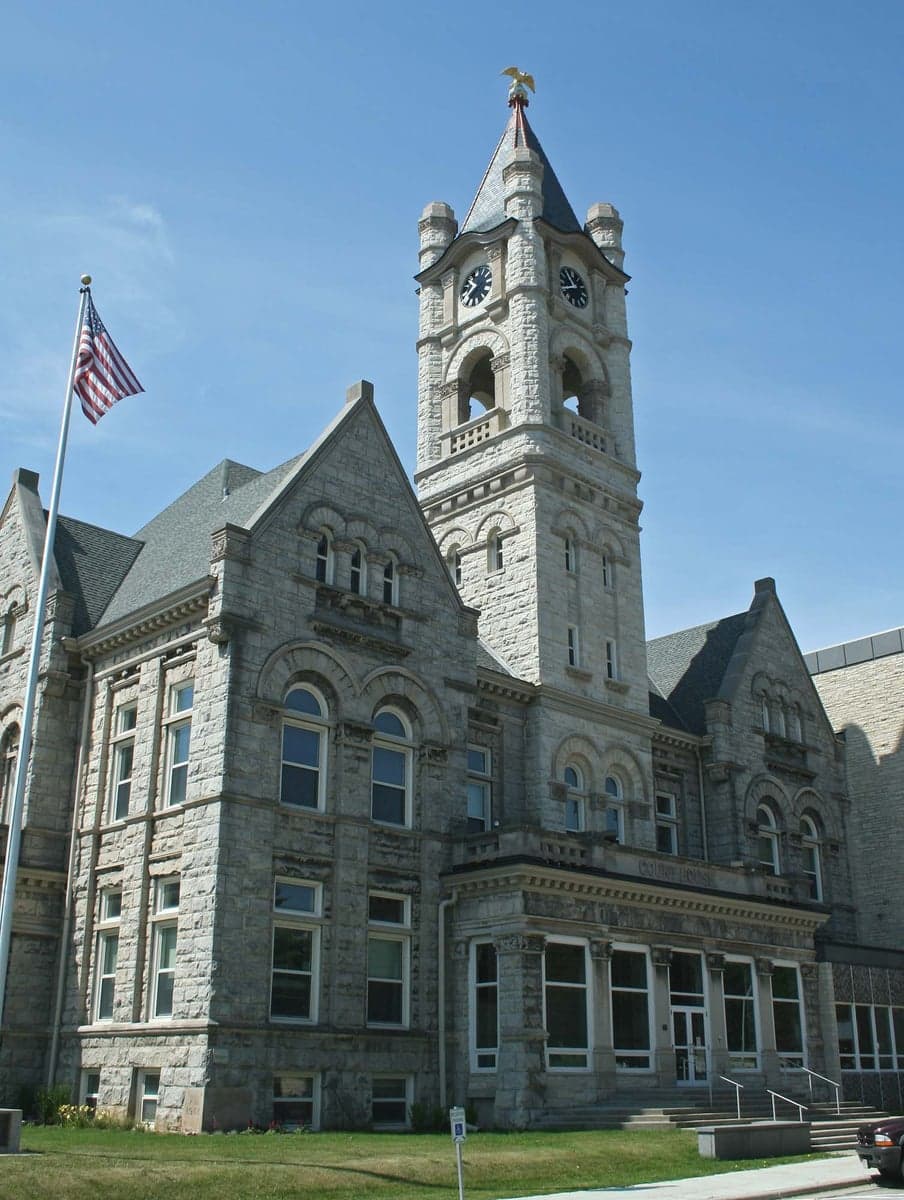
Photo: Wikipedia
Political ClimatePolitical Climate in Ozaukee County
Showing district-level results — no local-only data available.
Local Political AnalysisPolitical Analysis of Ozaukee County
Ozaukee County is one of the most reliably Republican counties in Wisconsin, with a Cook Partisan Voting Index (PVI) of R+8, meaning it votes about eight points more Republican than the national average. This stands in stark contrast to the state of Wisconsin as a whole, which has a Cook PVI of EVEN, reflecting its perennial swing-state status. While the county has trended slightly more Republican in recent presidential cycles, the real story is the widening gap between its conservative-leaning towns and its few, increasingly blue pockets, particularly in the southern reaches near Milwaukee.
How it compares
Wisconsin is a classic battleground, flipping from Obama to Trump to Biden by razor-thin margins. Ozaukee County, however, has been a Republican stronghold for decades. In 2020, Donald Trump carried the county by roughly 18 points, even as he narrowly lost the state. The political geography within the county is not uniform. The city of Mequon, especially its lakeshore precincts, is the most moderate and sometimes leans Democratic, driven by higher-education and professional-service voters. In contrast, Grafton and Cedarburg are more consistently red, with Cedarburg’s historic downtown and family-oriented neighborhoods reliably delivering strong GOP margins. The rural townships like Fredonia and Belgium are deeply conservative, often voting 70% or more Republican. The swing precincts are almost nonexistent—most areas are either solidly red or, in Mequon’s case, a lighter shade of red that can turn blue in a wave election. This is not a county that flips; it’s a county that sets the baseline for Republican turnout in southeastern Wisconsin.
What this means for residents
For conservative residents, Ozaukee County feels like a safe harbor. Local elected offices—from county board to school boards—are overwhelmingly held by Republicans, and conservative policy priorities like low taxes, school choice, and limited regulation are the norm. You’ll find strong support for the Second Amendment and a general skepticism of Milwaukee-centric governance. For liberal residents, the experience is different. While they are a clear minority, they are not isolated. Mequon provides a visible, if small, blue foothold, and the proximity to Milwaukee means access to progressive cultural and political events. However, liberal residents often feel their voices are sidelined in local elections, and issues like affordable housing or public transit expansion can be tough sells. The political discourse is generally polite but can be tense around school board meetings, especially over curriculum or library materials.
One cultural distinction worth noting: Ozaukee County’s Republicanism is more of the “country club” variety than the populist strain found in rural Wisconsin. It’s fiscally conservative, pro-business, and socially moderate in some respects—for instance, the county has a relatively high rate of college graduates and a strong environmental ethic, particularly around Lake Michigan. This means you’ll see support for conservation initiatives alongside opposition to new taxes. The county’s political trajectory is likely to remain stable, with the rural areas pulling it rightward and Mequon’s growth keeping it from becoming a deep-red outlier. For anyone moving here, the takeaway is simple: if you’re conservative, you’ll feel at home; if you’re liberal, you’ll find your people in Mequon or by commuting to Milwaukee for the broader political scene. Either way, the county’s politics are a predictable, steady force in a state that is anything but.

State Political ClimatePolitical Climate in Wisconsin
State Political AnalysisPolitical Environment in the State
Wisconsin is the ultimate swing state, with a Cook PVI of EVEN that perfectly captures its knife-edge political balance. Over the past 20 years, the state has shifted from a reliably blue-leaning battleground in presidential races (voting for Al Gore and John Kerry) to a true toss-up that flipped for Donald Trump in 2016 by less than 23,000 votes, then flipped back for Joe Biden in 2020 by a similarly razor-thin margin of about 20,000 votes. The dominant coalitions are a near 50-50 split between a Democratic stronghold in the urban southeast (Milwaukee, Madison) and a deeply Republican rural and exurban base that stretches across the rest of the state, with the critical swing voters living in the WOW counties (Waukesha, Ozaukee, Washington) and the western Wisconsin driftless region.
Urban vs. rural divide
The political map of Wisconsin is a study in stark contrasts. Milwaukee County and Dane County (home to Madison) are the Democratic engines, delivering massive margins that Democrats need to offset Republican dominance elsewhere. Milwaukee itself is a heavily Democratic, majority-minority city, while Madison is a liberal college town and state capital. The WOW counties—Waukesha, Ozaukee, and Washington—are the Republican firewall, consistently voting 60-65% Republican and providing the GOP with its largest vote margins in the state. The real battlegrounds are the suburban and exurban counties like Brown County (Green Bay), Outagamie County (Appleton), and Racine County, which have been trending toward Democrats in recent cycles but still lean Republican. The western Wisconsin driftless region, including La Crosse and Eau Claire, has become a key swing area, with college towns and rural voters creating a mixed political landscape. The northern third of the state, from Rhinelander to Hayward, is deeply Republican, driven by rural values, hunting culture, and opposition to environmental regulations.
Policy environment
Wisconsin's policy environment reflects its divided government. The state has a flat income tax rate of 4.4% (down from 7.65% in 2011), with a sales tax of 5% (localities can add up to 0.5%). Property taxes are moderate, averaging about 1.7% of home value, but vary significantly by county. The state is a "right-to-work" state (passed in 2015), and Act 10 (2011) effectively ended collective bargaining for most public employees, a landmark conservative reform that has held up in court. Education policy is a mixed bag: Wisconsin has a robust school choice program (vouchers for private schools, charter schools) that conservatives champion, but public school funding has been a perennial battleground, with rural districts struggling. Healthcare is dominated by two large systems (Aurora and UW Health), and the state did not expand Medicaid under the Affordable Care Act, though it operates a hybrid program. Election laws are moderately restrictive: voter ID is required, absentee voting is available without excuse, and the state has a bipartisan election commission that has been under constant partisan pressure since 2020.
Recent policy direction
Over the past five years, Wisconsin has lurched rightward on several fronts. In 2023, the Republican-controlled legislature passed a near-total abortion ban (triggered by the Dobbs decision), but it was blocked by the state Supreme Court, which flipped to a 4-3 liberal majority in 2023. The court is now expected to strike down the ban entirely. On gun rights, Wisconsin is a "shall-issue" state for concealed carry, with no permit required for open carry, and it has a "stand your ground" law (though not a "castle doctrine" statute). In 2024, the legislature passed a bill allowing parents to opt their children out of school library books they find objectionable, though the governor vetoed it. On election integrity, the legislature passed a bill requiring absentee ballots to be returned by 8 p.m. on Election Day (previously they could be postmarked by that day), but the governor vetoed it. The state has no sanctuary city policies, and immigration enforcement is generally cooperative with federal authorities. Property rights are strong, with no statewide rent control and limited eminent domain abuse. On privacy, Wisconsin has a biometric privacy law (similar to Illinois) but no comprehensive data privacy law. Medical marijuana is illegal, though CBD oil is allowed for certain conditions; full legalization is stalled in the legislature.
Civil unrest & political movements
Wisconsin has been a flashpoint for political movements. The 2011 Act 10 protests in Madison drew over 100,000 people to the Capitol, and the 2020 Kenosha unrest (following the Jacob Blake shooting) saw two nights of riots and the Kyle Rittenhouse shooting, which became a national flashpoint for gun rights and self-defense debates. The state has a strong grassroots conservative movement, particularly in the WOW counties and the northwoods, with active Tea Party and Moms for Liberty chapters. On the left, the Wisconsin Democratic Party is heavily influenced by labor unions (AFSCME, WEAC) and environmental groups. Immigration politics are relatively quiet, though there have been localized protests over ICE detention centers in Dodge County. Election integrity remains a live issue: the 2020 election saw a partisan audit in Brown County and ongoing lawsuits over ballot drop boxes, which the state Supreme Court banned in 2022 (then reinstated in 2024). There is no serious secession or nullification movement, though some rural counties have passed symbolic "Second Amendment sanctuary" resolutions.
Projection
Over the next 5-10 years, Wisconsin is likely to remain a swing state, but the demographic trends favor Democrats. The Milwaukee and Madison metros are growing, while rural counties are shrinking. The WOW counties are slowly diversifying and becoming less Republican (Waukesha County voted 58% for Trump in 2020, down from 62% in 2016). The state Supreme Court's liberal majority (until at least 2028) will likely uphold abortion rights, expand voting access, and potentially redraw legislative maps, which could flip the state Assembly to Democratic control. However, the Republican base in the northwoods and exurbs remains deeply entrenched, and the state's electoral college votes will continue to be decided by a few thousand votes in Brown County and the western Wisconsin driftless region. In-migration is modest, mostly from Illinois, and tends to be conservative-leaning (retirees and remote workers seeking lower taxes). A conservative relocating to Wisconsin should expect a state where their vote matters enormously, but where they will face a Democratic governor (likely through 2026) and a liberal Supreme Court that will check conservative legislation.
For a new resident, the bottom line is this: Wisconsin offers a genuine swing-state experience where your vote counts, but the policy environment is a tug-of-war. If you're conservative, you'll find strong gun rights, low taxes, and school choice, but you'll be frustrated by a liberal governor's veto pen and a Supreme Court that may strike down your preferred policies. If you're liberal, you'll find a vibrant urban scene in Madison and Milwaukee, but you'll be outnumbered in the legislature and in most of the state's geography. The practical takeaway is to choose your county carefully: Waukesha County for a reliably conservative suburban life, Dane County for a liberal college town, or Brown County if you want to live in the true battleground where elections are decided.
* Values derived from national, state, county, city and local statistics and may differ in a specific area. Last updated: 2026-07-10T08:30:06.000Z
Narrative content on this page is AI-generated and may contain mistakes. Verify any details that matter before acting on them.
ReloMaps may earn a commission from affiliate links at no extra cost to you.

