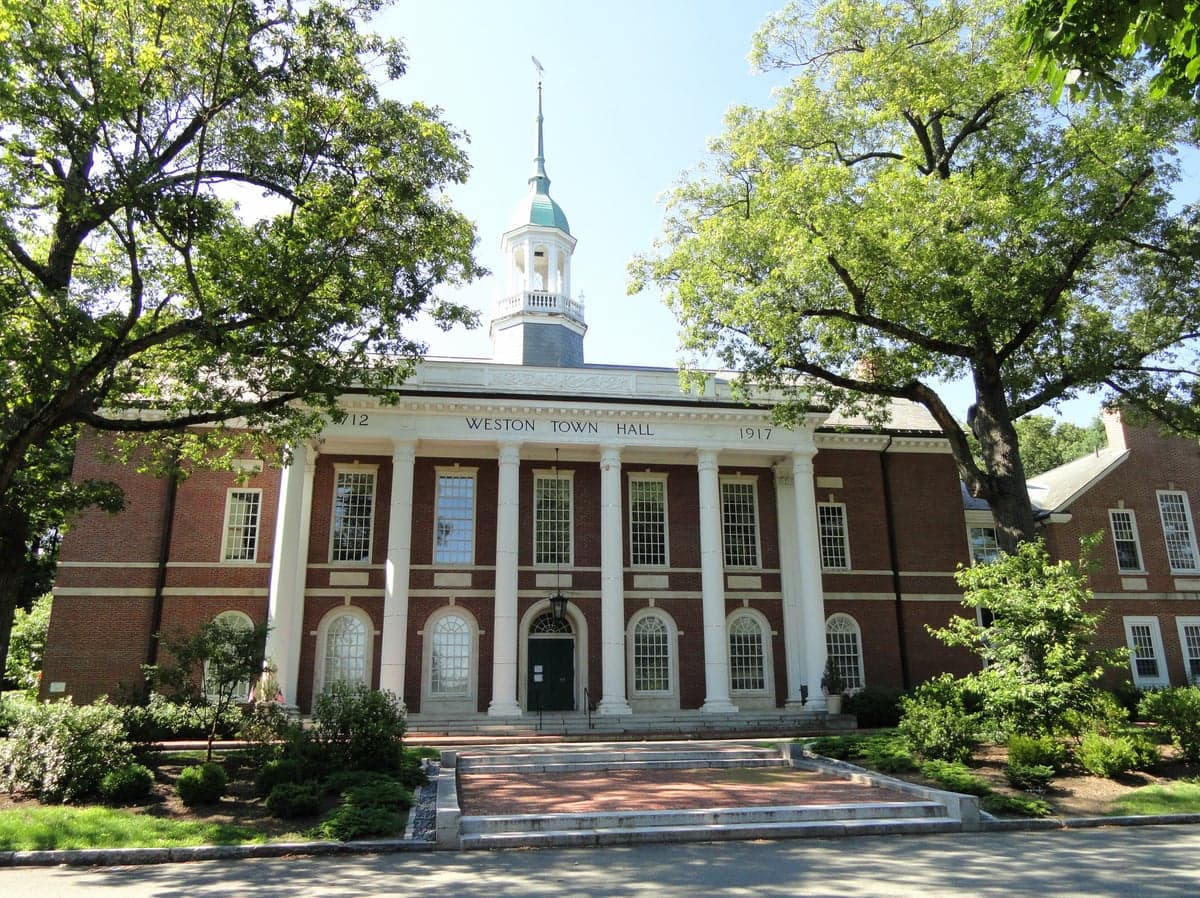
Photo: Wikipedia
Political ClimatePolitical Climate in Weston, MA
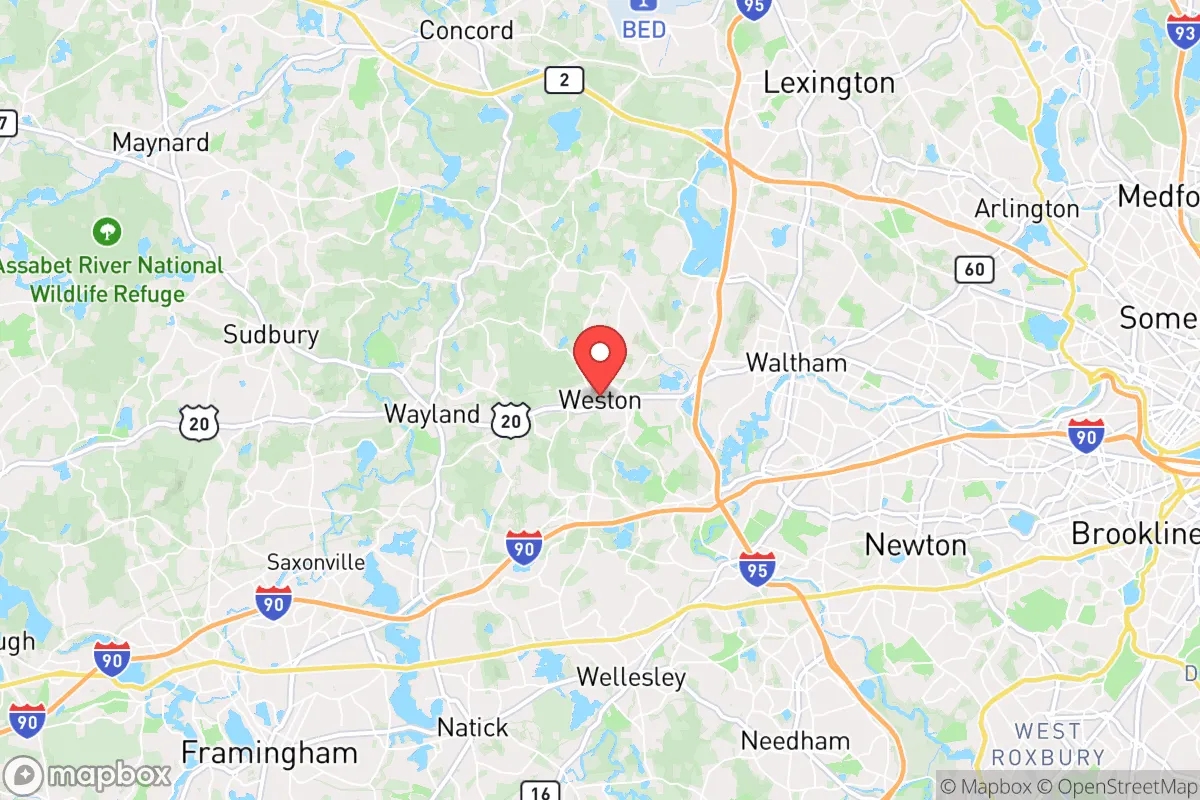
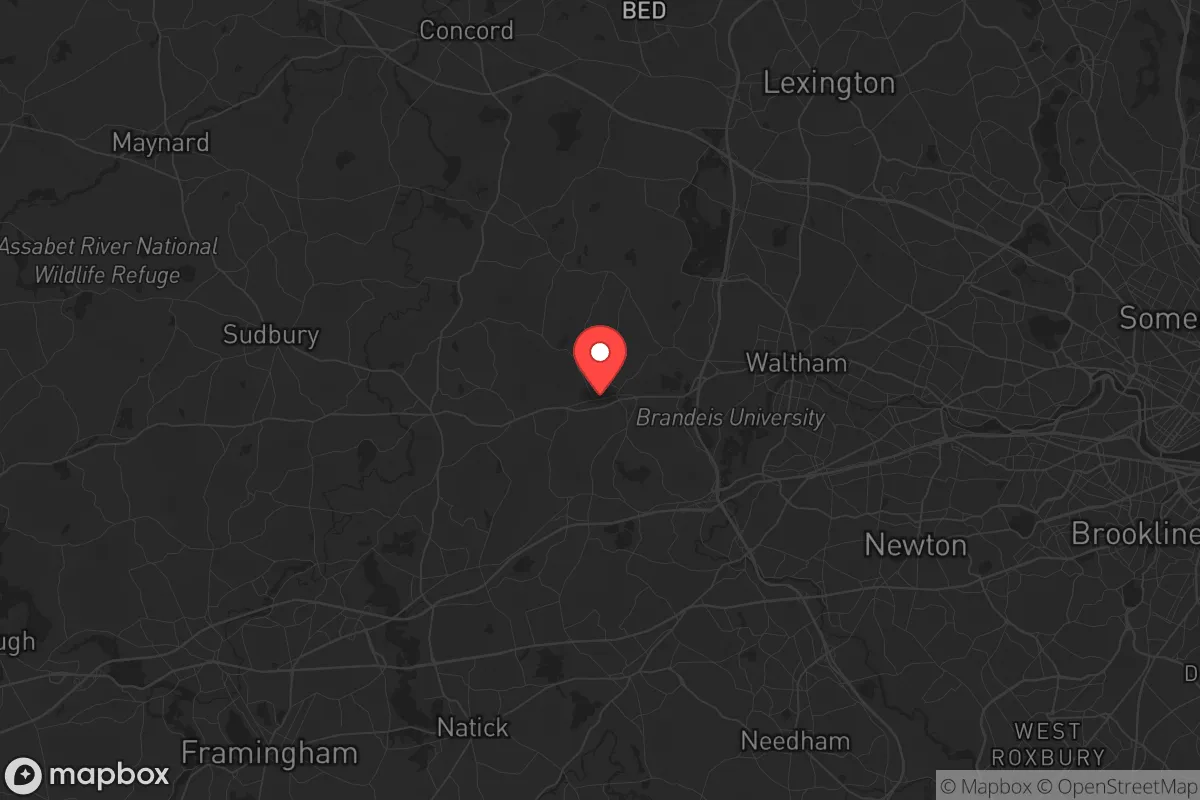
District shown is the primary district for this city’s centroid. Cities may span multiple districts.
Local Political AnalysisPolitical Analysis of Weston, MA
Weston is about as blue as it gets in Massachusetts, and that’s saying something. The town’s Cook Partisan Voting Index (PVI) of D+24 puts it a full nine points to the left of the state’s already deep-blue D+15 rating. That gap isn’t just a number—it reflects a community where Democratic candidates routinely pull 70-75% of the vote in presidential elections, and where local offices are almost universally held by Democrats or liberal-leaning independents. The trajectory here has been steadily leftward for decades, accelerating after 2016, and there’s no sign of a reversal on the horizon.
How it compares
To understand Weston’s politics, you have to look at its neighbors. Drive ten minutes east to Waltham (D+18) and you’ll find a more working-class, diverse electorate that still votes blue but with less uniformity. Head west to Wayland (D+16) or south to Wellesley (D+15), and you’re in towns that are solidly Democratic but with a noticeable moderate streak—more fiscal conservatism, more split-ticket voting in state races. The real contrast is with towns like Sudbury (D+12) or Concord (D+10), where the PVI numbers reflect a more mixed electorate, including a vocal minority of Republicans and independents. Weston’s D+24 is closer to Cambridge (D+35) or Brookline (D+30) than to its immediate suburban peers. That’s unusual for a town with Weston’s demographics—wealthy, highly educated, overwhelmingly white—but it speaks to a culture where progressive values on social issues, climate policy, and education funding are deeply embedded.
What this means for residents
For liberal residents, Weston is a comfortable fit. Town meeting votes on things like net-zero building codes, sanctuary town resolutions, and school diversity initiatives tend to pass easily. The local school system, already one of the best in the state, gets consistent funding boosts approved by voters. For conservative residents, life here can feel isolating. There’s no active Republican town committee, and GOP candidates often struggle to find volunteers for local races. That said, property taxes remain a hot-button issue—Weston’s are among the highest in Middlesex County—and fiscal conservatives do find allies on the Finance Committee and Board of Selectmen when it comes to keeping spending in check. Socially, most residents keep politics private; the town’s culture prizes politeness and discretion, so overt political arguments are rare, even at town meeting.
One cultural distinction worth noting: Weston’s political identity is tied closely to its role as a bedroom community for Boston’s academic and medical elite. A huge share of residents work at Harvard, MIT, Mass General, or biotech firms in Cambridge—institutions that lean heavily left. That professional pipeline reinforces the town’s politics in a way that’s less about activism and more about a shared worldview. You won’t see many yard signs for Bernie Sanders or Elizabeth Warren here, but you will see consistent support for Democratic candidates who emphasize competence, stability, and incremental progress. The long-term outlook? Weston will likely stay D+24 or drift even further left as younger families move in from Cambridge and Somerville, bringing their urban voting habits with them. For anyone moving here, the political reality is simple: if you’re comfortable in a deep-blue bubble, you’ll feel at home. If you’re not, you’ll find the town polite but politically monolithic.

State Political ClimatePolitical Climate in Massachusetts
State Political AnalysisPolitical Environment in the State
Massachusetts is one of the most reliably Democratic states in the country, with a Cook Partisan Voting Index of D+15, meaning it votes about 15 points more Democratic than the national average in presidential elections. Over the past 20 years, the state has shifted steadily leftward, driven by the consolidation of the Boston metro area and the emptying out of its once-competitive working-class towns. While the state hasn't voted Republican for president since 1984, the nature of that Democratic dominance has changed: the old moderate, pro-business, "Massachusetts Republican" tradition (think Governors Bill Weld, Mitt Romney, and Charlie Baker) has been replaced by a more uniformly progressive, single-party rule in the legislature that has lasted for decades.
Urban vs. rural divide
The political map of Massachusetts is a classic story of a deep blue urban core surrounded by a fading purple ring and a red-leaning but sparsely populated west. The Boston metro area, including Cambridge, Somerville, and Brookline, is the engine of the state's Democratic vote, routinely delivering 80-90% margins for Democrats. The inner suburbs like Lexington and Newton are similarly progressive. The old industrial cities — Worcester, Springfield, Lowell, and New Bedford — are solidly Democratic but more moderate, often split between establishment and progressive wings. The real shift has been in the outer suburbs and exurbs. Towns like Plymouth, Wrentham, and Franklin, which once elected moderate Republicans, now reliably vote Democratic, though often by narrower margins. The rural western part of the state, including Berkshire County and the hill towns, is a mix: the Berkshires themselves are liberal (driven by second-home owners and arts communities), while the small farming towns and the Cape Cod region have pockets of Republican strength, but not enough to flip any statewide race. The only reliably Republican county in presidential elections is Barnstable County (Cape Cod), and even that is trending blue. In practice, a conservative moving to Massachusetts will find the most political breathing room in the central and western towns, but they will still be a minority in most local elections.
Policy environment
The state's policy environment is defined by high taxes, strong regulation, and expansive public services. Massachusetts has a flat income tax rate of 5%, but a 2022 ballot measure added a 4% surtax on income over $1 million (the "Millionaire's Tax"), pushing the top rate to 9%. Property taxes are moderate by national standards but high for New England, averaging about 1.1% of home value, though they vary wildly by town — Boston is around 0.6%, while rural towns can be over 1.5%. Sales tax is 6.25%, with no tax on most groceries and clothing under $175. The state has a robust regulatory environment, particularly in environmental and labor law. Education policy is a major focus: Massachusetts consistently ranks first in the nation for K-12 outcomes, but the system is heavily funded by local property taxes, creating wide disparities between wealthy and poor districts. The state has universal healthcare coverage through its 2006 reform law (the model for the ACA), and it offers a generous Medicaid program. Election laws are among the most accessible in the country: no-excuse mail-in voting, same-day registration, and early voting are all permanent. For a conservative relocator, the tax burden is the most immediate practical concern, along with the state's aggressive enforcement of environmental regulations on property development and business operations.
Recent policy direction
The last five years have seen Massachusetts move decisively left on a broad range of issues. On gun and self-defense law, the state already had some of the strictest laws in the nation, and in 2024 it passed a major reform package that bans "ghost guns," expands the "red flag" law, and requires a license to carry in most public places. Parental and education rights have been a flashpoint: the state's Board of Education adopted a policy in 2023 that allows schools to withhold a child's gender identity from parents if disclosure could cause harm, a move that has sparked lawsuits and local school committee battles. On speech, Massachusetts has a strong public records law, but the state's anti-SLAPP statute is weaker than in some states, and there have been controversies over the use of non-disclosure agreements in government settlements. Privacy and surveillance are a mixed bag: the state has strong data breach notification laws, but Boston has one of the most extensive public camera networks in the country, and the state police use automated license plate readers widely. Medical and bodily autonomy is fully protected: abortion is legal up to 24 weeks and later for health reasons, and the 2020 ROE Act removed parental consent requirements for minors. Property rights are constrained by strong zoning laws, historic preservation rules, and the state's Chapter 40B affordable housing law, which allows developers to bypass local zoning in towns with less than 10% affordable housing. Taxation is trending upward: the Millionaire's Tax passed in 2022, and there is ongoing debate about a potential wealth tax. Voting and ballot access has been expanded: the VOTES Act of 2022 made mail-in voting permanent and added same-day registration. For a conservative, the direction is clearly toward more regulation and higher taxes, with the most contentious battles now centered on parental rights and school curriculum.
Civil unrest & political movements
Massachusetts has a long history of organized political activism, but it has become more polarized in recent years. The Black Lives Matter protests in Boston in 2020 were large and sustained, leading to the removal of a statue of Christopher Columbus in the North End and a push to rename Faneuil Hall's "Cradle of Liberty" narrative. On the right, the state has a small but active network of Second Amendment sanctuaries — about 100 towns have passed resolutions opposing new gun laws, though they are symbolic. Immigration politics are a major fault line: Massachusetts is a sanctuary state, with a 2017 law that limits local police cooperation with federal immigration enforcement. This has led to flashpoints in cities like Lynn and Lawrence, where tensions over housing and school resources have boiled over. Election integrity controversies have been minimal compared to other states, but there have been isolated disputes over the 2020 mail-in voting process. The most visible political movement in recent years has been the school committee wars, particularly in suburbs like Needham and Wellesley, where conservative parents have organized to challenge curriculum on race, gender, and history. These battles have been intense but have not yet shifted the overall political balance. A new resident will notice that political signs and bumper stickers are overwhelmingly Democratic, but that the intensity of local politics — particularly around schools and zoning — is high and can be surprisingly contentious.
Projection
Over the next 5-10 years, Massachusetts is likely to become even more Democratic, but the nature of that dominance may shift. The state is experiencing steady in-migration from other states, particularly from New York and California, which tends to reinforce the progressive lean. The biggest demographic change is the aging of the population: the state has one of the oldest median ages in the country, and younger residents are leaving for lower-cost states, which could moderate the pace of change. The Republican Party in Massachusetts is effectively a rump organization, with no bench of statewide candidates and a shrinking base in the suburbs. The most likely scenario is a continuation of one-party rule, with the main political fights happening within the Democratic Party between the establishment (Governor Maura Healey, Senator Elizabeth Warren) and the progressive wing (Boston Mayor Michelle Wu, the "Squad"-aligned members of the legislature). The practical effect for a new resident is that the state's political direction will be set by Democratic primaries, not general elections. A conservative moving in should expect that taxes will continue to rise, gun laws will get stricter, and the regulatory environment will remain tight. The wild card is the housing crisis: if the state fails to build enough housing, the cost of living could drive out the very families that the state's progressive policies aim to support, potentially creating a political backlash in the 2030s.
For a conservative relocator, the bottom line is that Massachusetts offers a high quality of life — excellent schools, safe communities, strong healthcare, and beautiful natural environment — but at the cost of living in a state where your political views will be in the minority and where policy will consistently move in a direction you likely oppose. The practical takeaway is to choose your town carefully: the western suburbs and the Cape offer more political breathing room than the inner metro, and the school committee and town meeting are where you can have the most direct impact. If you value low taxes, gun rights, or school choice, Massachusetts will be a constant frustration. If you value top-tier public services, a stable economy, and a state that invests heavily in its infrastructure and people, the trade-off may be worth it. Just know that you are moving into a state where the political trajectory is set, and it is not turning back.
* Values derived from national, state, county, city and local statistics and may differ in a specific area. Last updated: 2026-10-12T22:11:14.000Z
Narrative content on this page is AI-generated and may contain mistakes. Verify any details that matter before acting on them.
ReloMaps may earn a commission from affiliate links at no extra cost to you.

