
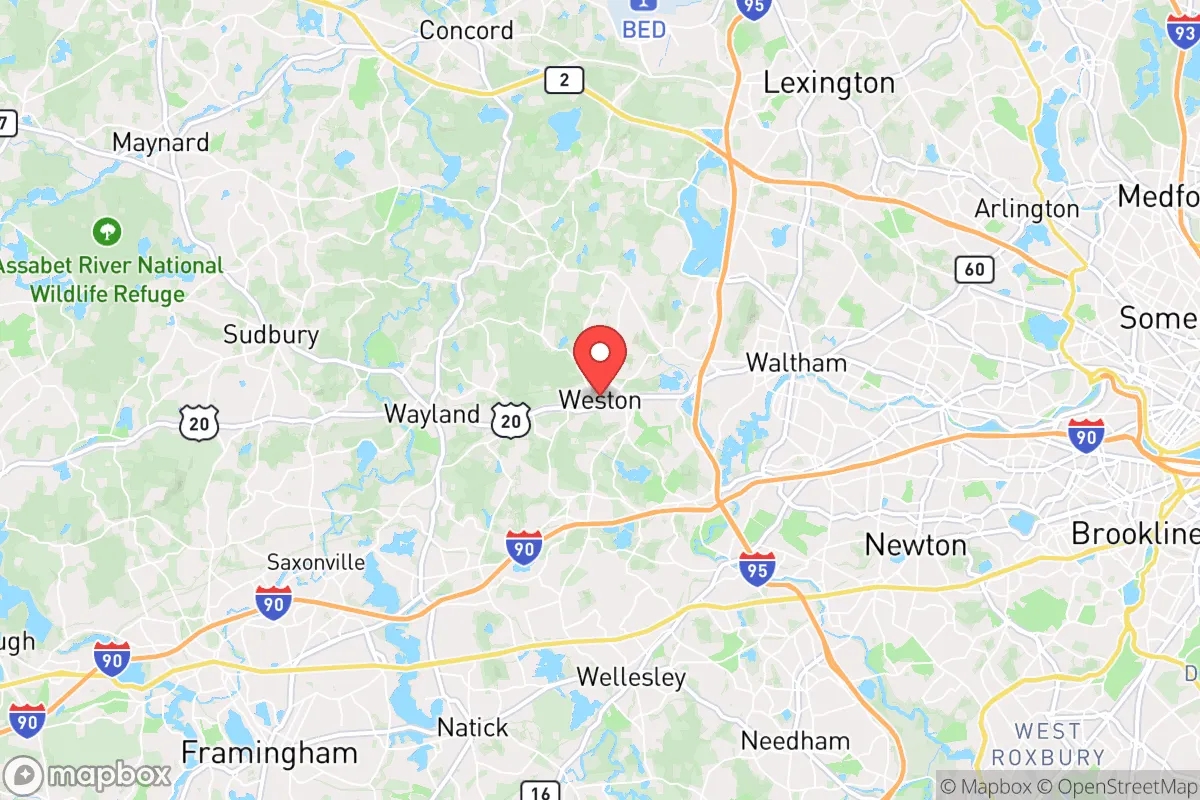
Photo: Wikipedia
Personal Sovereignty in Weston, MA
Moderate friction. Expect trade-offs in some aspect of personal liberty and independence.
What does Personal Sovereignty tell us?
Personal Sovereignty measures your capacity for self-reliance and independence with minimal government friction. Higher scores mean fewer barriers between you and the way you want to live... but it assumes you have the space you need and good neighbors.
What does this tell us?
Personal Sovereignty measures your capacity for self-reliance and independence with minimal government friction. Higher scores mean fewer barriers between you and the way you want to live... but it assumes you have the space you need and good neighbors.
State Policy
Energy independence: Importer (5% of energy produced in-state)
Personal Liberty
Homesteading

Personal Liberty Analysis
Weston, Massachusetts presents a complex autonomy environment for the freedom-oriented individual: the town itself is one of the most lightly regulated municipalities in Greater Boston, but it sits within a state with some of the nation's highest taxes and most restrictive gun laws. For a relocation researcher evaluating personal sovereignty, the key insight is that Weston offers significant local control over property use and lifestyle choices, but state-level policies impose substantial constraints on income, self-defense, and medical autonomy. The net effect is a high-cost, high-constraint state framework with meaningful but bounded local flexibility.
Tax burden and regulatory posture: what you pay and what you can do
Massachusetts ranks among the top five states for combined state and local tax burden, and Weston residents feel this acutely. The state levies a flat 5.0% personal income tax on all earned income, with no deductions for federal taxes paid. Property taxes in Weston are among the highest in the state: the 2025 residential rate is approximately $11.50 per $1,000 of assessed value, meaning a median-priced home (around $2.5 million) carries an annual tax bill of roughly $28,750. There is no local sales tax, but the state's 6.25% sales tax applies to most goods. The regulatory posture at the state level is heavy: Massachusetts has a robust environmental permitting regime under the Massachusetts Environmental Policy Act (MEPA), which can delay or block development projects, and the state's building code is among the most prescriptive in New England. However, Weston's local government is notably less interventionist than neighboring towns like Newton or Lexington. The town has no local income tax, no local meals tax, and its zoning board is generally deferential to property owners who follow the rules. For a conservative-leaning individual, the trade-off is clear: you pay a premium for the privilege of living in a town that largely leaves you alone, but the state's fiscal and regulatory apparatus is a constant drag on wealth accumulation and business flexibility.
Self-defense and gun law specifics: what's allowed and what's not
Massachusetts has some of the strictest firearm laws in the United States, and Weston residents must comply fully. The state requires a License to Carry (LTC) for both open and concealed carry, which is issued by the local police chief. Weston's police department is known for being reasonably pro-issuance for qualified applicants, but the process is not shall-issue: the chief retains discretion. Applicants must complete a state-approved firearms safety course, pass a background check, and provide references. The state bans "assault weapons" by name and feature, including many common semiautomatic rifles, and limits magazine capacity to ten rounds. There is no state preemption of local gun laws, but Weston has not enacted any additional restrictions beyond state mandates. Self-defense law in Massachusetts follows a duty-to-retreat standard in public, meaning a person must attempt to retreat before using deadly force unless they are in their home (the "castle doctrine" applies). Stand-your-ground does not exist in Massachusetts. For a gun owner, the practical reality is that carrying a firearm for self-defense is legally possible but bureaucratically burdensome, and the types of firearms available are significantly restricted compared to most of the country. Home defense is on firmer legal ground, but the state's strict liability laws mean that any use of force, even in the home, can lead to civil and criminal scrutiny.
Self-reliance and homesteading viability: lot sizes, zoning, and off-grid feasibility
Weston's zoning is a double-edged sword for the self-reliance-minded. Minimum lot sizes are large: most residential zones require one to two acres per dwelling, which preserves significant open space and privacy. This makes the town attractive for those who want room for gardens, small livestock, or solar panels. However, the zoning code is restrictive in other ways. Accessory dwelling units (ADUs) are permitted but subject to strict size and occupancy limits. Keeping chickens is allowed on lots of one acre or more, but roosters are prohibited. Beekeeping is permitted with registration. Off-grid living is effectively impossible: the town requires connection to municipal water and sewer in most areas, and the building code mandates grid-tied electrical service. Solar panels are allowed but must be installed by licensed contractors and meet historic district guidelines in certain neighborhoods. Rainwater harvesting is not regulated but is not a substitute for municipal water. For a family seeking true self-sufficiency, Weston's infrastructure requirements and permitting costs are a barrier. The town's conservation commission has authority over wetlands and vernal pools, which can limit clearing and construction. In practice, Weston is best suited for a "gentleman's homestead" — a large lot with a garden and some livestock, but not for off-grid independence.
Personal liberties: parental rights, medical autonomy, speech, and property
Parental rights in Massachusetts are relatively strong but not absolute. The state's compulsory education law requires school attendance from age 6 to 16, but homeschooling is legal and regulated by the local school district. Weston Public Schools has a reputation for being supportive of homeschooling families, requiring only a simple annual notification and a brief curriculum outline. Medical autonomy is more constrained: Massachusetts has a strict vaccine mandate for school attendance, with only medical exemptions allowed (no religious or philosophical exemptions). The state's COVID-19 emergency orders have expired, but the underlying public health law gives the Department of Public Health broad authority to impose mandates during declared emergencies. Speech is protected under the First Amendment, but Massachusetts has a relatively aggressive anti-SLAPP law that can be used to silence critics of public officials. Property rights are strong in Weston in terms of use, but the state's estate tax is among the most aggressive in the nation: estates over $1 million are taxed at rates up to 16%, with no portability between spouses. This means a family home worth $2.5 million can trigger a six-figure tax bill upon the death of the second spouse. For a conservative-leaning individual, the property rights environment is a mixed bag: you can do a lot with your land while you're alive, but the state takes a significant cut when you pass it on.
Overall sovereignty relative to other areas
Compared to other high-cost Northeast suburbs, Weston offers a relatively high degree of local autonomy, particularly in terms of property use and homeschooling. But compared to states like New Hampshire, Texas, or Florida, the sovereignty picture is dim. The state's tax burden, gun restrictions, and medical mandates create a ceiling on personal freedom that no amount of local flexibility can fully overcome. For a relocation researcher advising a conservative-leaning family, Weston is best understood as a high-constraint, high-amenity environment: you gain excellent schools, low crime, and large lots, but you surrender significant control over your income, your self-defense options, and your medical choices. It is not a freedom-friendly jurisdiction in the national sense, but it is one of the more freedom-friendly options within Massachusetts. The decision to move here should be made with eyes open to the trade-offs: you are paying a premium for a bubble of local autonomy within a state that is structurally opposed to many forms of personal sovereignty.

* Values derived from national, state, county, city and local statistics and may differ in a specific area. Last updated: 2026-10-12T22:11:14.000Z
Narrative content on this page is AI-generated and may contain mistakes. Verify any details that matter before acting on them.
ReloMaps may earn a commission from affiliate links at no extra cost to you.

