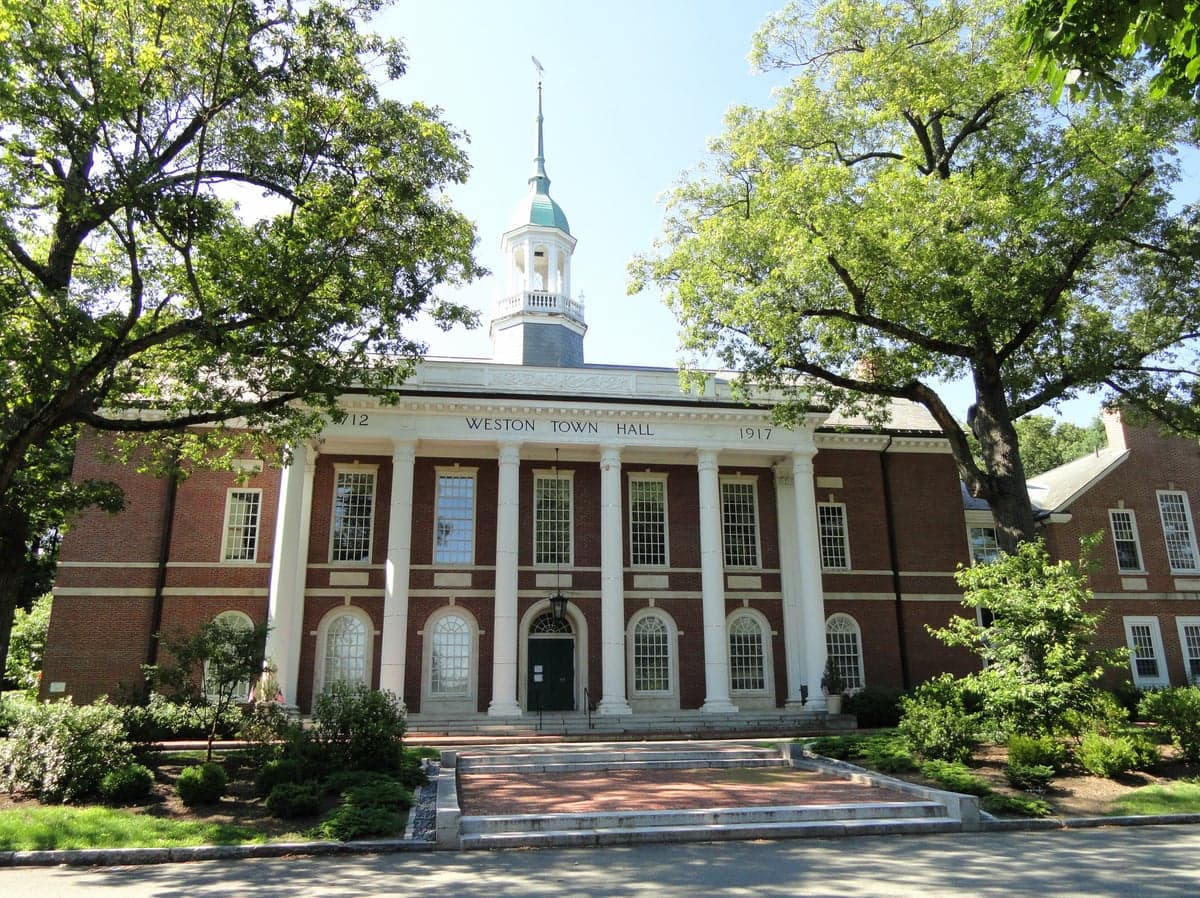
Photo: Wikipedia
Demographics of Weston, MA
Affluence Level in Weston, MA
An upper-middle-class area. Household wealth, education levels, and homeownership run ahead of national benchmarks.
People of Weston, MA
The people of Weston, Massachusetts today form a highly educated, affluent, and increasingly diverse community of 64,723 residents. With 56.4% holding a college degree and a median household income well above the state average, the population is characterized by professionals in finance, technology, and law, alongside a growing number of families from a wide range of ethnic backgrounds. While the town retains a distinctly suburban, family-oriented character with strong public schools and large estates, its demographic profile has shifted markedly from the nearly all-white, Yankee-Protestant community of the mid-20th century to a place where 58.1% of residents now identify as white, 18.2% as Hispanic, 8.3% as East or Southeast Asian, 7.1% as Black, and 4.5% as Indian (subcontinent).
How the city was settled and grew
Weston was first settled in the 1630s as part of the Watertown land grant, but it remained a sparsely populated farming community for nearly two centuries. The town was officially incorporated in 1713, drawing English Puritan families who established homesteads along what is now Boston Post Road and the area around Central Square. These early settlers were subsistence farmers, and the population grew slowly through the 1700s. A significant wave arrived in the mid-19th century with the construction of the Fitchburg Railroad in the 1840s, which transformed Weston into a summer retreat for wealthy Boston merchants and industrialists. These families built large country estates in what is now the South Side and along Wellesley Street, establishing the town’s reputation as an enclave of old money. The Irish immigrants who built the railroad and later worked as domestic servants settled in smaller clusters near the train depot in Weston Center, forming the town’s first Catholic community. By 1900, the population had reached roughly 2,000, and the character of the town was firmly set as a wealthy, white, Protestant suburb.
Modern era (post-1965)
The Immigration and Nationality Act of 1965 opened the door for a new wave of residents, but Weston’s transformation was gradual. Through the 1970s and 1980s, the town remained overwhelmingly white and affluent, with new arrivals coming primarily from other parts of Massachusetts and the Northeast. The first significant non-white population growth began in the 1990s, driven by professionals in the booming technology and biotech sectors along Route 128. East and Southeast Asian families, particularly those of Chinese and Korean ancestry, began moving into the North Side neighborhoods near the Weston High School and the commuter rail, attracted by the top-ranked school system. Indian (subcontinent) families followed in the 2000s and 2010s, concentrating in the Silver Hill area and around the Weston Golf Club, drawn by the same educational opportunities and proximity to corporate campuses in Waltham and Cambridge. The Hispanic population, now 18.2% of residents, grew more steadily through domestic migration from other parts of Massachusetts and direct immigration from Central and South America. Many Hispanic families settled in the Kendall Green and South Side neighborhoods, often in multi-generational households, working in construction, landscaping, and service industries that support the town’s larger estates. The Black population, at 7.1%, includes both African American professionals and families of Caribbean descent, dispersed across the town but with a notable concentration near the Weston Public Library and along School Street. By 2020, the foreign-born share had reached 14.5%, a figure that would have been unthinkable in the 1960s.
The future
Weston’s population is becoming more diverse, and this trend is likely to accelerate over the next 10-20 years. The white share has declined from roughly 85% in 2000 to 58.1% today, and projections based on current migration patterns suggest it could fall below 50% by 2040. The East and Southeast Asian and Indian (subcontinent) populations are the fastest-growing segments, driven by continued demand for the town’s schools and its location near the Route128 tech corridor. These groups are dispersing beyond their initial neighborhoods, with new construction in the North Side and Silver Hill areas attracting younger families. The Hispanic population is also growing, though at a slower pace, and is becoming more geographically integrated as second-generation families move into larger homes. The town’s cultural identity is evolving from a quiet, old-money WASP enclave to a more dynamic, globally connected suburb where multiple languages are spoken in the schools and the annual Fourth of July parade reflects a broader cross-section of the community. The biggest challenge ahead is housing affordability: the median home price exceeds $2 million, which limits who can move in and reinforces the town’s economic exclusivity even as its ethnic diversity increases.
For someone moving in now, Weston is a place of high opportunity and high cost, where the public schools remain the primary draw and the population is becoming more varied by the year. The town is no longer the homogeneous retreat of the 1950s, but a wealthy, educated, and increasingly multi-ethnic suburb that rewards those who can afford its real estate with top-tier services and a safe, family-oriented environment. The demographic trajectory points toward continued diversification, especially among Asian and Indian communities, while the white share continues a steady decline — a shift that is reshaping the town’s social fabric without altering its fundamental character as one of Massachusetts’ most desirable addresses.

* Values derived from national, state, county, city and local statistics and may differ in a specific area. Last updated: 2026-10-12T22:11:14.000Z
Narrative content on this page is AI-generated and may contain mistakes. Verify any details that matter before acting on them.
ReloMaps may earn a commission from affiliate links at no extra cost to you.

