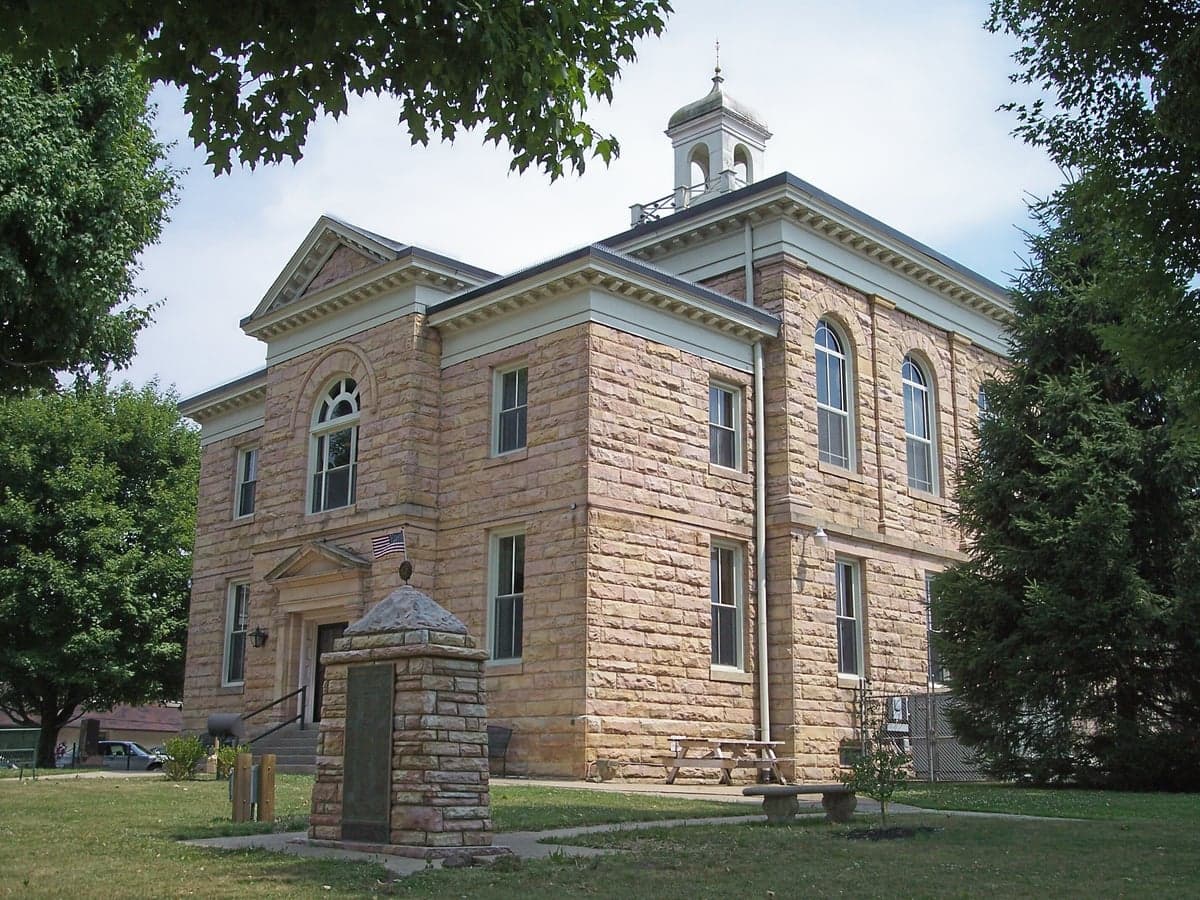
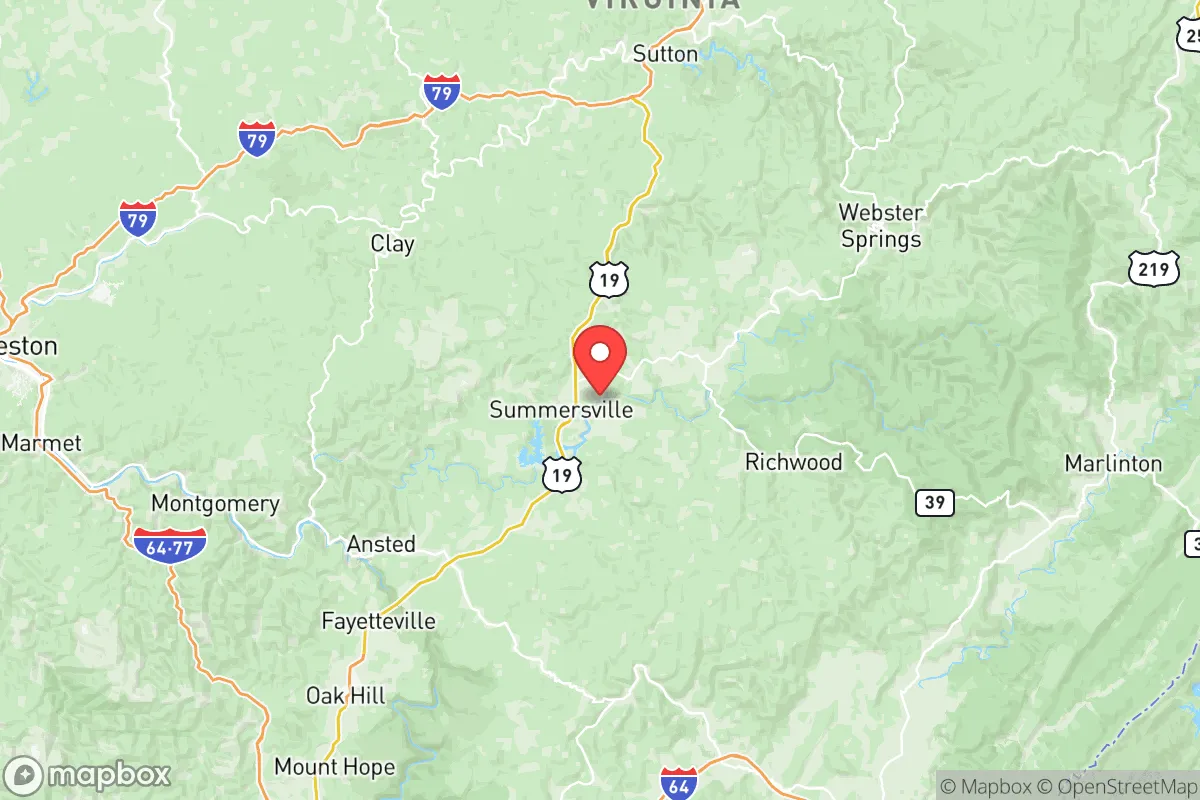
Photo: Wikipedia
Political ClimatePolitical Climate in Nicholas County
Showing district-level results — no local-only data available.
Local Political AnalysisPolitical Analysis of Nicholas County
Nicholas County, West Virginia, is a deeply conservative stronghold with a Cook Partisan Voting Index (PVI) of R+22, making it one of the most reliably Republican counties in the state. This lean is slightly more pronounced than West Virginia's overall PVI of R+21, and the county has been trending redder over the past decade, driven by a combination of cultural values, economic anxiety, and a strong distrust of federal environmental regulations. The shift is most visible in the county seat, Summersville, where Democratic-leaning precincts around the downtown area have been shrinking, while the rural precincts in places like Craigsville and Richwood have become overwhelmingly Republican.
How it compares
While Nicholas County's R+22 PVI is only one point more Republican than the state's R+21, the practical difference on the ground is more pronounced. In the 2024 presidential election, Nicholas County voted for Donald Trump by a margin of roughly 78% to 20%, a wider gap than the statewide average of about 68% to 30%. The county's political geography is not monolithic, however. The town of Richwood, historically a union stronghold tied to the timber and coal industries, still shows pockets of Democratic resistance, particularly in precincts near the old mill sites. In contrast, the more affluent lakeside communities around Summersville Lake, like the Mount Lookout area, are among the most conservative in the county, with Republican margins often exceeding 85%. The swing precincts are largely in the central corridor along U.S. Route 19, where a mix of small business owners, service workers, and retirees create a more competitive environment, though even these areas have shifted right since 2020.
What this means for residents
For conservative residents, Nicholas County offers a deeply affirming political environment where Republican candidates are rarely challenged in local races, and conservative values dominate public discourse. Churches, gun clubs, and veteran organizations are central to community life, and local government tends to prioritize low taxes, limited regulation, and support for the energy and timber industries. For liberal or moderate residents, the reality is more isolating. There is no organized Democratic Party presence in the county, and progressive viewpoints are often met with suspicion or outright hostility in public forums. Socially liberal residents, particularly in Summersville, tend to keep their political views private or engage in activism through regional networks in Charleston or Morgantown. The lack of political diversity can also affect policy outcomes: local school board and county commission decisions often go uncontested, and issues like public transit, affordable housing, and environmental conservation receive less attention than in more competitive areas.
Culturally, Nicholas County stands out for its fierce independence and skepticism of outside influence, whether from the state capital in Charleston or from Washington, D.C. This is a place where the Second Amendment is a near-sacred right, where the coal and timber industries are still seen as the backbone of the local economy, and where the opioid crisis has left deep scars but also fostered a strong sense of community resilience. The county's political trajectory shows no signs of moderating; if anything, the growing influence of national conservative media and the continued decline of organized labor are likely to push it even further to the right. For anyone considering a move here, understanding that this is a place where politics is personal and often tied to family history and local identity is essential. It's not just about how you vote—it's about how you fit into a community that values tradition, self-reliance, and a certain wariness of the world beyond the county line.

State Political ClimatePolitical Climate in West Virginia
State Political AnalysisPolitical Environment in the State
West Virginia is one of the most reliably Republican states in the nation, with a Cook Partisan Voting Index of R+21, meaning it votes about 21 points more Republican than the national average in presidential elections. This wasn't always the case — as recently as 2000, the state was a swing state that voted for George W. Bush by just 6 points, and before that it was a Democratic stronghold for decades. The shift has been dramatic and sustained: from 2008 onward, the state has voted for the GOP presidential candidate by margins of 13 to 39 points, driven by a collapse of the old coal-country Democratic coalition and a cultural realignment that has made the Mountain State one of the most conservative places in the country. For a relocator, this means you're moving into a state where conservative values dominate public life, but the flavor is distinct — more populist, more union-friendly in memory, and deeply skeptical of both coastal elites and federal overreach.
Urban vs. rural divide
The political map of West Virginia is less about urban-rural tension and more about degrees of rural conservatism. The state has no major metropolitan area — Charleston, the capital and largest city (pop. ~47,000), leans Democratic but is surrounded by deep-red Kanawha County. Huntington and Morgantown are the other notable population centers. Morgantown, home to West Virginia University, is the most liberal pocket in the state — it voted for Joe Biden in 2020 and is a hub for younger, more progressive voters and university faculty. Berkeley County in the Eastern Panhandle, part of the Washington D.C. exurbs, has grown rapidly and is reliably Republican but with a more moderate, suburban flavor than the rest of the state. The rest of West Virginia — the southern coalfields, the Ohio River towns, the mountain counties — is overwhelmingly Republican. McDowell County in the south voted 78% for Trump in 2020, while Monongalia County (Morgantown) voted 51% for Biden. That 29-point spread is the state's political spectrum in a nutshell. The rural areas are not just Republican; they are culturally conservative, with strong ties to gun culture, hunting, and evangelical Christianity, while the few urban islands are more diverse in outlook.
Policy environment
West Virginia's policy environment is aggressively conservative by national standards. The state has no personal income tax on most wages — a 2023 law cut the income tax rate from 6.5% to 3.99% and set a path to full elimination by 2028. Sales tax is 6%, with no local add-ons. Property taxes are among the lowest in the nation, capped by the state constitution at 1% of assessed value for most property. The regulatory posture is business-friendly, with a right-to-work law (repealed in 2023 but still in effect for existing contracts) and a strong tort reform environment. Education policy has been a flashpoint: the state passed a broad school choice law in 2021 allowing charter schools and education savings accounts, and in 2023 expanded the Hope Scholarship program to nearly all families. Healthcare is a mixed bag — the state expanded Medicaid under the Affordable Care Act, but the legislature has resisted further expansion and has passed restrictions on abortion (see below). Election laws are moderately restrictive: voter ID is required, early voting is available for 10 days, and absentee voting requires an excuse. The state has no ballot initiative process, meaning all policy changes go through the legislature.
Recent policy direction
The last five years have seen a hard right turn across multiple fronts. On gun and self-defense law, West Virginia became a constitutional carry state in 2016, allowing permitless concealed carry for adults 21 and older. In 2023, the legislature passed a "Second Amendment Preservation Act" that purports to nullify federal gun laws — a symbolic but popular move. On parental and education rights, the 2021 school choice law and the 2023 expansion of the Hope Scholarship (now worth about $4,700 per student) give families broad options to leave public schools. The state also passed a "Parents' Bill of Rights" in 2022 requiring schools to notify parents about curriculum changes and medical services. On speech and privacy, the state has no broad privacy law, but it passed a social media content moderation bill in 2023 that prohibits platforms from banning users based on political viewpoints — a law that is currently tied up in court. On medical and bodily autonomy, abortion is banned after 15 weeks with exceptions for rape, incest, and medical emergencies, and a 2024 law further restricted medication abortion. Medical marijuana is legal (since 2017), but the program is slow to roll out and has few dispensaries. On property rights, the state has strong eminent domain protections and a 2022 law that limits local governments' ability to regulate short-term rentals. On taxation, the income tax cuts are the headline — the state is on a glide path to zero income tax by 2028, which would make it one of nine states with no wage tax. On voting and ballot access, the 2021 voter ID law tightened requirements, and the state purged about 100,000 inactive voters from the rolls in 2023 — a move that drew criticism but was upheld in court.
Civil unrest & political movements
West Virginia is not a state known for street protests, but it has a long history of labor activism that has morphed into modern conservative populism. The 2018 teachers' strike — which shut down schools across the state for nine days — was a rare moment of mass mobilization, driven by low pay and rising healthcare costs. That strike was nonpartisan in spirit but drew support from both left-leaning unions and rural conservatives. More recently, the state has seen organized opposition to vaccine mandates and COVID-19 restrictions, with large rallies at the state capitol in 2021. The "Second Amendment Sanctuary" movement is strong — over 40 counties have passed resolutions declaring themselves sanctuaries from federal gun laws. Immigration politics are less visible here than in border states, but the legislature passed a bill in 2024 requiring law enforcement to cooperate with federal immigration authorities. There is no sanctuary city policy anywhere in the state. Election integrity controversies have been muted compared to other states — West Virginia uses paper ballots and has strong audit laws, and both parties generally accept results. The most visible political flashpoint for a new resident would be the ubiquitous "Don't Tread on Me" flags and Trump signs, especially in rural areas, and the occasional counter-protest in Morgantown or Charleston.
Projection
Over the next 5-10 years, West Virginia is likely to become even more Republican, but the flavor may shift. The state is losing population — it was one of only three states to lose population in the 2020 Census — and the people leaving tend to be younger and more moderate, while those moving in are often retirees or remote workers drawn by low taxes and conservative values. The Eastern Panhandle, particularly Berkeley County and Jefferson County, is growing fastest, and those newcomers are often more moderate Republicans from the D.C. suburbs. The southern coalfields will continue to shrink and harden politically. The income tax elimination will likely accelerate in-migration of high-earning remote workers, especially to the Morgantown and Shepherdstown areas. The state's politics will remain dominated by cultural issues — guns, abortion, education — but the economic agenda may shift toward attracting tech and manufacturing jobs as coal continues its long decline. A new resident moving in now should expect to find a state that is deeply conservative, increasingly libertarian on taxes, and culturally homogeneous, with the main political tension being between the old-school union populists and the newer free-market conservatives.
For a relocator, the bottom line is straightforward: if you are conservative, you will find West Virginia deeply welcoming — low taxes, strong gun rights, school choice, and a culture that values self-reliance and community. If you are liberal, you will find yourself in a distinct minority, especially outside of Morgantown and Charleston. The state's politics are not angry or confrontational on a day-to-day basis — most people just go about their lives — but the policy direction is clear and accelerating. The practical takeaway is that West Virginia offers a high degree of personal freedom in the traditional sense: low taxes, minimal regulation, and a government that stays out of your business, as long as your business aligns with conservative social norms. It's a place where your vote will matter little in national elections but a lot in local ones, and where the political culture is shaped more by hunting, church, and family than by cable news.
* Values derived from national, state, county, city and local statistics and may differ in a specific area. Last updated: 2026-07-03T04:54:02.000Z
Narrative content on this page is AI-generated and may contain mistakes. Verify any details that matter before acting on them.
ReloMaps may earn a commission from affiliate links at no extra cost to you.

