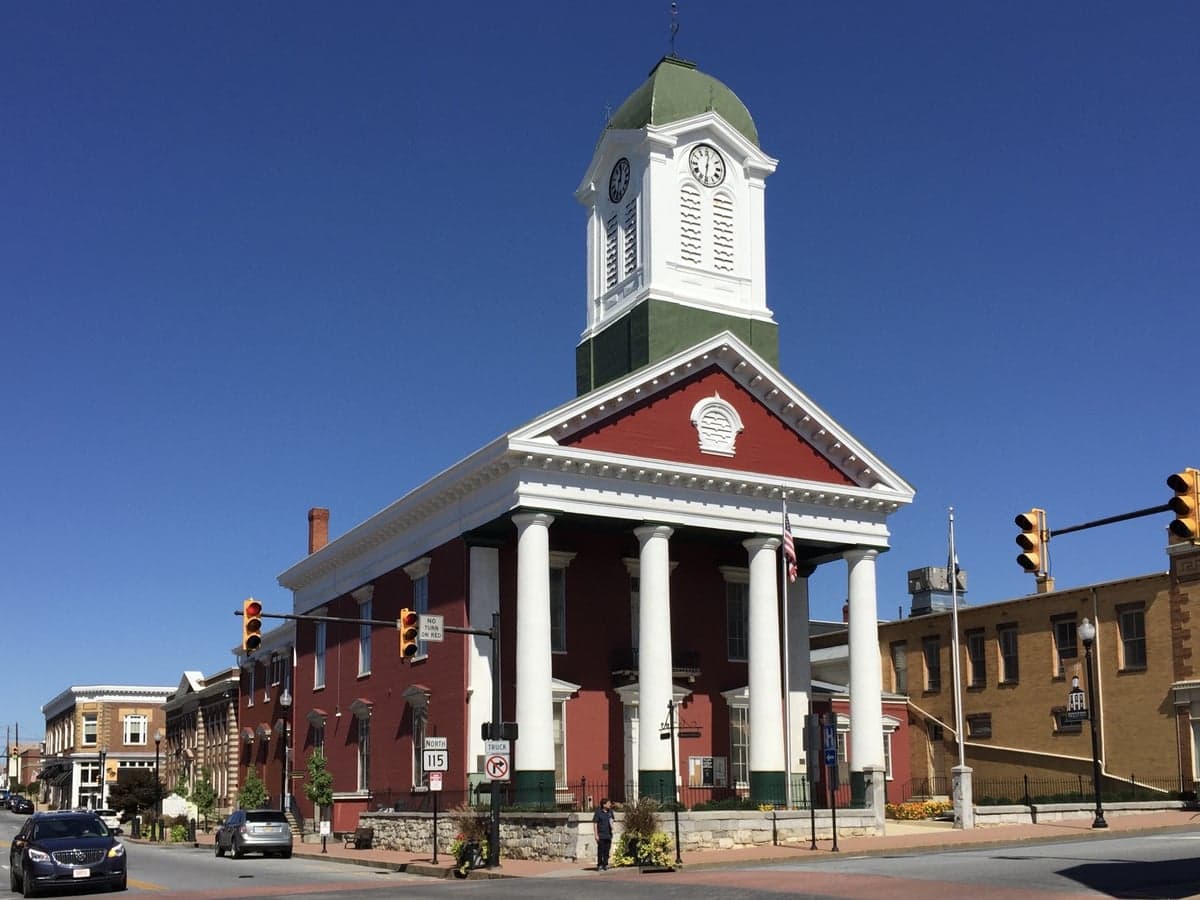
Photo: Wikipedia
Political ClimatePolitical Climate in Jefferson County
Showing district-level results — no local-only data available.
Local Political AnalysisPolitical Analysis of Jefferson County
Jefferson County, West Virginia, is a fascinating political outlier in a deeply red state. While the county carries a Cook PVI of R+20, meaning it leans Republican by a significant margin, its politics are far more nuanced than that number suggests. The eastern panhandle, particularly the areas closest to the Washington D.C. and Baltimore metro areas, has seen a steady influx of new residents over the past two decades, creating a genuine political tug-of-war that you don't see in most of West Virginia. The county has been slowly trending more competitive, with Democratic candidates occasionally winning local races, even as the national environment has shifted right.
How it compares to the rest of West Virginia
Compared to the rest of West Virginia, Jefferson County is a blue dot on a red map. The state as a whole is one of the most reliably Republican in the nation, with a Cook PVI that is likely even more conservative than Jefferson County's R+20. The key difference is the nature of the Republicanism. In much of the state, the GOP is rooted in traditional, coal-country conservatism. In Jefferson County, the Republican lean is more suburban and exurban, driven by fiscal conservatism, lower taxes, and a desire for less regulation, rather than the cultural or resource-extraction issues that dominate elsewhere. This creates a unique dynamic where the county's Republican voters are often more moderate on social issues than their counterparts in the southern part of the state. The political variation within the county is stark. The town of Shepherdstown, home to Shepherd University, is a well-known liberal stronghold, consistently voting blue. Charles Town and Ranson are more of a mixed bag, with swing precincts that can decide county-wide elections. Meanwhile, the more rural areas around Kearneysville and Harpers Ferry (outside the tourist zone) lean heavily red, providing the bulk of the Republican vote.
What this means for residents
For a conservative resident, Jefferson County is a comfortable place to live. You are in the majority, and your views on taxes, gun rights, and local governance are generally reflected in county commission decisions and state legislative representation. The local Republican party is well-organized and active. For a liberal resident, the experience is more complex. You are a clear minority in the county, but you are not isolated. Shepherdstown provides a strong, visible liberal community, and the proximity to Maryland and D.C. means you can easily access like-minded social and political circles. The practical reality is that local elections are often decided by a few hundred votes, so your vote genuinely matters. The county's trajectory is the most interesting part. The continued growth from the D.C. exurbs is likely to make the county more competitive over the next decade. New residents often bring more moderate or even liberal voting habits, which could eventually flip some county-level seats.
Culturally, this creates a county that feels different from the rest of West Virginia. You'll find a mix of old-time West Virginia families, D.C. commuters, and second-home owners. The policy debates are less about coal and more about development, school funding, and traffic management on Route 9. The local Democratic party is more moderate and business-friendly than in deep-blue areas, and the local Republican party is more focused on growth and infrastructure than on cultural wars. It's a place where a Republican county commissioner and a Democratic town council member can find common ground on a new sewer line or a road improvement project, even if they disagree on national politics. That pragmatic, local-first approach is the real story of Jefferson County's political climate.

State Political ClimatePolitical Climate in West Virginia
State Political AnalysisPolitical Environment in the State
West Virginia has become one of the most reliably Republican states in the nation, a dramatic shift from its 20th-century identity as a Democratic stronghold. The state voted for Donald Trump by nearly 39 points in 2020 and again by a similar margin in 2024, with the GOP now holding every statewide office, both U.S. Senate seats, and supermajorities in the state legislature. This transformation has been driven by a combination of cultural realignment, economic anxiety, and the decline of organized labor’s political influence, with the state’s rural and small-town character now overwhelmingly shaping its political identity.
Urban vs. rural divide
The political map of West Virginia is defined by a stark urban-rural split, though even the "urban" areas are modest by national standards. The state’s largest city, Charleston, and its surrounding Kanawha County have trended Republican but remain more competitive, with Trump winning Kanawha by about 15 points in 2024—still a solid GOP margin but less than the statewide average. Morgantown, home to West Virginia University, is the most politically distinct metro area; Monongalia County has been a rare Democratic holdout, voting for Joe Biden in 2020 and remaining competitive in 2024 due to the university’s liberal-leaning faculty and student population. Huntington (Cabell County) and Wheeling (Ohio County) are reliably Republican but with pockets of Democratic support in older union households. The rural counties—especially in the southern coalfields like Mingo, Logan, and McDowell—have flipped hard from Democratic to Republican since 2008, driven by cultural issues and opposition to federal environmental regulations. The eastern panhandle, including Martinsburg and Berkeley County, has grown rapidly with Washington D.C. exurbanites and is now solidly Republican, though with a more moderate, suburban flavor than the rest of the state.
Policy environment
West Virginia’s policy environment is among the most conservative in the country, reflecting its Republican supermajority. The state has no personal income tax on most wages (phased in by 2026), a flat corporate tax rate of 6.5%, and low property taxes, making it attractive for relocators seeking a low-tax burden. The regulatory posture is business-friendly, with right-to-work laws and a weak collective bargaining environment. Education policy has shifted toward school choice: the state passed a universal Education Savings Account (ESA) program in 2021, allowing families to use public funds for private school tuition, homeschooling, or tutoring. Healthcare is a mixed bag—West Virginia expanded Medicaid under the Affordable Care Act, but the state has not pursued a state-based exchange or additional coverage mandates. Election laws have tightened: voter ID is required, early voting is limited to 10 days, and absentee voting requires an excuse. The state has also passed laws restricting ballot drop boxes and limiting third-party ballot collection.
Recent policy direction
Recent legislation points toward a deepening of conservative priorities across multiple fronts. On gun and self-defense law, West Virginia is a constitutional carry state (permitless carry for adults 21 and older, passed in 2016), and a 2024 law expanded the "stand your ground" doctrine to remove the duty to retreat in any place where a person is lawfully present. Parental and education rights have been a focus: the 2021 ESA law was followed by a 2023 "Parental Bill of Rights" requiring schools to notify parents of curriculum changes and medical services. Speech and privacy are protected by a 2024 law prohibiting government-mandated vaccine passports and a 2023 law restricting public schools from requiring students to use pronouns inconsistent with their biological sex. Medical and bodily autonomy is heavily restricted: abortion is banned after 15 weeks with no exceptions for rape or incest (a 2022 law), and the state has a trigger law that would ban abortion entirely if Roe v. Wade were overturned (which it was, though the 15-week ban is currently in effect). Property rights are strong, with a 2023 law limiting eminent domain for economic development and a 2024 law expanding mineral rights protections for surface owners. Taxation is trending downward: the 2023 income tax cut was accelerated, and a 2024 law eliminated the state’s tax on Social Security benefits. Voting and ballot access have been tightened, with a 2023 law requiring proof of citizenship to register and a 2024 law banning ranked-choice voting in any state election.
Civil unrest & political movements
West Virginia has a history of labor activism, but recent political movements have been dominated by conservative and libertarian-leaning groups. The 2018 teachers’ strike, which shut down schools statewide for nine days, was a rare flashpoint of left-leaning activism, but it did not translate into lasting Democratic gains. The state has seen organized opposition to federal environmental regulations, particularly around coal mining, with groups like the "Friends of Coal" holding rallies and lobbying for industry protections. Immigration politics are relatively muted—West Virginia has one of the smallest foreign-born populations in the U.S.—but the state has passed laws requiring local law enforcement to cooperate with federal immigration authorities (a 2024 law). There is no sanctuary city movement; Charleston and Morgantown have seen small pro-immigrant protests but no policy changes. Election integrity controversies have been minimal, though the state’s Republican secretary of state has pushed for voter roll purges and stricter ID laws. Secession or nullification rhetoric is rare, though some local officials have floated "constitutional sheriffs" movements in rural counties like Pocahontas and Randolph, asserting local authority over federal land management. The most visible flashpoint for a new resident would be the ubiquity of political signage and bumper stickers, which lean heavily Republican, and the occasional heated debate over coal mining or public land use in the Monongahela National Forest.
Projection
Over the next 5-10 years, West Virginia is likely to become even more conservative, driven by demographic trends and in-migration patterns. The state’s population is aging and declining, with young people leaving for job opportunities elsewhere, which tends to reinforce the existing political lean. In-migration is modest but growing, primarily from neighboring states like Ohio, Pennsylvania, and Virginia, with many relocators drawn by low taxes and a slower pace of life. These newcomers are often more conservative than the national average, though they may bring suburban sensibilities that could moderate the state’s hardline stance on issues like public land access or broadband expansion. The eastern panhandle, particularly Berkeley County and Jefferson County, will continue to grow with D.C. exurbanites, potentially creating a more moderate Republican bloc. The Democratic Party’s presence will likely shrink further, confined to Morgantown and a few union households in the northern panhandle. A new resident moving in now should expect to find a state where conservative policies are entrenched and likely to deepen, with little prospect of a political shift unless the national Democratic Party makes inroads on economic issues or the state’s economy diversifies away from energy extraction.
For a new resident, the bottom line is that West Virginia offers a deeply conservative political environment with low taxes, strong gun rights, and a business-friendly regulatory climate. Conservatives will find their values reflected in state law and local culture, while liberals should expect to be in a clear minority, especially outside of Morgantown and parts of Charleston. The state’s political trajectory is stable and predictable—more of the same, with incremental tightening of conservative policies. If you value a low-tax, low-regulation lifestyle with a strong sense of community and minimal political friction, West Virginia delivers. If you’re looking for political diversity or progressive policy experimentation, you’ll find it only in small, isolated pockets.
* Values derived from national, state, county, city and local statistics and may differ in a specific area. Last updated: 2026-07-26T04:07:30.000Z
Narrative content on this page is AI-generated and may contain mistakes. Verify any details that matter before acting on them.
ReloMaps may earn a commission from affiliate links at no extra cost to you.

