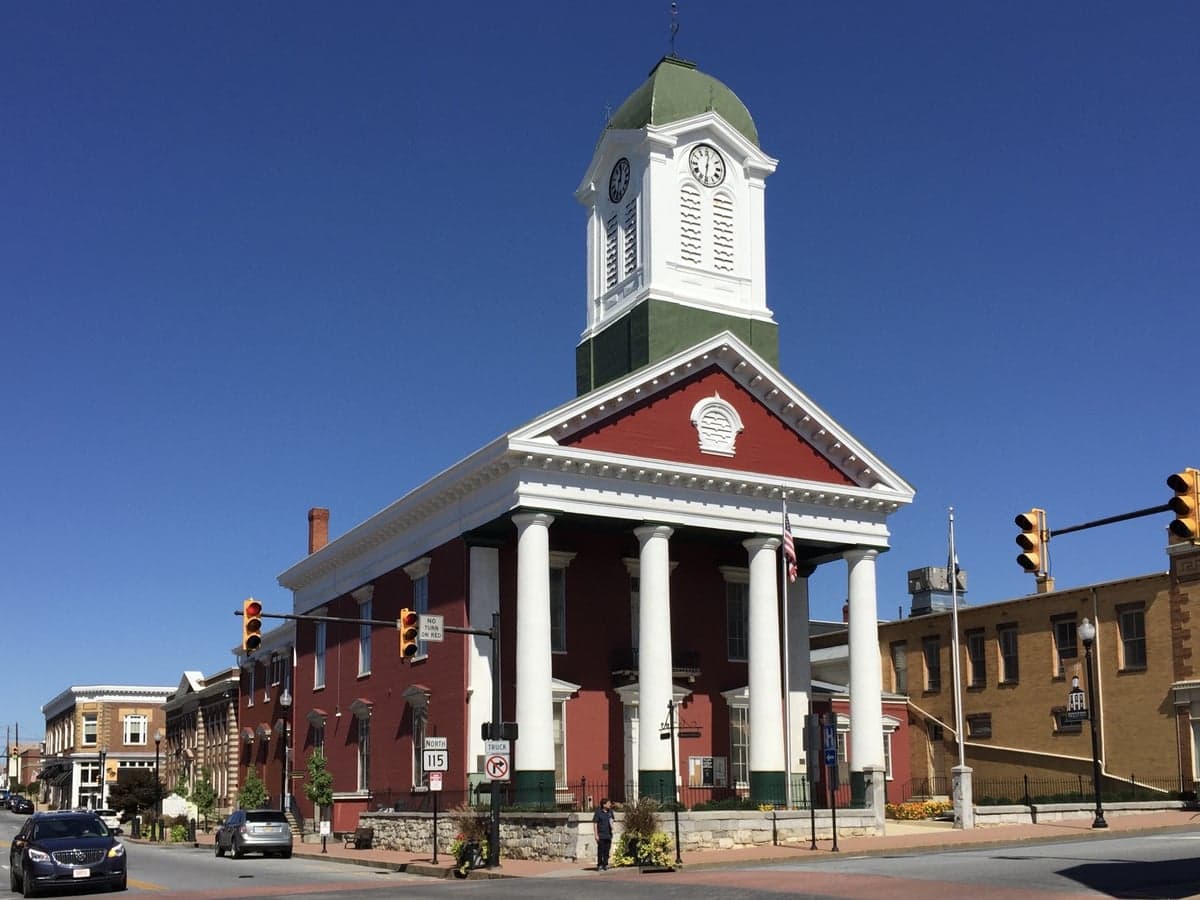
Photo: Wikipedia
Demographics of Jefferson County
Affluence Level in Jefferson County
A middle-class area roughly in line with national averages across income, home values, education, and employment.
People of Jefferson County
Jefferson County, West Virginia, is a predominantly White, historically rooted community of 58,546 residents, where a strong sense of local identity blends with the pressures of exurban growth from the Washington, D.C., metro area. The county is characterized by its rural character, historic towns, and a population that is 80.4% White, with a notable Hispanic minority of 7.5% and a Black population of 5.3%. Its residents are slightly more educated than the national average, with 33.7% holding a college degree, and the foreign-born share is a low 2.4%, reflecting a community shaped more by domestic migration than international immigration.
Settlement & growth (pre-1960)
Long before European settlement, the area now known as Jefferson County was part of the hunting grounds of the Iroquois Confederacy, particularly the Seneca, and was also used by the Shawnee and Delaware. The first permanent European settlers were primarily of English, Scots-Irish, and German descent, arriving in the 1730s and 1740s as part of the broader wave of migration into the Shenandoah Valley. These early settlers were drawn by the fertile limestone soil of the Shenandoah River valley and the promise of land grants from Lord Fairfax. They established farms and small communities, with the town of Charles Town, founded in 1786 by Charles Washington (George Washington's youngest brother), becoming the county seat and a center of commerce and government.
The 19th century saw the county's population grow steadily, fueled by the expansion of agriculture, particularly wheat and livestock, and the development of the Baltimore and Ohio Railroad. The region's economy was heavily reliant on enslaved labor, and by 1860, enslaved people made up a significant portion of the county's population. The Civil War deeply divided the county, which was part of Virginia until West Virginia's statehood in 1863. After the war, the economy slowly diversified, with small-scale manufacturing and the rise of the apple and peach orchards that still define the landscape. Towns like Shepherdstown, the oldest town in West Virginia (chartered in 1762), and Harpers Ferry, a historic industrial and transportation hub, grew as centers of trade and education. The population remained overwhelmingly native-born White, with a small but established Black community, many of whom were descendants of freed slaves who stayed in the area after emancipation.
Through the early 20th century, Jefferson County remained a quiet, rural area. The Great Depression and World War II brought little demographic change, as the county's agricultural base provided stability. The post-war period saw a modest suburbanization trend, with some families moving from the Washington, D.C., area into the county's more affordable housing and open spaces, but the pace was slow. By 1960, the population was still under 20,000, and the county's character was defined by its historic towns, working farms, and a deeply rooted, mostly White, native-born population.
Modern era (post-1965)
The 1965 Hart-Cellar Act had a minimal direct impact on Jefferson County, as the foreign-born population remains very low at 2.4%. Instead, the most significant demographic shift since 1965 has been driven by domestic migration from the Washington, D.C., metropolitan area. Beginning in the 1990s and accelerating after 2000, the county became a popular exurb for families and professionals seeking larger, more affordable homes and a slower pace of life within commuting distance of the D.C. job market. This wave of newcomers, predominantly White and college-educated, has reshaped the county's housing market and political dynamics, contributing to a gradual increase in the share of residents with a college degree (now 33.7%).
The Hispanic population, now 7.5%, has grown steadily since the 1990s, driven by labor demand in agriculture, construction, and the service industry. Many Hispanic residents, primarily of Mexican and Central American origin, have settled in and around Ranson and Charles Town, where they work in the region's expanding logistics and warehousing sectors. The Black population, at 5.3%, remains concentrated in historic communities like Harpers Ferry and parts of Charles Town, with a mix of long-established families and newer arrivals from the D.C. area. The East/Southeast Asian population is small at 1.1%, with a modest presence in the county's more suburban areas, while the Indian subcontinent population is even smaller at 0.4%. The county has not seen the formation of large ethnic enclaves; instead, new residents tend to disperse across the county's towns and subdivisions.
Suburbanization has been most pronounced in the eastern part of the county, closer to the Virginia border and the commuter rail line. Developments in Kearneysville and Bakerton have seen significant new home construction, attracting families from the D.C. area. This growth has brought new retail, schools, and infrastructure, but has also created tension between long-time residents who value the county's rural character and newcomers who bring suburban expectations. The county's population has more than doubled since 1970, and the pace of growth shows no signs of slowing.
The future
Jefferson County is projected to continue growing, driven by the ongoing expansion of the Washington, D.C., exurban ring. The population is likely to become slightly more diverse, with the Hispanic share expected to increase as families settle and new workers arrive for jobs in logistics, healthcare, and construction. The White share, while still dominant, will likely decline gradually as the county attracts a more diverse mix of domestic migrants. The foreign-born population may rise slowly, but the county is unlikely to see the high levels of international immigration typical of major urban centers.
New residential development will likely concentrate in the eastern corridor, particularly around Ranson and Charles Town, where land is available and infrastructure is being expanded. The historic towns of Shepherdstown and Harpers Ferry will likely see more limited growth due to their historic preservation restrictions and smaller land areas. The county's cultural identity is evolving from a quiet, rural farming community into a more diverse, exurban bedroom community, with a growing emphasis on commuter-friendly amenities, schools, and services. This shift will continue to create a blend of old and new, with long-time residents and newcomers negotiating the county's future character.
For someone moving in now, Jefferson County offers a place where historic charm and rural landscapes coexist with the pressures of suburban growth. The community is becoming more diverse and more connected to the D.C. metro area, but it retains a distinct, locally rooted identity. The key demographic trend is the steady influx of domestic migrants, which will continue to reshape the county's economy, housing, and culture, making it a dynamic but still predominantly White and native-born place to live.

* Values derived from national, state, county, city and local statistics and may differ in a specific area. Last updated: 2026-07-26T04:07:30.000Z
Narrative content on this page is AI-generated and may contain mistakes. Verify any details that matter before acting on them.
ReloMaps may earn a commission from affiliate links at no extra cost to you.

