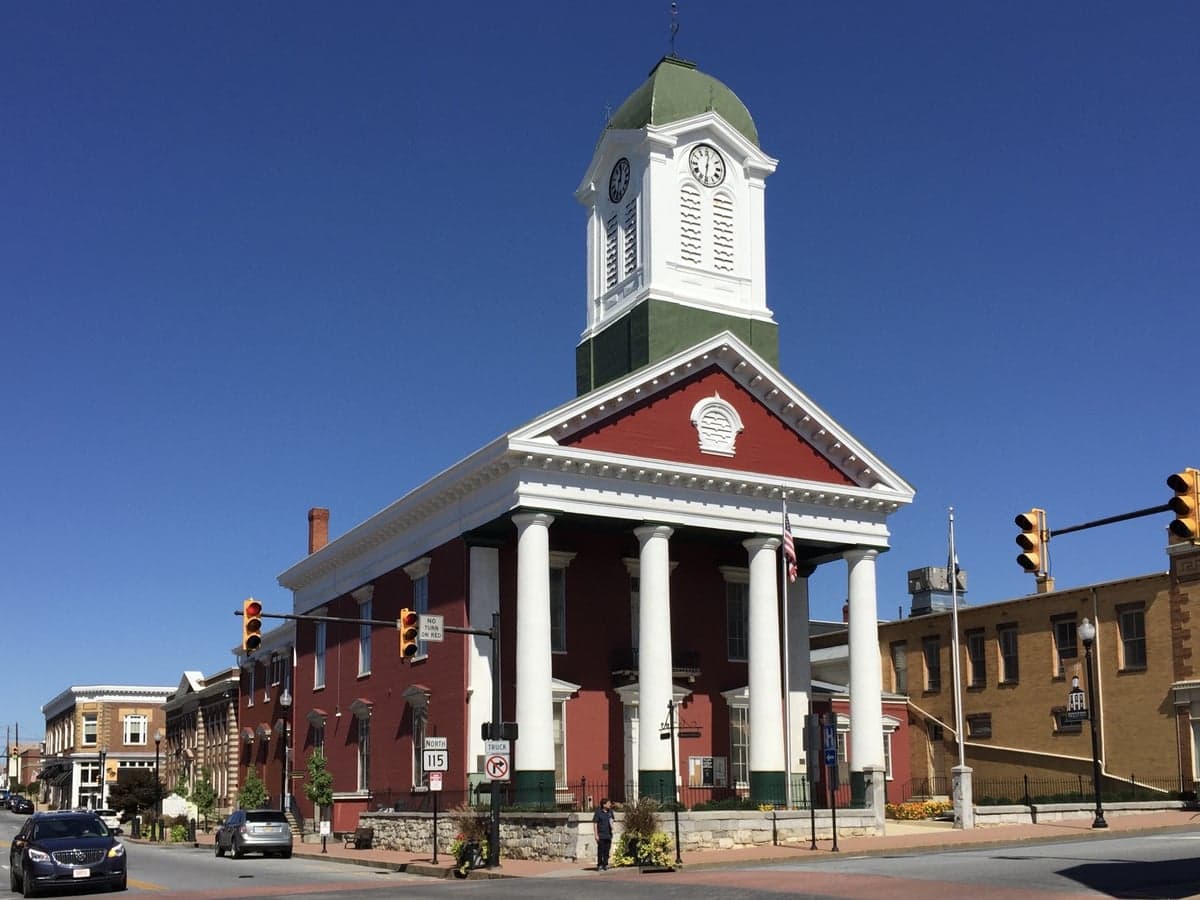
Photo: Wikipedia
Personal Sovereignty in Jefferson County
Strong independent fundamentals that actively favor personal liberty and low regulation.
What does Personal Sovereignty tell us?
Personal Sovereignty measures your capacity for self-reliance and independence with minimal government friction. Higher scores mean fewer barriers between you and the way you want to live... but it assumes you have the space you need and good neighbors.
What does this tell us?
Personal Sovereignty measures your capacity for self-reliance and independence with minimal government friction. Higher scores mean fewer barriers between you and the way you want to live... but it assumes you have the space you need and good neighbors.
State Policy
Energy independence: Net exporter (200% of energy produced in-state)
Personal Liberty
Homesteading

Personal Liberty Analysis
Jefferson County, West Virginia offers a notably high degree of personal sovereignty compared to many East Coast and Mid-Atlantic locales, particularly for those who value limited government interference in daily life. The county’s regulatory environment is generally light-touch, with a strong tradition of self-reliance rooted in its rural and small-town character, though proximity to the Washington, D.C. metro area introduces some suburban-style pressures in certain communities. For a relocation-minded individual or family with a conservative-leaning perspective on autonomy, Jefferson County presents a compelling balance of low taxes, permissive gun laws, and space for independent living, especially when contrasted with neighboring Loudoun County, Virginia, just across the Potomac River.
Tax burden and regulatory posture: How Jefferson County compares to neighboring states
West Virginia’s overall tax burden is among the lowest in the nation, and Jefferson County benefits directly from this state-level posture. There is no state income tax on Social Security benefits, and the state’s flat personal income tax rate of 3.99% (as of 2026) is significantly lower than Virginia’s progressive rates, which can reach 5.75% for higher earners. Property taxes in Jefferson County are a major draw: the effective property tax rate is roughly 0.55% of assessed value, compared to over 1.0% in many Northern Virginia counties. This means a $400,000 home in Jefferson County carries an annual tax bill of about $2,200, versus $4,400 or more in Loudoun County. The county’s regulatory posture is generally business-friendly, with fewer permitting hurdles for home-based businesses and small-scale agriculture than in more urbanized areas. However, there are distinctions within the county: the town of Charles Town has a more formalized zoning code and building permit process, while unincorporated areas like Kearneysville and Shepherdstown (outside the historic district) offer more lenient enforcement. The county’s comprehensive plan does not aggressively push growth controls, but residents near Ranson and the developing Harpers Ferry corridor should expect some suburban-style regulations, including stormwater management requirements and setback rules. Overall, the regulatory environment is light enough to allow significant personal freedom in land use and business operations, but not so lax as to be chaotic.
Self-defense and gun law specifics: What West Virginia’s permitless carry means for residents
West Virginia is a constitutional carry state, meaning that any law-abiding resident aged 21 or older can carry a concealed firearm without a permit. This is a foundational element of personal sovereignty in Jefferson County. The state also has strong preemption laws, preventing local governments like the Charles Town City Council or Jefferson County Commission from enacting their own gun control ordinances. This means that even in the more liberal-leaning town of Shepherdstown, home to Shepherd University, residents enjoy the same firearm rights as those in rural Bakerton or Halltown. Stand-your-ground laws are in effect, with no duty to retreat in any place where a person has a legal right to be. The state’s firearm-friendly culture is reinforced by a network of local gun shops and ranges, including the Jefferson County Sportsmen’s Association near Ranson. For those moving from restrictive states like Maryland or New York, the contrast is stark: no waiting periods, no magazine capacity limits, and no firearm registration. The only notable restriction is that carrying on school property is prohibited without specific authorization, but this is standard nationwide. For a family prioritizing self-defense rights, Jefferson County offers one of the most permissive legal environments east of the Mississippi.
Self-reliance and homesteading viability: Lot sizes, zoning, and off-grid feasibility across the county
Jefferson County’s agricultural heritage and relatively low population density make it a strong candidate for homesteading and self-reliant living, though feasibility varies by location. In the unincorporated areas of Kearneysville and Middleway, minimum lot sizes in agricultural zones are typically 3 to 5 acres, and many properties are sold with existing wells and septic systems. Off-grid living is legally viable: West Virginia has no state-level prohibition on rainwater collection, and solar panel installation is straightforward, with net metering available through Potomac Edison. However, the county does enforce building codes for new structures, so a completely unpermitted cabin would be difficult to pull off legally. The town of Shepherdstown has stricter historic district regulations that can limit solar panel placement and outbuilding construction, while Charles Town requires permits for accessory dwelling units. For those seeking maximum freedom, the rural areas near Bakerton and Halltown offer the least regulatory friction. Raising livestock—chickens, goats, even cattle—is common and generally unrestricted outside town limits. The county’s extension office provides resources for small-scale farming, and the local farmers’ markets in Charles Town and Shepherdstown support a robust local food economy. For a family wanting to grow their own food, keep animals, and reduce reliance on utilities, Jefferson County’s rural zones are highly accommodating, though the suburbanizing areas near Ranson are becoming less so.
Personal liberties: Parental rights, medical autonomy, speech, and property rights in practice
West Virginia law generally supports parental rights in education and healthcare decisions. The state has a parental bill of rights that affirms parents’ authority to direct their children’s upbringing, and Jefferson County’s school board has not been a flashpoint for curriculum disputes compared to some Virginia counties. Medical autonomy is less codified: West Virginia does not have a broad medical freedom law, but it does allow for conscientious objection to vaccinations and has relatively loose licensing for direct primary care arrangements. The state’s COVID-era executive orders were less restrictive than those in neighboring Maryland and Virginia, which resonates with residents who prioritize bodily autonomy. Speech and assembly rights are robust, with no notable local ordinances restricting political expression. Property rights are strongly protected: eminent domain is rarely used for private development, and the county’s zoning is permissive enough that homeowners can generally use their land as they see fit, within basic health and safety codes. The town of Harpers Ferry, due to its National Park Service presence, has more federal overlay on land use, but this is a narrow exception. For a family moving from a more regulated state, the sense of personal freedom in Jefferson County is tangible—fewer HOAs, less government signage, and a general expectation that adults can make their own choices without bureaucratic approval.
Overall, Jefferson County ranks among the top areas in the Mid-Atlantic for personal sovereignty, particularly when compared to the high-tax, high-regulation environments of Northern Virginia, Maryland, and the District of Columbia. The combination of low property taxes, constitutional carry, viable off-grid living in rural zones, and strong parental rights creates a freedom-friendly ecosystem that is rare this close to a major metropolitan area. The county is not a libertarian utopia—building codes exist, school funding is moderate, and suburban growth is creeping in—but for a conservative-leaning individual or family seeking a place where self-reliance is respected and government overreach is minimal, Jefferson County offers a practical and livable balance of autonomy and access.

* Values derived from national, state, county, city and local statistics and may differ in a specific area. Last updated: 2026-07-26T04:07:30.000Z
Narrative content on this page is AI-generated and may contain mistakes. Verify any details that matter before acting on them.
ReloMaps may earn a commission from affiliate links at no extra cost to you.

