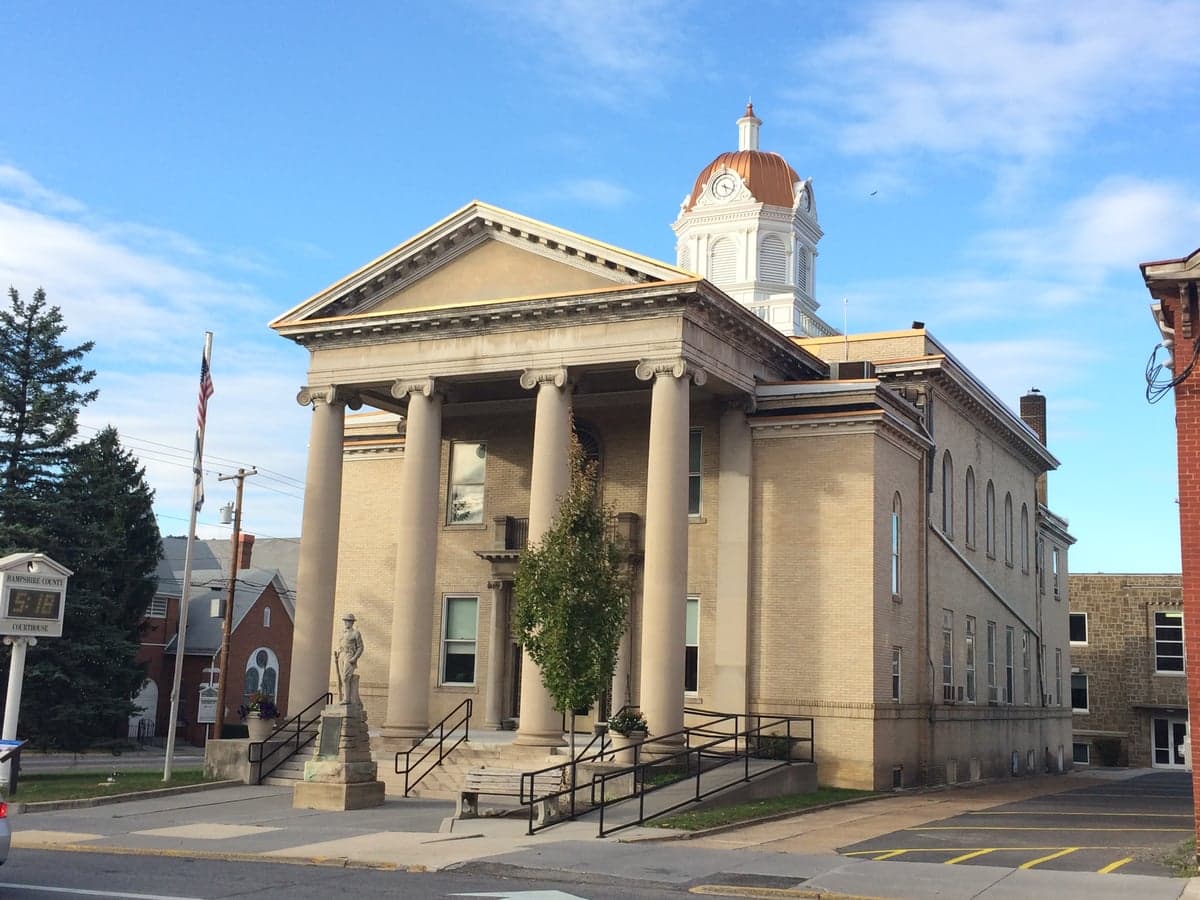
Photo: Wikipedia
Political ClimatePolitical Climate in Hampshire County
Showing county-level results — no local-only data available.
Lean and PVI are calculated from this county’s 2020 and 2024 presidential results, Cook-style.
Political rankings in West Virginia
- Most Conservative Cities in West Virginia
- Most Liberal Cities in West Virginia
- Best Liberal-Leaning Towns in the South
- Best Liberal-Leaning Towns in Appalachia
- Safest Liberal-Leaning Towns in the South
- Safest Conservative-Leaning Towns in the South
- Affordable Small Towns for Conservatives
- Safest Conservative-Leaning Cities in the U.S.
- Most Conservative Counties in West Virginia
- Most Liberal Counties in West Virginia
Local Political AnalysisPolitical Analysis of Hampshire County
Hampshire County, West Virginia, is deeply Republican, with a Cook Partisan Voting Index of R+20, making it one of the most reliably red counties in the eastern panhandle. The county has been trending further right for the past decade, driven by an influx of conservative-leaning retirees from the D.C. metro area and a shrinking Democratic base in its older industrial towns. In the 2024 presidential election, Donald Trump carried the county by roughly 45 points, a margin that has widened from about 35 points in 2016, reflecting a steady shift that shows no signs of reversing.
How it compares to the rest of West Virginia
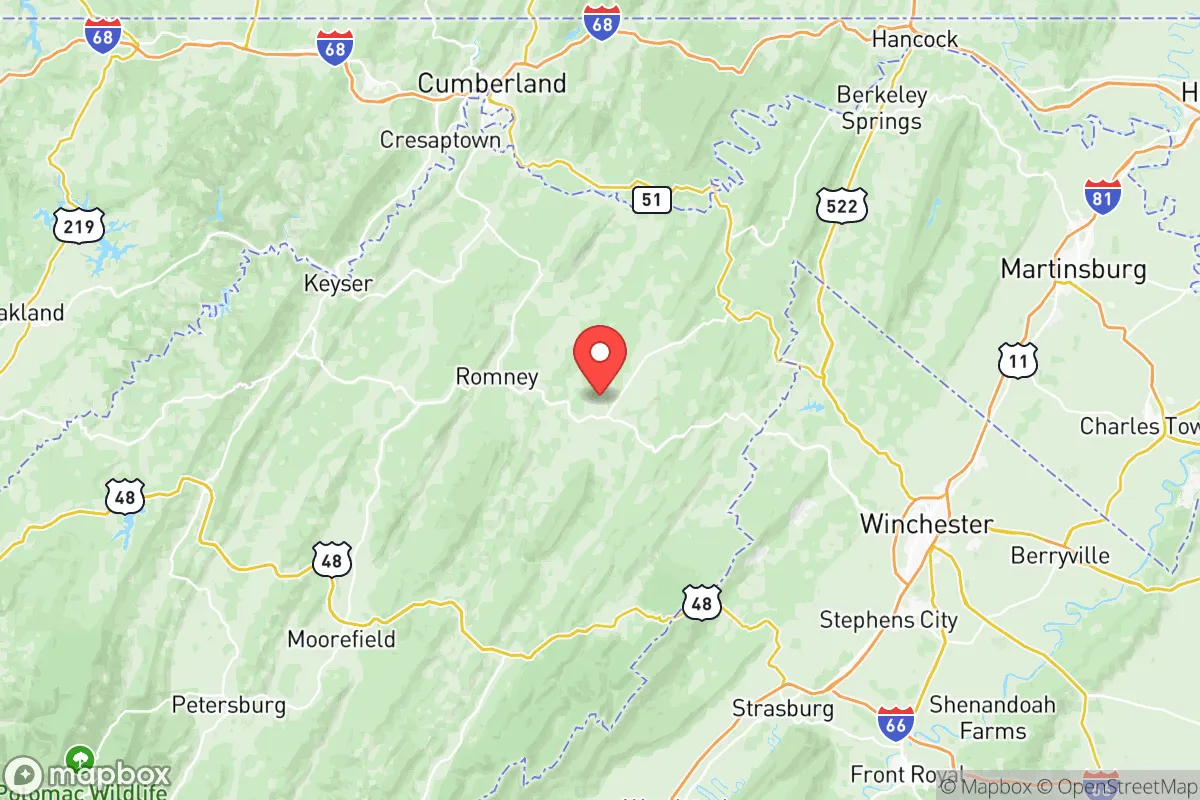
West Virginia as a whole is also deeply Republican—Trump won the state by nearly 39 points in 2024—but Hampshire County is even redder than the state average, sitting about 6 points to the right of the statewide lean. This puts it in the same conservative tier as neighboring Hardy and Grant counties, but notably more Republican than the more moderate Eastern Panhandle counties like Jefferson (R+8) or Berkeley (R+16), which have larger populations of commuters and younger voters. Within Hampshire County itself, the political geography is not uniform. Romney, the county seat, is the most reliably Republican town, with precincts routinely delivering 75-80% of the vote to GOP candidates. In contrast, Capon Bridge and Augusta show slightly more competitive numbers, with Republican margins closer to 60-65%, partly due to a mix of small-business owners and a handful of younger families who lean more moderate. The swing precincts are in the central part of the county around Springfield and Slanesville, where independent voters can tip a local race by 5-10 points in a good year for Democrats, though they still break heavily red in presidential elections.
What this means for residents
For conservative residents, Hampshire County offers a deeply comfortable political environment. Local offices—county commission, school board, sheriff—are held almost exclusively by Republicans, and policy debates tend to focus on property rights, gun access, and limiting tax increases. The county’s Republican executive committee is active and well-organized, with monthly meetings that often draw 40-50 people. For liberal residents, the reality is more isolating. There is no organized Democratic party presence in the county; the local party committee has been dormant for years, and progressive candidates rarely file for office. Socially liberal residents often drive to Winchester, Virginia, or even to Morgantown for community events or political discussions that feel less hostile. That said, the county’s small size—about 23,000 people—means that political disagreements rarely escalate into open conflict; most people just avoid the topic at the grocery store or the post office.
Culturally, Hampshire County stands apart from the rest of West Virginia in a few key ways. The county has a strong independent streak that predates its current Republican dominance—it was one of the few counties in the state to vote for George Wallace in 1968, and it has a long history of distrusting both major parties. This manifests today in a libertarian-leaning conservatism: residents are pro-gun and anti-tax, but also skeptical of federal overreach from either party. The county’s proximity to the D.C. metro area (about 90 minutes to downtown) means it attracts a mix of remote workers and retirees who value low taxes and rural living but don’t always share the cultural conservatism of deeper West Virginia. You’ll find more “live and let live” attitudes here than in, say, Mingo or Logan counties, though the voting patterns remain just as red. For anyone moving to the area, the political climate is straightforward: if you’re conservative, you’ll feel at home; if you’re liberal, you’ll need to find your community outside the county lines. Either way, the trajectory is clear—Hampshire County will only get redder as the older, more moderate generation fades and the new arrivals lean further right.

State Political ClimatePolitical Climate in West Virginia
State Political AnalysisPolitical Environment in the State
West Virginia is one of the most reliably Republican states in the nation, having undergone a seismic political realignment over the past 20 years. In 2000, the state voted for George W. Bush by a narrow 6-point margin, but by 2024, Donald Trump carried it by nearly 40 points, making it the reddest state in the country by presidential vote margin. The dominant coalition is a mix of rural, working-class voters who have shifted sharply away from the Democratic Party, driven by cultural and economic grievances, and a growing conservative base in the exurbs and small towns. The state’s two U.S. Senate seats are held by Republicans, and the GOP holds supermajorities in both chambers of the legislature, with a Republican governor, Patrick Morrisey, elected in 2024.
Urban vs. rural divide
The political map of West Virginia is starkly divided between a handful of small urban centers and the vast, deeply red rural countryside. The state’s largest city, Charleston, and its surrounding Kanawha County have trended Republican but remain more competitive, with Trump winning Kanawha by about 20 points in 2024—still a landslide but less extreme than the rest of the state. Morgantown, home to West Virginia University, is a notable outlier: it voted for Joe Biden in 2020 and has a younger, more educated population that leans Democratic, though it is surrounded by deep-red Monongalia County. Huntington and Cabell County are solidly Republican, while Wheeling in the Northern Panhandle has become a GOP stronghold after decades of Democratic dominance. The Eastern Panhandle, including Martinsburg and Charles Town, has seen an influx of commuters from the D.C. metro area, bringing a mix of conservative and moderate voters, but the region still votes heavily Republican. The rural counties—like McDowell, Mingo, and Logan in the south—are among the most Republican in the nation, often giving Trump 80% or more of the vote. The divide is less about urban vs. suburban and more about the few college towns and state capital versus the rest of the state.
Policy environment
West Virginia’s policy environment is aggressively conservative, reflecting its Republican supermajority. The state has no personal income tax on most wages after a 2023 phase-out, though it retains a corporate net income tax and a sales tax of 6%. Property taxes are among the lowest in the nation, capped by the state constitution. The regulatory posture is business-friendly, with right-to-work laws and a weak labor union presence outside of the coal industry. Education policy has been a flashpoint: the state passed a universal school choice law in 2021, allowing public funds to follow students to private or homeschool options, and charter schools were legalized in 2019. Healthcare is a mixed bag—West Virginia expanded Medicaid under the Affordable Care Act, but the state has some of the highest rates of chronic disease and opioid addiction in the country. Election laws are restrictive: voter ID is required, early voting is limited to 10 days, and no-excuse absentee voting was eliminated in 2021. The state also passed a law in 2023 banning most abortions after 8 weeks, with no exceptions for rape or incest, making it one of the most restrictive abortion bans in the nation.
Recent policy direction
The last five years have seen a sharp rightward shift across nearly every policy domain. On gun and self-defense law, West Virginia became a constitutional carry state in 2016, allowing permitless concealed carry, and in 2023 passed a law prohibiting state enforcement of federal gun laws deemed unconstitutional. Parental and education rights have been a major focus: the 2021 school choice law was followed by a 2023 law allowing parents to challenge school library books and curricula, and a 2024 law requiring schools to notify parents of any changes to a student’s gender identity or pronoun use. Speech and privacy are protected by a 2023 law that restricts social media platforms from censoring political speech, though it faces legal challenges. On medical and bodily autonomy, the 2023 abortion ban is the centerpiece, but the state also passed a law in 2024 banning gender-affirming care for minors. Property rights are strong, with no statewide zoning and a 2023 law limiting eminent domain for economic development. Taxation has moved toward elimination: the personal income tax is being phased out, with a goal of zero by 2026, and the corporate tax rate was cut from 6.5% to 4.5% in 2024. Voting and ballot access have tightened: the 2021 law shortened early voting, banned ballot drop boxes, and required absentee ballots to be notarized or witnessed by two people.
Civil unrest & political movements
West Virginia has a history of labor activism, but recent political movements are dominated by conservative and libertarian groups. The 2018 teachers’ strike, which shut down schools statewide for nine days, was a rare moment of cross-party labor solidarity, but it did not halt the rightward trend. The state has seen organized opposition to COVID-19 mandates, with large protests at the state capitol in 2020 and 2021. The West Virginia Citizens Defense League is a powerful gun-rights group that has successfully pushed for permitless carry and nullification of federal gun laws. Immigration politics are muted—the state has a very small foreign-born population (about 1.5%)—but there is strong support for border security, and the legislature passed a 2024 law requiring local law enforcement to cooperate with federal immigration authorities. There is no sanctuary city movement; in fact, Huntington and Charleston have both passed resolutions opposing sanctuary policies. Election integrity controversies have been minimal, though the 2020 audit found no widespread fraud, and the state has not seen the kind of post-election activism seen in other states. Secession or nullification rhetoric is present but fringe, mostly limited to online forums and a few local politicians. A new resident would notice a general lack of visible political conflict in daily life—most people agree on the basics, and the few liberal enclaves like Morgantown are small and quiet.
Projection
Over the next 5-10 years, West Virginia is likely to become even more Republican, driven by out-migration of younger, more liberal residents and in-migration of conservative retirees and remote workers from the D.C. area, particularly in the Eastern Panhandle. The state’s population is aging and shrinking—it lost about 3% of its population between 2020 and 2024—and the remaining population is increasingly conservative. The phase-out of the income tax may attract some new residents, but the state’s poor healthcare outcomes, limited job opportunities outside of energy and healthcare, and opioid crisis will continue to suppress growth. The political trajectory points toward further deregulation, tax cuts, and cultural conservatism. A new resident moving in now should expect a state where the GOP holds total control, where policy debates are about how far right to go, not whether to go right. The liberal minority, concentrated in Morgantown and parts of Charleston, will have little political influence but will find small, supportive communities.
For a conservative relocator, West Virginia offers a low-tax, gun-friendly, culturally traditional environment where your vote will feel impactful and your values are reflected in state law. For a liberal relocator, the state will feel politically hostile, with few protections for reproductive rights, LGBTQ+ individuals, or public education, but the cost of living is low and the natural beauty is unmatched. The bottom line: West Virginia is a place where politics is deeply woven into daily life, but the direction is clear and unlikely to change soon. If you align with the dominant coalition, you’ll find a welcoming, affordable home. If you don’t, you’ll need to be prepared for a long-term minority position.
* Values derived from national, state, county, city and local statistics and may differ in a specific area. Last updated: 2026-10-23T18:20:33.000Z
Narrative content on this page is AI-generated and may contain mistakes. Verify any details that matter before acting on them.
ReloMaps may earn a commission from affiliate links at no extra cost to you.

