
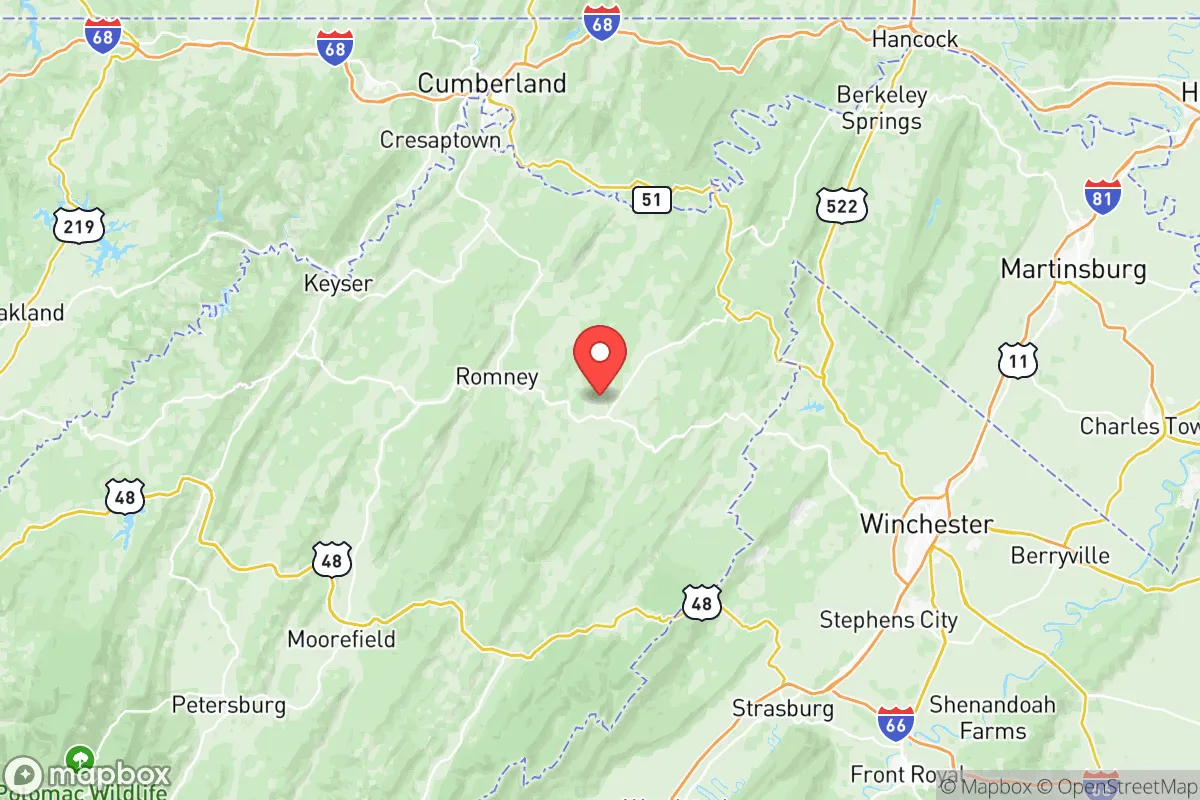
Photo: Wikipedia
Personal Sovereignty in Hampshire County
Strong independent fundamentals that actively favor personal liberty and low regulation.
What does Personal Sovereignty tell us?
Personal Sovereignty measures your capacity for self-reliance and independence with minimal government friction. Higher scores mean fewer barriers between you and the way you want to live... but it assumes you have the space you need and good neighbors.
What does this tell us?
Personal Sovereignty measures your capacity for self-reliance and independence with minimal government friction. Higher scores mean fewer barriers between you and the way you want to live... but it assumes you have the space you need and good neighbors.
State Policy
Energy independence: Net exporter (754% of energy produced in-state)
Personal Liberty
Homesteading

Personal Liberty Analysis
Hampshire County, West Virginia, offers a notably high degree of personal sovereignty, grounded in the state’s historically light-touch governance and a local culture that prizes self-reliance. For individuals and families seeking to minimize external interference in their daily lives—from tax policy to self-defense rights to land use—this rural county in the Eastern Panhandle presents a compelling option. The autonomy environment here is defined by low state-level taxation, permissive gun laws, and a regulatory framework that generally defers to individual property owners, though specific conditions vary across the county’s towns and unincorporated areas.
Tax burden and regulatory posture: How West Virginia’s policies affect your wallet and property
West Virginia’s overall tax burden is among the lowest in the nation, and Hampshire County residents benefit directly. The state imposes no tax on Social Security benefits and offers a partial exemption on pension and retirement income, which is a significant draw for retirees and those planning for financial independence. Property taxes are assessed at a low effective rate—typically around 0.55% of market value—and are capped by the state constitution. The county’s personal property tax on vehicles and business equipment is also modest. On the regulatory side, West Virginia is a right-to-work state, meaning union membership cannot be a condition of employment, and it has no state-level minimum wage above the federal floor of $7.25. Business licensing requirements are minimal compared to neighboring states like Maryland or Virginia. For a reader prioritizing low interference, the county’s posture is decidedly light-touch, though local zoning exists in the county’s two incorporated towns—Romney, the county seat, and Capon Bridge—where building permits and land-use restrictions are more formalized. Outside these town limits, in areas like Springfield and Augusta, the regulatory environment is far more permissive, with no county-wide zoning and minimal oversight on most residential and agricultural activities.
Self-defense and gun law specifics: What the Second Amendment looks like in practice
West Virginia is a constitutional carry state, meaning no permit is required to carry a concealed firearm for anyone legally allowed to possess one. This applies statewide, including all of Hampshire County. The state also has a strong preemption law that prohibits local governments from enacting their own firearm ordinances, so gun laws are uniform across the county—whether you are in downtown Romney or a remote hollow near Yellow Spring. There is no waiting period for firearm purchases, no state-level registration requirement, and no ban on standard-capacity magazines or specific firearm types. Stand-your-ground laws are in effect, with no duty to retreat in any place where a person is lawfully present. For a reader who views self-defense as a core personal liberty, Hampshire County offers one of the most permissive legal environments in the country. The local sheriff’s office in Romney processes concealed carry permits for those who still want one for reciprocity with other states, but it is not required for daily carry within West Virginia. Gun culture is deeply embedded here; shooting ranges and hunting clubs are common, and firearm ownership is the norm rather than the exception.
Self-reliance and homesteading viability: Lot sizes, zoning, and off-grid feasibility
Hampshire County’s rural character makes it a strong candidate for homesteading and off-grid living. The county has no county-wide zoning ordinance, which means that in unincorporated areas—the vast majority of the county’s 645 square miles—there are no restrictions on keeping livestock, building outbuildings, or operating a home-based business. Minimum lot sizes vary by subdivision but are typically one to three acres in rural subdivisions, while raw land parcels can be purchased in sizes ranging from five to over 100 acres. In areas like Slanesville and Bloomery, it is common to find properties with no building codes enforced beyond basic state health department requirements for septic systems. Off-grid living is feasible: West Virginia has no state law prohibiting rainwater collection, and solar panel installation is not subject to special permitting beyond standard electrical work. However, the county does enforce the state’s Uniform Statewide Building Code for new residential construction, which requires permits and inspections for structural, electrical, and plumbing work. This is a moderate hurdle for those seeking complete regulatory independence, but it is far less restrictive than in neighboring Virginia or Maryland. For readers serious about self-sufficiency, the area around Purgitsville offers large tracts of forested land with minimal neighbor density, while properties closer to Capon Bridge have better road access but slightly more oversight due to proximity to the town’s limited zoning.
Personal liberties: Parental rights, medical autonomy, speech, and property
West Virginia law generally supports parental rights in education and healthcare. The state has a Parental Bill of Rights that affirms parents’ authority to direct their children’s upbringing, and it does not require parental consent for minors to receive most medical care—though parental notification is required for abortion. In Hampshire County, the school system—Hampshire County Schools—operates under local control, and school board meetings in Romney have seen active debate on curriculum transparency and library materials, reflecting a community that values parental input. Medical autonomy is more mixed: West Virginia has not expanded Medicaid under the Affordable Care Act, and the state does not have a right-to-try law for terminally ill patients, though it does allow direct primary care agreements that bypass insurance. On speech and property rights, the county is strongly protective. There are no local noise ordinances outside of town limits, and property owners can generally use their land as they see fit, subject only to state environmental regulations on mining and logging. The state’s “Ag-Gag” law, which restricts undercover filming on farms, has been struck down by courts, but the cultural sentiment in rural Hampshire County remains skeptical of regulatory overreach. For a reader who values the ability to speak, build, and live without government permission, the county’s ethos is aligned with that priority.
Overall, Hampshire County ranks among the more sovereignty-friendly areas in the Mid-Atlantic region. Its combination of constitutional carry, low taxes, minimal zoning outside town limits, and a culture of self-reliance places it well ahead of most jurisdictions in neighboring states. For a family or individual seeking a place where personal autonomy is the default rather than the exception, the county offers a practical, grounded option—especially when compared to the heavily regulated environments of the Washington, D.C. suburbs just 90 miles east. The trade-off is access to services and infrastructure, but for those who prioritize freedom over convenience, Hampshire County delivers a high degree of personal sovereignty in a setting that still feels connected to the broader region.

* Values derived from national, state, county, city and local statistics and may differ in a specific area. Last updated: 2026-10-23T18:20:33.000Z
Narrative content on this page is AI-generated and may contain mistakes. Verify any details that matter before acting on them.
ReloMaps may earn a commission from affiliate links at no extra cost to you.

