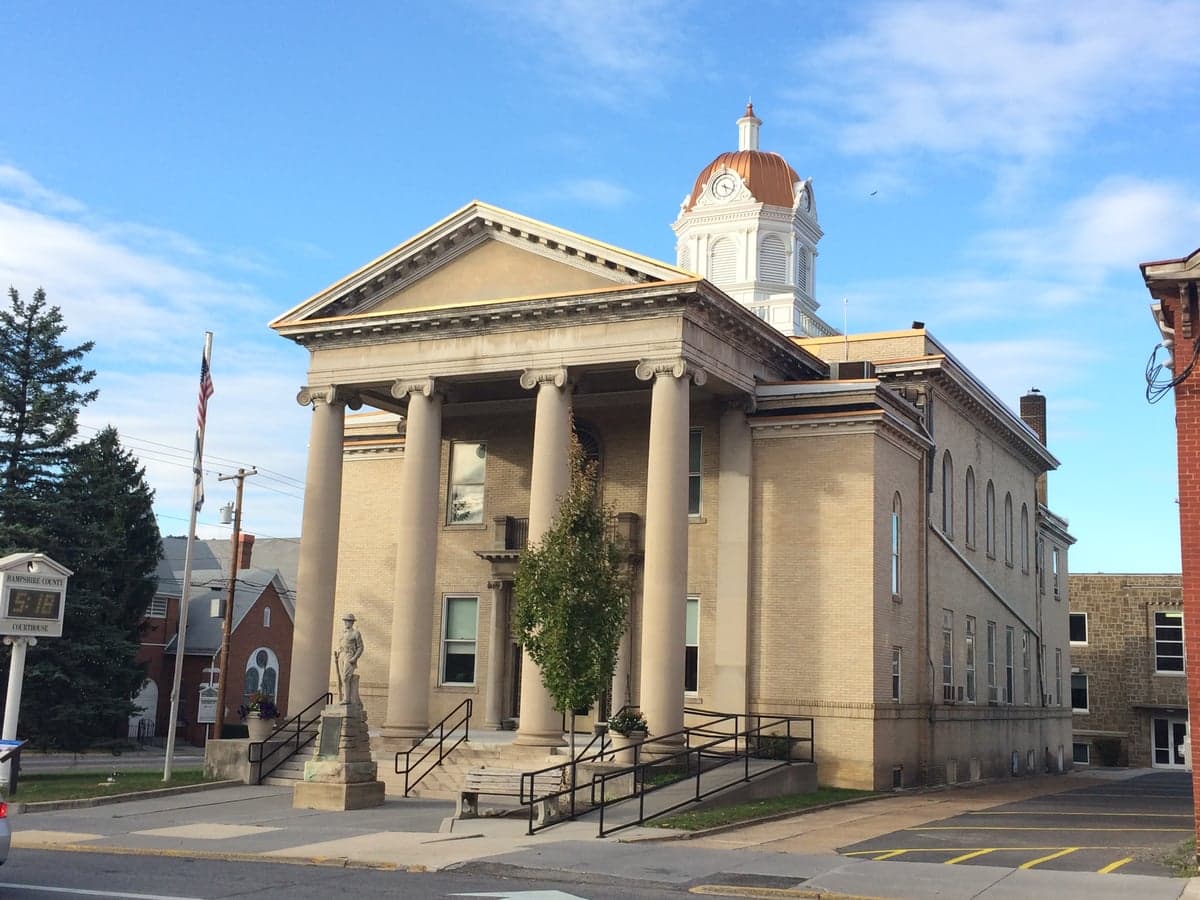
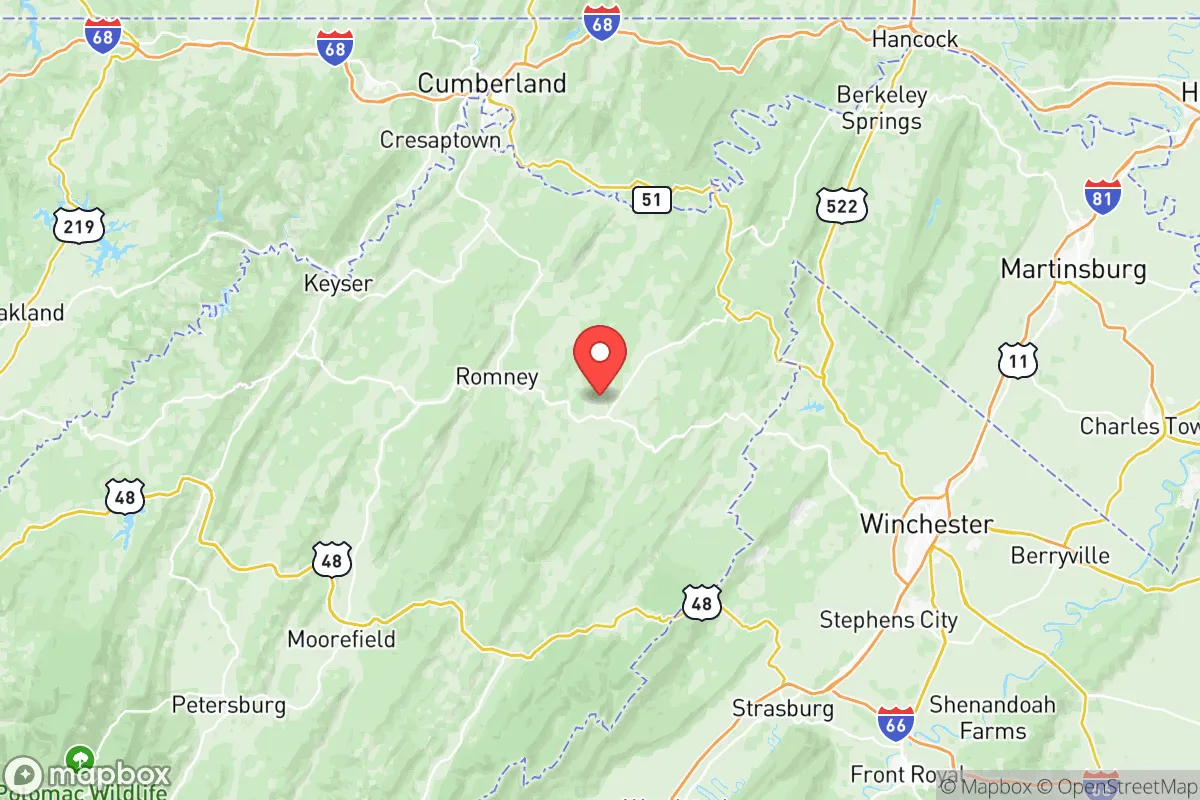
Photo: Wikipedia
Demographics of Hampshire County
Affluence Level in Hampshire County
A middle-class area roughly in line with national averages across income, home values, education, and employment.
People of Hampshire County
The people of Hampshire County, West Virginia, today are overwhelmingly white, native-born, and rural, with a population of 23,340 that is 93.9% white and only 0.2% foreign-born. This is a deeply rooted community where just 16.3% of adults hold a college degree, and the county's identity is shaped by its Appalachian heritage, small-town independence, and a population density of roughly 40 people per square mile. Unlike many parts of the eastern United States, Hampshire County has experienced minimal demographic change over the past half-century, remaining one of the least diverse counties in West Virginia.
Settlement & growth (pre-1960)
Long before European settlers arrived, the area now known as Hampshire County was part of the hunting grounds of the Shawnee and Iroquois nations, who used the South Branch Potomac River valley as a travel corridor. The first European presence came in the early 1700s, when German and Scots-Irish pioneers pushed westward from the Virginia Tidewater region, drawn by the promise of fertile bottomland along the Potomac's South Branch. Hampshire County was officially formed in 1754 from parts of Frederick and Augusta counties, making it the oldest county in what is now West Virginia.
The earliest permanent settlements clustered around the South Branch River, with Romney, the county seat since 1762, serving as the primary hub. German-speaking farmers from Pennsylvania and the Shenandoah Valley settled in and around Springfield and Capon Bridge, establishing Lutheran and Reformed congregations that still exist today. Scots-Irish families, typically Presbyterian, moved into the more rugged hill country around Augusta and Slanesville, where they practiced subsistence farming and livestock grazing. By 1790, the county's population had reached roughly 4,000, almost entirely of British Isles and German stock.
The 19th century brought little new immigration to Hampshire County. The region remained isolated, with no major railroad lines until the late 1800s, and the economy stayed tied to agriculture, timber, and small-scale milling. The Civil War split the county—Hampshire was part of Virginia but voted heavily against secession, and its men served in both Union and Confederate units. After the war, the county's population grew slowly, from 8,000 in 1870 to 12,000 by 1900, as families remained on the land and few outsiders moved in. The arrival of the Baltimore and Ohio Railroad in the 1880s did spur modest growth in Green Spring and Paw Paw, where limestone quarrying and apple orchards became local industries, but the county never attracted the wave of Southern and Eastern European immigrants that transformed industrial cities like Wheeling or Pittsburgh.
The first half of the 20th century saw Hampshire County's population peak at around 17,000 in 1950, then begin a slow decline as young people left for factory jobs in the Ohio Valley and Mid-Atlantic cities. The county remained overwhelmingly rural and white, with African American residents numbering fewer than 200 throughout this period, most of them descendants of families who had been enslaved in the county before the Civil War. No significant immigrant communities formed, and the county's cultural character—heavily Protestant, family-oriented, and self-reliant—remained largely unchanged from its 18th-century origins.
Modern era (post-1965)
The 1965 Hart-Cellar Act, which reshaped American immigration, had virtually no impact on Hampshire County. The foreign-born population today stands at just 0.2%, meaning that fewer than 50 residents were born outside the United States. This is not a place where new immigrant enclaves formed or where domestic migration from other regions brought significant diversity. Instead, the county's demographic story since the 1960s has been one of slow population loss and aging, as young adults continued to leave for college and jobs elsewhere, while retirees from the Washington, D.C., area began buying second homes and farmland in the county's scenic river valleys.
The Hispanic population, at 1.6%, is the largest minority group, but it is dispersed rather than concentrated in any single town. A small number of Hispanic families have moved into Romney and Capon Bridge over the past two decades, primarily working in construction, landscaping, and the poultry processing plants in neighboring counties. The Black population, at 0.6%, is centered in Romney and the Springfield area, where a few families trace their roots back to the 19th century. East and Southeast Asian residents make up just 0.1% of the population, and there are no recorded residents of Indian subcontinent ancestry. The county's racial and ethnic makeup has barely shifted since 1970, when it was 99.2% white.
Domestic migration has been the more significant force in the modern era, though it has not dramatically changed the county's character. Since the 1990s, Hampshire County has seen a modest influx of retirees and remote workers from the Washington, D.C., and Northern Virginia suburbs, drawn by lower property taxes, cheaper land, and a slower pace of life. These newcomers tend to settle along the Potomac River corridor, particularly in Paw Paw and Green Spring, where riverfront properties are available. However, the county lacks the employment base to attract large numbers of working-age migrants; the largest employers are the Hampshire County Schools, the county government, and a few manufacturing plants in Romney and Augusta. Suburbanization has not occurred in any meaningful way—there are no subdivisions or master-planned communities, and most new housing consists of single-family homes on acre lots.
The future
Hampshire County's population is projected to remain stable or decline slightly over the next 10 to 20 years, with no major demographic shifts expected. The county's low birth rate and continued out-migration of young adults will likely keep the population below 25,000, while the aging of the current resident base means the median age—already around 45—will continue to rise. The foreign-born population is unlikely to grow significantly, as the county offers few of the entry-level jobs or ethnic networks that attract immigrants to other parts of the country.
The most notable trend is the gradual in-migration of telecommuters and retirees from the D.C. area, who are drawn by Hampshire County's low cost of living and rural character. This group tends to be more educated and politically moderate than the native-born population, which could slowly shift the county's cultural and political dynamics. However, these newcomers are dispersing across the county rather than forming distinct enclaves, and their numbers are too small to fundamentally alter the county's identity. The Hispanic population may grow slightly as families follow agricultural and construction jobs, but it will remain a small minority.
What this means for someone moving in now is that Hampshire County will remain a place where community ties are deep, change is slow, and the population is overwhelmingly white and native-born. The county is not becoming more diverse, and its cultural identity—rooted in Appalachian self-reliance, rural traditions, and a strong sense of local history—will persist. For families seeking a quiet, affordable, and stable environment away from the pressures of urban growth, Hampshire County offers a demographic continuity that is increasingly rare in the United States.

* Values derived from national, state, county, city and local statistics and may differ in a specific area. Last updated: 2026-10-23T18:20:33.000Z
Narrative content on this page is AI-generated and may contain mistakes. Verify any details that matter before acting on them.
ReloMaps may earn a commission from affiliate links at no extra cost to you.

