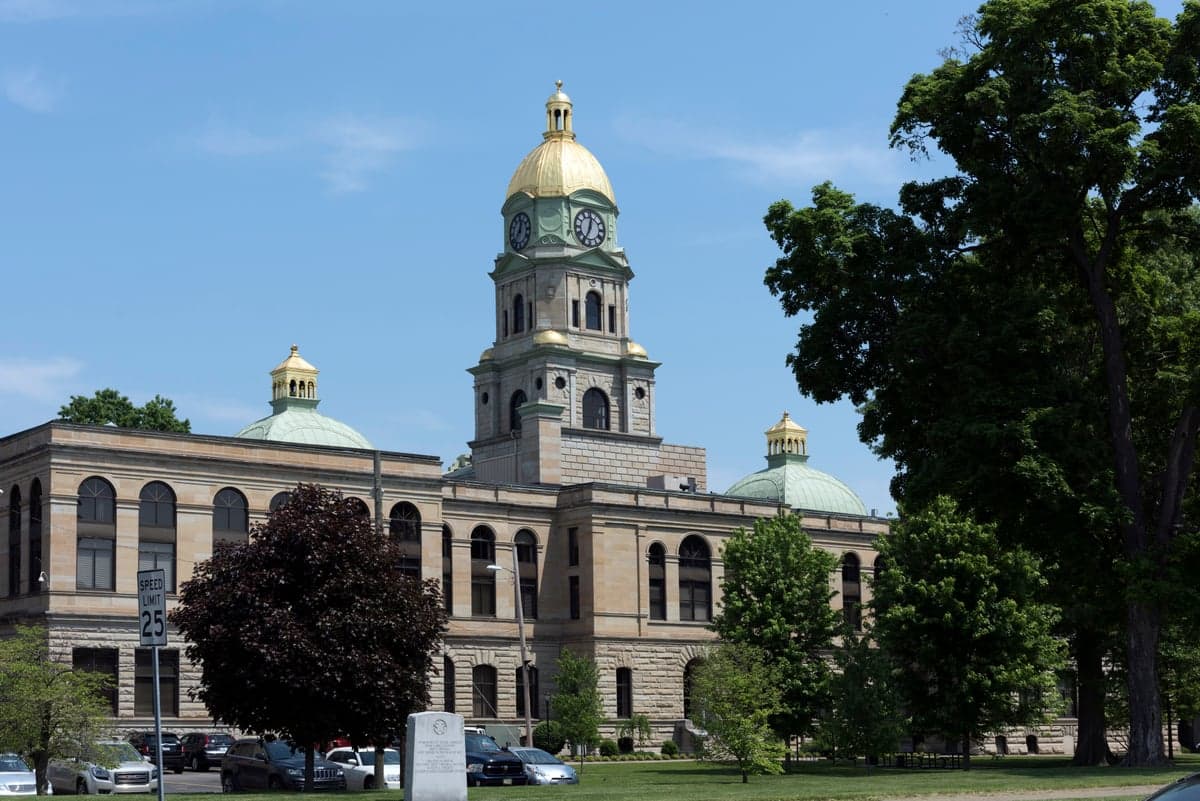
Photo: Wikipedia
Political ClimatePolitical Climate in Cabell County
Showing district-level results — no local-only data available.
Local Political AnalysisPolitical Analysis of Cabell County
Cabell County, West Virginia, is a reliably Republican stronghold with a Cook Partisan Voting Index of R+22, meaning it votes about 22 points more Republican than the national average. This isn't a new development—the county has been trending red for decades, but the shift has accelerated since the early 2000s. In 2024, Donald Trump carried the county with roughly 70% of the vote, a margin that would have been unthinkable even in the 1990s when the area was still a swing county. The real story, though, is the variation within the county: Huntington, the county seat and home to Marshall University, leans more Democratic than the rest of the county, while smaller towns like Barboursville, Milton, and Culloden are deeply red. The swing precincts are mostly in the suburban fringe around Huntington, where moderate voters in places like the Pea Ridge area can tip local races.
How it compares
Compared to West Virginia as a whole, Cabell County is slightly more Republican than the state average. West Virginia's Cook PVI is not publicly available in the same format, but statewide, Trump won by about 39 points in 2024, making Cabell's 70% share actually a bit less red than the state's rural eastern panhandle and coal country. The difference is Huntington: it's the only city in the county with a significant Democratic base, driven by union households, university faculty, and a small but active progressive community. In contrast, towns like Barboursville and Milton are as conservative as any in the state, with churches and gun clubs dominating local politics. The county commission is all Republican, and the state legislative delegation is heavily GOP, but Huntington's city council often has a Democratic majority, reflecting the urban-rural split.
What this means for residents
For conservative residents, Cabell County is a comfortable place to live politically. Local government is generally pro-business, taxes are low, and Second Amendment rights are broadly supported. You'll find conservative values reflected in school board decisions and zoning policies. For liberal residents, it's more of a mixed bag. Huntington provides a blue bubble where progressive candidates can win local office, but statewide and countywide elections are a lost cause. The practical effect is that liberal residents often focus on city-level issues like affordable housing, public transit, and downtown revitalization, while conservative residents focus on economic development, infrastructure, and keeping taxes low. Both sides tend to avoid the culture war battles that dominate national politics, instead focusing on practical concerns like the opioid crisis and job retention.
Culturally, Cabell County has a distinct identity within West Virginia. Huntington's Marshall University gives the area a more educated, slightly more cosmopolitan feel than the rest of the state, with a vibrant arts scene and a walkable downtown. The county is also more economically diversified, with healthcare (Mountain Health Network), education, and logistics (the Port of Huntington Tri-State) providing jobs beyond coal and gas. This economic base means the political conversation is less about resource extraction and more about healthcare access, education funding, and small business support. The county's proximity to Ohio and Kentucky also creates a tri-state regional identity that softens some of the insularity you find in deeper parts of West Virginia. For anyone moving here, the key takeaway is that your political experience will depend heavily on whether you settle in Huntington or one of the surrounding towns—the county is not a monolith, and the local flavor varies block by block.

State Political ClimatePolitical Climate in West Virginia
State Political AnalysisPolitical Environment in the State
West Virginia has been one of the most reliably Republican states in the nation for over two decades, with a partisan lean of roughly +39 points for the GOP in the 2024 presidential election — the largest margin of any state. This wasn’t always the case; as recently as the 1990s, the Mountain State was a Democratic stronghold at the state and local level, voting for Bill Clinton twice. The shift accelerated after 2000, driven by cultural and economic realignment, and by 2016, Donald Trump won the state by 42 points. Today, the dominant coalition is a mix of rural conservatives, working-class voters who left the Democratic Party over gun rights, energy policy, and social issues, and a growing number of out-of-state transplants seeking lower taxes and fewer regulations. The state’s two U.S. senators, Joe Manchin (an independent who caucuses with Democrats) and Shelley Moore Capito (a Republican), reflect the lingering moderate-to-conservative Democratic tradition, but the state legislature and governor’s office have been firmly in GOP control since 2015.
Urban vs. rural divide
The political map of West Virginia is starkly divided between its small urban centers and its vast rural expanse. The state’s largest metro area, Charleston (Kanawha County), leans slightly Democratic — it voted for Joe Biden in 2020 by about 5 points — but even there, the margins have narrowed. The state capital is a hub for government workers, healthcare professionals, and a shrinking union base, which keeps it more competitive. Morgantown, home to West Virginia University, is the state’s most liberal city, with Monongalia County voting for Biden by 12 points in 2020; its student population and tech-adjacent economy create a pocket of progressive politics. Huntington (Cabell County) is a swing area, voting for Trump by about 10 points in 2020, reflecting its mix of Appalachian State University students and working-class voters. In contrast, rural counties like Mingo, Logan, and McDowell in the southern coalfields routinely vote 80%+ Republican, driven by strong opposition to environmental regulations and cultural conservatism. The Eastern Panhandle — counties like Berkeley and Jefferson — is a fast-growing region influenced by Washington, D.C. exurbs; it leans Republican but with a more moderate, suburban flavor, as seen in Berkeley County voting for Trump by 20 points in 2020, down from 30 points in 2016. The divide isn’t just about population density — it’s also about economic base: coal country votes hard red, while university towns and government centers provide the only blue footholds.
Policy environment
West Virginia’s policy environment is among the most conservative in the country, with a strong emphasis on low taxes, limited regulation, and cultural traditionalism. The state has no personal income tax on Social Security benefits and a flat 4.12% income tax rate on other income, with a goal of phasing it out entirely — the state legislature passed a bill in 2023 to cut the rate to 3.99% by 2026. Property taxes are among the lowest in the nation, with a median effective rate of 0.55%. The regulatory posture is business-friendly, especially for energy extraction: the state has no statewide zoning laws, and permitting for natural gas drilling and coal mining is streamlined. Education policy is a flashpoint: the state passed a school choice law in 2021 creating Education Savings Accounts (ESAs) for all students, one of the most expansive programs in the country, and in 2023, it banned transgender athletes from girls’ sports and restricted gender-affirming care for minors. Healthcare is a mixed bag — the state expanded Medicaid under the Affordable Care Act in 2014, but it has one of the highest uninsured rates in the nation (around 8%). Election laws are restrictive: the state requires a photo ID to vote, has no early voting on Sundays, and in 2021 passed a law limiting absentee ballot drop boxes and requiring stricter signature verification. Gun laws are among the most permissive: the state has permitless carry (effective 2016), no red flag law, and a “Stand Your Ground” law passed in 2018.
Recent policy direction
Over the past five years, West Virginia has moved aggressively to the right on a broad set of liberties that relocators care about. On gun and self-defense law, the state passed the “Constitutional Carry” Act in 2016, allowing any adult who can legally possess a firearm to carry it concealed without a permit, and in 2023, it passed a law prohibiting state and local enforcement of federal gun laws that conflict with state law — a form of nullification. On parental and education rights, the 2021 ESA law (the “Hope Scholarship”) gives parents roughly $4,600 per child per year for private school, homeschooling, or tutoring, and a 2023 law requires schools to notify parents of any changes to a student’s health or well-being, effectively a “parental rights” bill. On speech and privacy, the state has no shield law for journalists, but it passed a law in 2023 protecting free speech on college campuses. On medical and bodily autonomy, the state banned nearly all abortions in 2022 after the Dobbs decision, with exceptions only for rape, incest, or life of the mother, and in 2023, it banned gender-affirming care for minors. On property rights, the state has strong eminent domain protections, but it also allows surface mining with minimal restrictions. On taxation, the 2023 income tax cut bill is part of a long-term plan to eliminate the income tax entirely, with a trigger mechanism that reduces the rate as revenue grows. On voting and ballot access, the 2021 law (SB 1) shortened the absentee ballot request window, banned ballot harvesting, and required a notary or two witnesses for absentee ballots — making it harder to vote by mail.
Civil unrest & political movements
West Virginia has a history of labor activism, but in recent years, political movements have been dominated by the right. The 2018 statewide teachers’ strike — which shut down all public schools for nine days — was a rare left-leaning protest, driven by low pay and rising healthcare costs; it succeeded in winning a 5% pay raise. Since then, the state has seen periodic protests over abortion rights, with the 2022 ban drawing hundreds to the Capitol in Charleston. On the right, the “Second Amendment Sanctuary” movement has been strong: over 40 of the state’s 55 counties have passed resolutions declaring themselves sanctuaries from federal gun laws, and the 2023 nullification law was a direct result of that activism. Immigration politics are less prominent here than in border states — West Virginia has one of the smallest foreign-born populations in the U.S. (about 1.5%) — but there is strong opposition to sanctuary policies; the state passed a law in 2020 requiring all law enforcement to cooperate with federal immigration authorities. Election integrity controversies flared after 2020, with the state GOP pushing for the 2021 voting restrictions, but there were no major fraud allegations in the state. A notable flashpoint is the Mountain Valley Pipeline, a natural gas pipeline that has drawn protests from environmental activists and some landowners; clashes have occurred in Fayette County and Greenbrier County, but the project was ultimately approved by Congress in 2023. New residents will notice a general lack of visible political conflict in daily life — most people keep their politics private, and the state’s homogeneity means fewer culture-war flashpoints than in more diverse states.
Projection
Over the next 5-10 years, West Virginia’s political trajectory is likely to remain solidly Republican, but with some interesting shifts. The state’s population is aging and declining — it lost about 3% of its population between 2010 and 2020 — and the young people who leave tend to be more liberal, which reinforces the conservative tilt. However, the Eastern Panhandle is growing fast, driven by remote workers and D.C. exiles; Berkeley County grew 12% between 2010 and 2020, and that influx could moderate the state’s politics slightly, as these newcomers tend to be more fiscally conservative but socially moderate. The coal industry is in long-term decline — production fell by 50% between 2008 and 2022 — which will weaken the influence of the most conservative rural counties. Meanwhile, the state’s push to attract remote workers and retirees with low taxes and outdoor recreation (the “Almost Heaven” campaign) could bring in more libertarian-leaning transplants who support gun rights and low taxes but may be less enthusiastic about social restrictions. The biggest wildcard is the income tax phase-out: if it succeeds, it could accelerate in-migration from high-tax states like New York and California, potentially shifting the electorate. For now, expect the GOP to maintain supermajorities in the legislature, and for the state to remain a safe red vote in presidential elections. A new resident moving in now should expect a stable, conservative environment where cultural issues dominate local politics, but with a growing libertarian streak in the Eastern Panhandle and university towns.
For someone choosing West Virginia, the bottom line is this: you’ll find a state that is deeply conservative on social issues, aggressively pro-gun, and committed to low taxes and limited government. If you’re a conservative or libertarian, you’ll feel at home in most places, especially outside of Morgantown and Charleston. If you’re a liberal, you’ll find a small but active community in the university towns, but you’ll need to be comfortable with being in a clear minority. The state’s politics are stable and predictable — no wild swings — and the practical impact on daily life is minimal for most residents, as long as you’re not seeking abortion access or gender-affirming care. The biggest practical consideration is the tax environment: if you’re moving from a high-tax state, you’ll see immediate savings, but you’ll also get fewer public services, especially in rural areas. The political climate is a feature, not a bug, for the state’s target audience — and it’s likely to stay that way for the foreseeable future.
* Values derived from national, state, county, city and local statistics and may differ in a specific area. Last updated: 2026-07-16T02:13:28.000Z
Narrative content on this page is AI-generated and may contain mistakes. Verify any details that matter before acting on them.
ReloMaps may earn a commission from affiliate links at no extra cost to you.

