
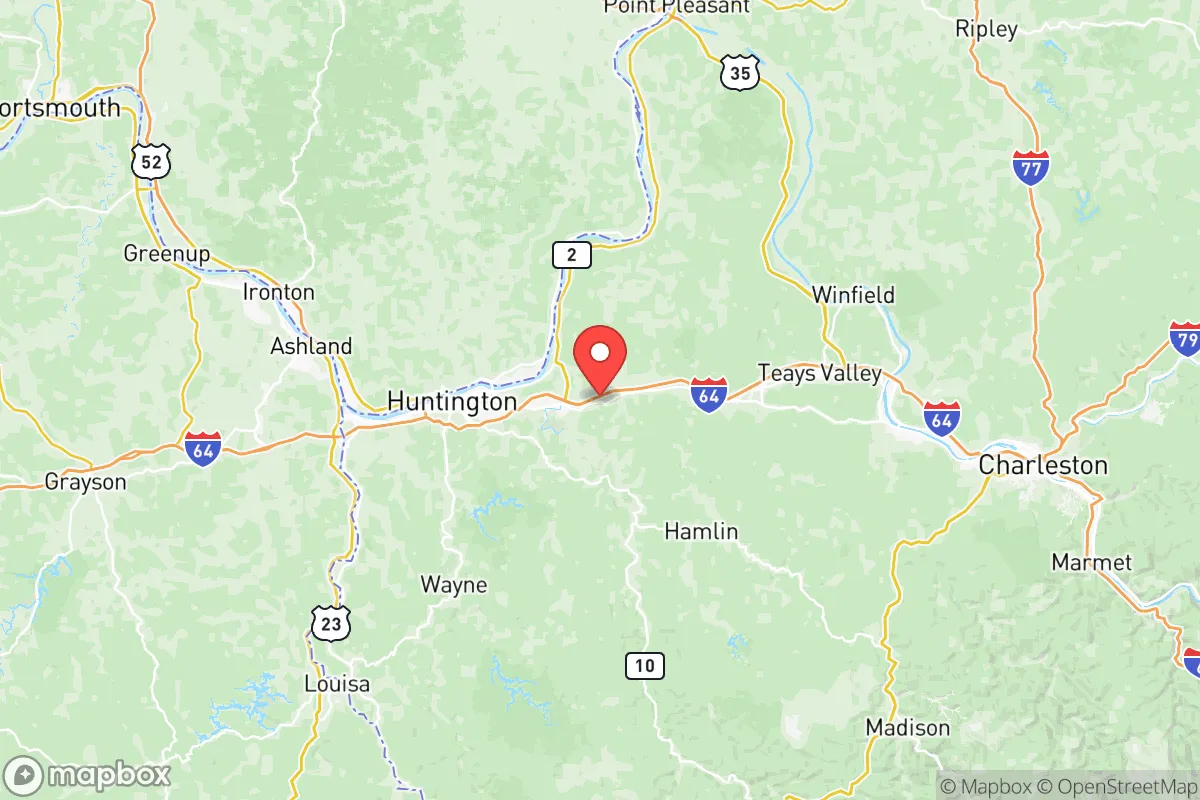
Photo: Wikipedia
Strategic Assessment of Cabell County
Meaningful friction. Expect exposure to either population pressure, blast zones, or natural disaster risk. Consider buying a retreat property.
What does the Strategic Assessment tell us?
Our Strategic Assessment grades tactical survivability of an area. Major population centers, military targets, fallout zones, natural disasters, and border exposure all drive risk — lower exposure means a more defensible position in a crisis.
This is heavily inspired by Joel Skousen's Strategic Relocation book. Highly recommended you checkout the book ($)What does this tell us?
Our Strategic Assessment grades tactical survivability of an area. Major population centers, military targets, fallout zones, natural disasters, and border exposure all drive risk — lower exposure means a more defensible position in a crisis.
This is heavily inspired by Joel Skousen's Strategic Relocation book. Highly recommended you checkout the book ($)Strategic Pillars

Key Distances
Strategic Assessment Analysis
Cabell County, West Virginia, offers a surprisingly strong strategic position for relocation-minded individuals and families who prioritize resilience and self-sufficiency, provided they understand its specific trade-offs. Anchored by the city of Huntington and the Ohio River, the county sits at a geographic sweet spot—close enough to major metro areas for supply runs and medical access, yet far enough from the densest population centers and most obvious strategic targets to offer meaningful buffer. Its hilly terrain, river access, and relatively low population density (roughly 93,000 residents across 287 square miles) create a foundation for a more self-reliant lifestyle, though the region's industrial history and proximity to certain infrastructure introduce risks that a serious relocator must weigh.
Geographic position and natural advantages for self-sufficiency
Cabell County's location along the Ohio River is its single greatest geographic asset for resilience. The river provides a reliable water source, a potential transportation corridor for trade or evacuation, and a natural boundary that limits approach from the north. The county's terrain—rolling hills and narrow valleys—offers natural defensibility, with numerous hollows and ridgelines that can provide cover and chokepoints. Huntington, the county seat, sits at the confluence of the Ohio and Guyandotte Rivers, giving residents access to two major waterways. The surrounding Wayne and Lincoln counties are even more rural, creating a buffer zone to the south and east. For a relocator, this means the ability to tap into the Ohio River Valley's agricultural potential (the region has a long history of small-scale farming) while remaining within a two-hour drive of Charleston, WV, and a three-hour drive of Columbus, OH, for specialized goods or medical care. The county's position in the humid continental climate zone also means reliable rainfall—averaging 40 inches annually—which supports gardening and livestock without the drought risks of the West.
Risks, exposures, and proximity to fallout-relevant landmarks
No strategic assessment is complete without acknowledging the liabilities. Cabell County's industrial history and current infrastructure create several exposure points that a disaster-preparedness-minded reader should note. The most significant is the Marathon Petroleum refinery in nearby Catlettsburg, Kentucky—just 10 miles west of Huntington—which processes crude oil and stores large quantities of volatile chemicals. A major accident or targeted disruption at this facility could release toxic plumes or cause secondary explosions. Additionally, the Ohio River itself is a major industrial waterway, with barge traffic carrying chemicals, fuels, and agricultural products; a spill or collision could contaminate the primary water source for much of the county. On the military side, the nearest major base is Yeager Airport in Charleston (about 50 miles east), which hosts the West Virginia Air National Guard's 130th Airlift Wing—a potential target in a conflict scenario, though far enough to avoid direct blast effects. The county also lies within 100 miles of the Port of Huntington-Tristate, one of the busiest inland ports in the U.S., which handles coal, chemicals, and steel. While this port is a economic engine, it also concentrates risk: a disruption there could ripple through supply chains. Natural hazards are less dramatic but real: the region is prone to flooding, particularly in low-lying areas near the Ohio and Guyandotte Rivers, and the hilly terrain can produce landslides after heavy rain. Tornado risk is moderate, but the Ohio Valley does see occasional severe storms.
Practical resilience for a relocator: food, water, energy, and defensibility
For a family or individual serious about self-sufficiency, Cabell County offers a mixed but workable picture. Water is the strongest asset: the Ohio River is a massive, year-round source, and many rural properties have private wells. The county's groundwater is generally good quality, though testing is recommended near old industrial sites. For off-grid living, rainwater catchment is viable given the 40 inches of annual precipitation. Food production is feasible but requires work: the growing season runs roughly April to October, and the soil in the river bottoms is fertile, but the hillsides are rocky and steep. Small-scale gardening, orchards, and livestock (chickens, goats, pigs) are common in the outlying areas. The county has a strong farmers' market culture—the Huntington Farmers Market operates seasonally—and local food networks exist, though they're not as robust as in more agrarian parts of the state. Energy resilience is a weak point: the grid is aging and prone to outages during storms, and while natural gas is plentiful (the county sits atop the Marcellus Shale), individual homes rarely have backup generation. Solar is viable but less common due to the region's cloud cover; a well-designed system with battery storage can work, but expect lower output than in the Southwest. Defensibility is good in the rural hollows but poor in Huntington itself. The city's density and grid street pattern make it hard to secure, while the surrounding hills offer natural chokepoints and line-of-sight advantages. A relocator should prioritize property on a dead-end road or in a valley with limited access points. The county's gun culture is strong—West Virginia has some of the most permissive firearms laws in the country—which is a plus for self-defense but also means a higher baseline of armed residents, something to factor into community dynamics.
Overall, Cabell County presents a credible option for the strategic relocator who values water access, moderate isolation, and a supportive legal environment for self-sufficiency, but who is willing to accept the risks of living near industrial infrastructure and a major river. The county's greatest strength is its combination of river access, defensible terrain, and a climate that supports year-round food production. Its greatest weakness is the concentration of chemical and energy infrastructure along the Ohio River corridor, which creates a non-trivial exposure to man-made disasters. For a family that can secure a property in the rural southern or eastern parts of the county—away from the river and the refinery—and invest in backup power and water filtration, Cabell County offers a solid foundation for a resilient lifestyle. It is not a bug-out location for the truly paranoid, but it is a practical, livable choice for someone who wants to be prepared without living in a bunker.

* Values derived from national, state, county, city and local statistics and may differ in a specific area. Last updated: 2026-07-16T02:13:28.000Z
Narrative content on this page is AI-generated and may contain mistakes. Verify any details that matter before acting on them.
ReloMaps may earn a commission from affiliate links at no extra cost to you.

