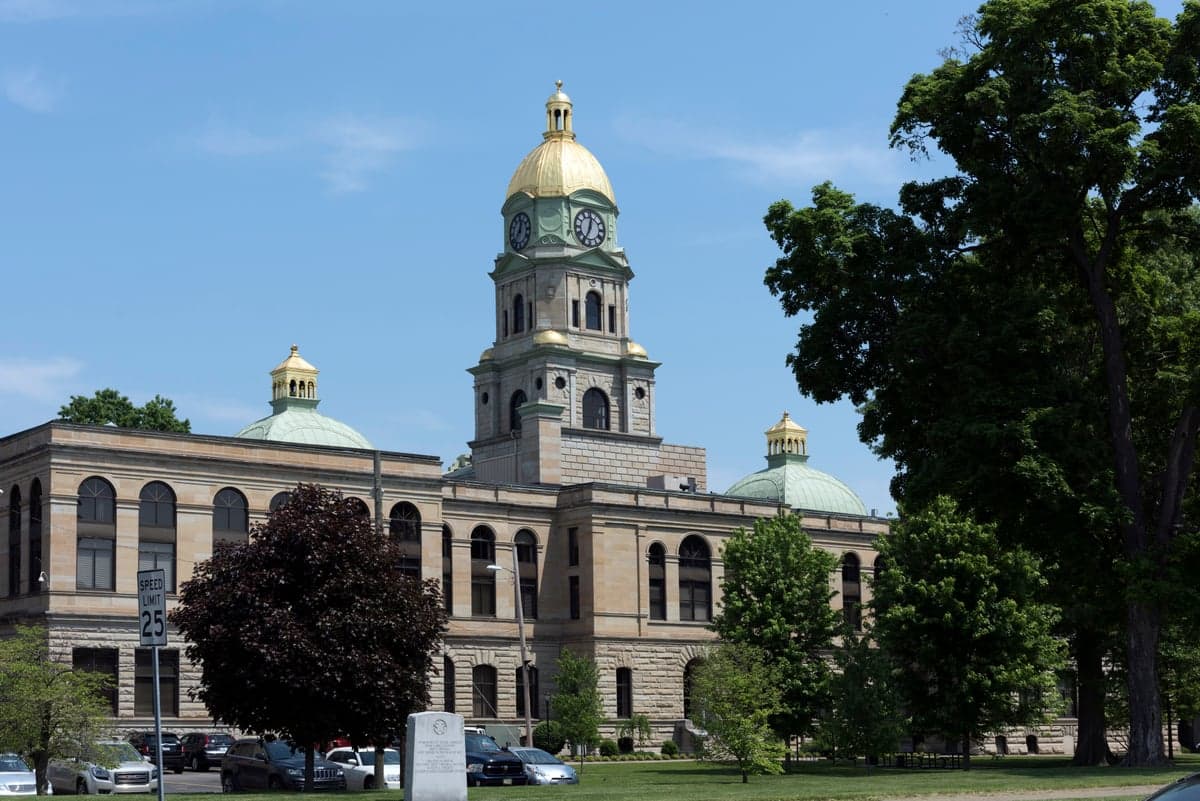
Photo: Wikipedia
Demographics of Cabell County
Affluence Level in Cabell County
A below-average socioeconomic profile. Incomes, home values, and educational attainment trail the U.S., with higher poverty and unemployment.
People of Cabell County
Today, Cabell County, West Virginia, is home to roughly 93,300 residents, a population that is 89.1% white and notably less diverse than the national average. The county’s character is defined by its historic river city, Huntington, which serves as the economic and cultural anchor, and a scattering of smaller towns like Barboursville and Milton. With a foreign-born population of just 0.7% and a college attainment rate of 32.4%, the people of Cabell County are predominantly native-born, rooted in generations of Appalachian and Mid-Atlantic heritage, and increasingly shaped by the pull of Marshall University and regional healthcare employment.
Settlement & growth (pre-1960)
Long before European settlement, the area now known as Cabell County was part of the hunting grounds of the Shawnee and other Native nations, who used the Ohio River as a major travel and trade corridor. The region saw little permanent Native settlement, but it was contested territory between the Shawnee and the Iroquois Confederacy. European incursion began in earnest after the American Revolution, with the first permanent white settlers arriving in the late 1700s, drawn by fertile bottomlands along the Ohio and Guyandotte rivers.
The county was formally created in 1809 from parts of Kanawha County and named after Virginia Governor William H. Cabell. The earliest settlers were overwhelmingly of Scots-Irish and English descent, migrating from Virginia, Pennsylvania, and Maryland. They were subsistence farmers and hunters, and the population grew slowly through the early 19th century. The real transformation came with the arrival of the Chesapeake and Ohio Railway (C&O) in the 1870s, which made Huntington a major rail hub and industrial center. This triggered a wave of European immigration between 1880 and 1920, with significant numbers of Germans, Irish, and Italians arriving to work in the railroad yards, foundries, and emerging chemical plants. Many of these families settled in Huntington’s west end and along the rail corridors, establishing ethnic neighborhoods and Catholic parishes that persist today.
The early 20th century also saw the growth of Barboursville as a farming and trading center, while Milton developed around the Guyandotte River as a milling and timber town. The Great Migration brought a small but notable African American population to Huntington, primarily between 1910 and 1940, seeking industrial jobs in the rail yards and factories. By 1950, the county’s population had peaked at over 108,000, with Huntington as the dominant urban center and a thriving downtown commercial district. The post-World War II era saw suburban expansion, with families moving to newer developments in Pea Ridge and Lesage, but the county remained overwhelmingly white and native-born.
Modern era (post-1965)
The 1965 Hart-Cellar Act had minimal impact on Cabell County. Unlike major metropolitan areas that saw surges of immigration from Asia and Latin America, Cabell County’s foreign-born population remained minuscule—just 0.7% today. The county’s demographic story in the modern era is one of domestic out-migration and suburbanization, not international influx. From the 1970s through the 1990s, the county lost population as manufacturing and rail employment declined, with many residents leaving for the Sun Belt or larger Midwestern cities. Huntington’s population fell from a peak of roughly 80,000 in 1950 to around 46,000 by 2020.
The most significant demographic shift since 1965 has been the growth of the Black population, which now stands at 4.1%. This is largely a legacy of the earlier Great Migration, with families remaining in Huntington’s historic neighborhoods like the Fairfield District and along 8th Avenue. The Hispanic population (1.7%) and East/Southeast Asian population (0.7%) are small but growing, concentrated primarily in Huntington near Marshall University and the medical complex at Cabell Huntington Hospital. The Indian subcontinent population (0.6%) is almost entirely tied to professional employment at Marshall University and the region’s healthcare system, with families living in newer subdivisions in Barboursville and Pea Ridge.
Suburbanization has reshaped the county significantly. Barboursville has emerged as the primary retail and commercial hub, anchored by the Huntington Mall and a growing number of housing developments. Milton has seen modest growth as a bedroom community for Huntington and Charleston commuters. The county’s overall population has stabilized in recent years, hovering around 93,000, as the decline in Huntington’s urban core has been offset by growth in the suburban townships. The college-educated share of the population has risen to 32.4%, driven by Marshall University’s role as a regional employer and the expansion of healthcare and education jobs.
The future
Cabell County is likely to remain a predominantly white, native-born population for the foreseeable future. The foreign-born share is expected to increase only slightly, driven by continued recruitment of international students and medical professionals at Marshall University and the Edwards Comprehensive Cancer Center. The Hispanic and Asian populations will grow slowly, but from a very low base, and will likely remain concentrated in Huntington and the immediate suburbs. The Black population is stable, with no major in-migration expected.
The county’s future demographic trajectory is more about internal redistribution than diversification. Huntington’s urban core will continue to see population loss or stagnation, while Barboursville and Pea Ridge will absorb most new residential development. The county is also seeing a modest influx of retirees and remote workers from higher-cost states, drawn by low housing costs and the Ohio River valley’s natural amenities. This group is overwhelmingly white and tends to settle in rural areas like Lesage and Culloden.
Culturally, Cabell County is becoming more college-educated and service-oriented, with a growing divide between the university-anchored, slightly more diverse Huntington and the surrounding, more traditional small towns. The county’s identity remains deeply Appalachian and Midwestern in character, with a strong sense of local history and community. The next 10-20 years will likely see a slow, gradual increase in diversity, but the county will remain one of the least diverse in the United States.
For someone moving in now, Cabell County offers a stable, affordable, and historically rooted community. The population is overwhelmingly native-born and white, with small but established Black, Hispanic, and Asian communities concentrated in Huntington. The county is not becoming a melting pot; it is becoming a more suburban, service-oriented version of its historic self. New residents will find a place where family ties run deep, the pace of life is slow, and the biggest demographic story is not who is arriving, but who is staying.

* Values derived from national, state, county, city and local statistics and may differ in a specific area. Last updated: 2026-07-16T02:13:28.000Z
Narrative content on this page is AI-generated and may contain mistakes. Verify any details that matter before acting on them.
ReloMaps may earn a commission from affiliate links at no extra cost to you.

