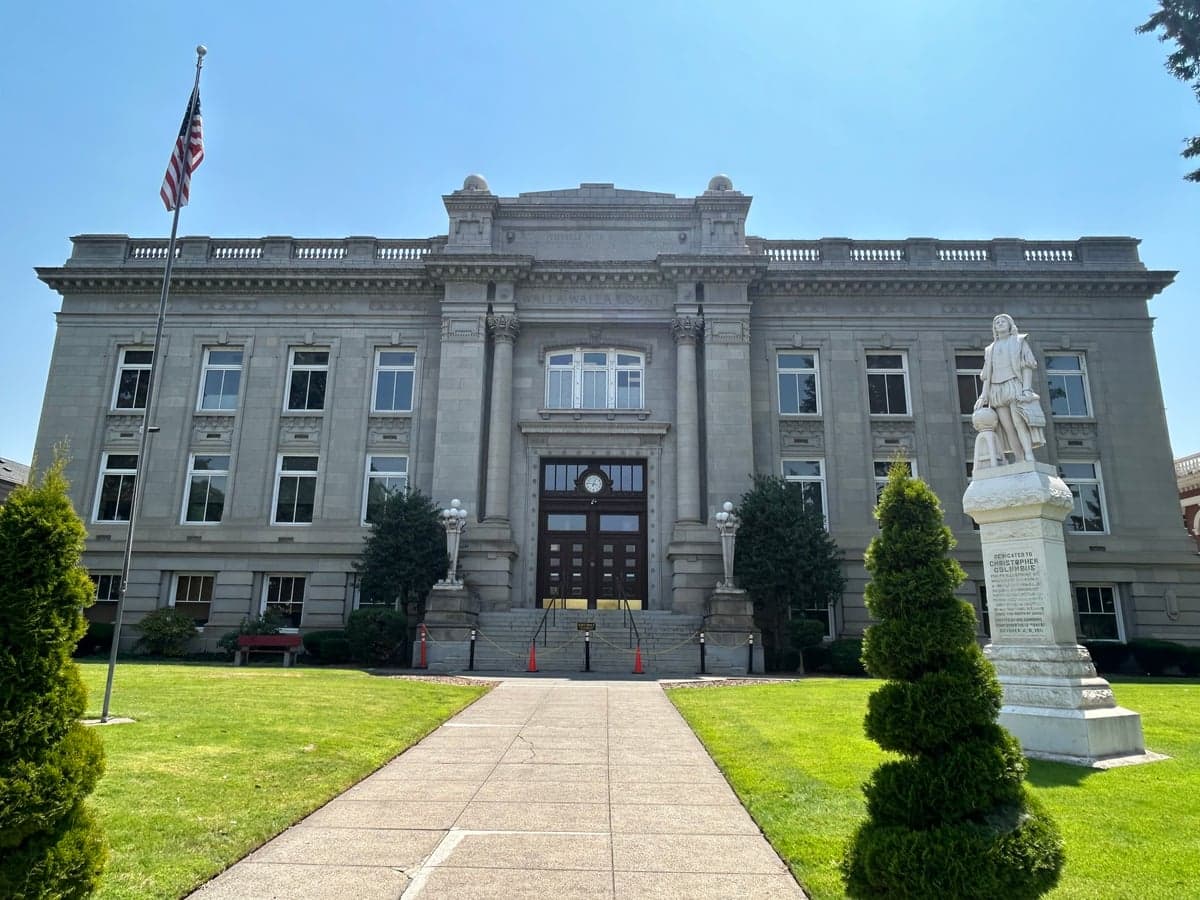
Photo: Wikipedia
Political ClimatePolitical Climate in Walla Walla County
Showing district-level results — no local-only data available.
Local Political AnalysisPolitical Analysis of Walla Walla County
Walla Walla County leans reliably Republican, with a Cook Partisan Voting Index (PVI) of R+5, meaning it votes about five points more conservative than the national average. This makes it a distinct outlier in Washington state, which as a whole has trended solidly blue in recent presidential cycles. The county's political identity is rooted in its agricultural economy, strong military presence, and a slower pace of growth compared to the Seattle metro area, though the city of Walla Walla itself has shown a noticeable shift toward the center-left over the past decade.
How it compares
Compared to Washington state as a whole, Walla Walla County is a red island in a blue sea. While the state's Cook PVI isn't publicly calculated the same way for every cycle, Washington has voted Democratic in every presidential election since 1988, often by double digits. In 2024, the state went for the Democratic candidate by roughly 19 points. Walla Walla County, by contrast, voted for Donald Trump by about 12 points in 2024, a slightly narrower margin than in 2020. The real story is the internal split: the city of Walla Walla, home to Whitman College and a growing healthcare sector, has become a blue-leaning pocket, with precincts near downtown and the college campus voting Democratic by 10-15 points. Meanwhile, the rural towns of College Place, Milton-Freewater, and Waitsburg remain deeply conservative, often voting Republican by 30 points or more. The swing precincts are in the suburban fringe around Walla Walla city limits, where new housing developments are drawing a mix of retirees and young families who tend to split their tickets.
What this means for residents
For conservative residents, the county's R+5 lean means local offices—county commissioners, sheriff, and most school boards—are reliably held by Republicans. Tax policy remains business-friendly, and Second Amendment rights are broadly supported. For liberal residents, the city of Walla Walla offers a comfortable bubble: the local paper, the Union-Bulletin, covers both sides fairly, and the city council has a moderate-to-liberal majority on issues like housing density and climate resilience. That said, state-level policies from Olympia—like the capital gains tax, paid family leave, and stricter gun laws—often chafe here, and you'll hear plenty of grumbling about "Seattle values" at the feed store or the county fair. The practical effect is that most people get along fine day-to-day, but the political divide shows up in school board meetings and zoning debates, especially around growth management and water rights.
Culturally, Walla Walla County stands apart from the rest of Washington in a few key ways. The wine industry, which has exploded since the 1990s, brings a steady stream of liberal-leaning tourists and second-home owners, softening the county's edges. The presence of the Washington State Penitentiary and the Walla Walla VA Medical Center means a significant portion of the workforce is unionized and politically moderate. There's also a strong libertarian streak here—people don't like being told what to do, whether by Olympia or by the county seat. That independent spirit is probably the one thing that unites everyone, regardless of party registration.

State Political ClimatePolitical Climate in Washington
State Political AnalysisPolitical Environment in the State
Washington state has been a reliably blue stronghold for over a decade, with Democrats controlling the governorship, both chambers of the legislature, and both U.S. Senate seats since 2012. The state hasn't voted for a Republican presidential candidate since 1984, and in 2024, Kamala Harris carried it by roughly 19 points. But that top-line number hides a deeply fractured political landscape — the state is essentially two political universes: the hyper-progressive Puget Sound corridor and a vast, increasingly frustrated conservative hinterland. For a relocator, the practical reality is that your experience of Washington’s politics will depend almost entirely on which of those two worlds you land in.
Urban vs. rural divide
The political map of Washington is a story of three metros versus everything else. King County (Seattle) alone generates about 30% of the state's total vote, and it delivers margins of 70-80% Democratic. Add in neighboring Snohomish County (Everett) and Pierce County (Tacoma), and you have the engine that powers every statewide Democratic victory. On the other side, Eastern Washington is solidly Republican — Spokane County has been trending redder, and rural counties like Ferry, Stevens, and Garfield routinely vote 70-75% Republican. The suburbs tell a more nuanced story: Clark County (Vancouver) flipped from red to purple to blue over the last decade, driven by Portland exurbanites and California transplants, while Thurston County (Olympia) has become reliably Democratic thanks to state government workers. The one notable exception to the urban-rural binary is Benton and Franklin counties (Tri-Cities), which remain conservative strongholds anchored by the Hanford nuclear site and agricultural interests. A conservative moving to Washington would feel politically at home in Spokane Valley or Richland, but would face constant cultural friction in Seattle or Bellevue.
Policy environment
Washington’s policy environment is defined by a few structural features that matter enormously for daily life. There is no state income tax, which is the single biggest draw for conservatives and high-earners alike — but the trade-off is high property taxes and one of the highest state sales tax rates in the country (currently 6.5% state-level, with local add-ons pushing it past 10% in some cities). The regulatory posture is among the most aggressive in the nation: Washington has a state-run health insurance exchange, a strict cap-and-trade program (the Climate Commitment Act), and some of the nation’s strongest tenant protections and labor laws, including a $16.28 minimum wage as of 2025. Education policy is a mixed bag — the state funds K-12 at above-average levels per pupil, but school choice is extremely limited, with no voucher program and only a handful of charter schools that have faced constant legal challenges. Election law is heavily mail-in ballot based — every registered voter automatically receives a ballot, which boosts turnout but has drawn criticism from conservatives over ballot harvesting concerns. For a conservative relocator, the lack of income tax is a powerful lure, but the regulatory and tax structure on everything else can feel stifling.
Recent policy direction
The last five years have seen Washington move decisively left on nearly every front a relocator might weigh. On gun policy, the state passed a ban on certain semi-automatic firearms (HB 1240) in 2023, along with a high-capacity magazine ban and a requirement for a 10-day waiting period on all firearm purchases — making it one of the strictest states in the nation for gun owners. On parental and education rights, Washington has moved in the opposite direction from states like Florida: the state mandates LGBTQ-inclusive curriculum and has passed laws protecting transgender students’ access to sports and facilities. On medical and bodily autonomy, Washington has codified abortion rights into state law and passed a shield law protecting providers who serve patients from states with bans. Property rights have been constrained by the state’s Growth Management Act, which limits rural development and has driven up housing costs, particularly in the I-5 corridor. On privacy and surveillance, the state passed a strong biometric privacy law in 2023, but also expanded police use of automated traffic enforcement cameras. Voting access has been expanded with automatic voter registration and same-day registration, while ballot drop boxes are ubiquitous. The net direction is clear: Washington is becoming more regulated, more protective of individual rights on social issues, and more restrictive on gun and property rights — a combination that appeals strongly to progressive relocators but alienates many conservatives.
Civil unrest & political movements
Washington has been a flashpoint for political activism on both sides. The 2020 CHOP/CHAZ occupation in Seattle’s Capitol Hill neighborhood became a national symbol of progressive direct action, while the city’s handling of the protests led to a moderate backlash that helped elect a more centrist city council in 2023. On the right, the Washington State Republican Party has been riven by internal fights between establishment and MAGA-aligned factions, and the state has seen a steady stream of secessionist rhetoric from rural counties — with proposals to create a separate "Liberty State" out of Eastern Washington gaining occasional traction but no real legislative path. Immigration politics are a live wire: Washington is a sanctuary state, with state law prohibiting local law enforcement from cooperating with federal immigration authorities in most circumstances, and King County has explicitly refused to honor ICE detainers. Election integrity has been a persistent issue on the right, with the state GOP filing multiple lawsuits over mail-in ballot procedures, though courts have consistently upheld the system. A new resident would notice the political polarization most visibly in yard signs, bumper stickers, and the stark difference in news coverage between Seattle-based media and Eastern Washington outlets.
Projection
Over the next 5-10 years, Washington’s political trajectory is likely to continue leftward at the state level, but with growing friction. In-migration from California and other high-cost states is accelerating the blue shift in the suburbs — places like Vancouver, Bothell, and Issaquah are getting more Democratic, not less. At the same time, the cost of living crisis in King County is pushing moderate and conservative families eastward, strengthening the red vote in Spokane and the Tri-Cities. The most likely outcome is a state that remains solidly Democratic statewide but with an increasingly angry and organized conservative minority concentrated east of the Cascades. The wild card is the state’s housing crisis — if affordability continues to deteriorate, it could trigger a political realignment similar to what happened in California, where moderate voters began pushing back against progressive governance. For now, a relocator should expect the policy environment to continue tightening on guns, regulation, and taxes, while social liberalism remains entrenched.
For a new resident, the bottom line is straightforward: if you’re a conservative, you can live comfortably in Washington by choosing your location carefully — Spokane, the Tri-Cities, or the more rural parts of Clark County — but you will be voting in a state where your values are increasingly out of step with the majority. If you’re a liberal, you’ll find Seattle and its suburbs among the most ideologically welcoming places in the country, but you’ll pay for it in cost of living and regulatory friction. The state’s lack of income tax is a genuine advantage for both sides, but it’s increasingly offset by high sales and property taxes. Washington is not a place where you can ignore politics — the divide is too visible — but it is a place where you can find a community that matches your values, as long as you’re willing to live in the right corner of the state.
* Values derived from national, state, county, city and local statistics and may differ in a specific area. Last updated: 2026-07-07T17:48:20.000Z
Narrative content on this page is AI-generated and may contain mistakes. Verify any details that matter before acting on them.
ReloMaps may earn a commission from affiliate links at no extra cost to you.

