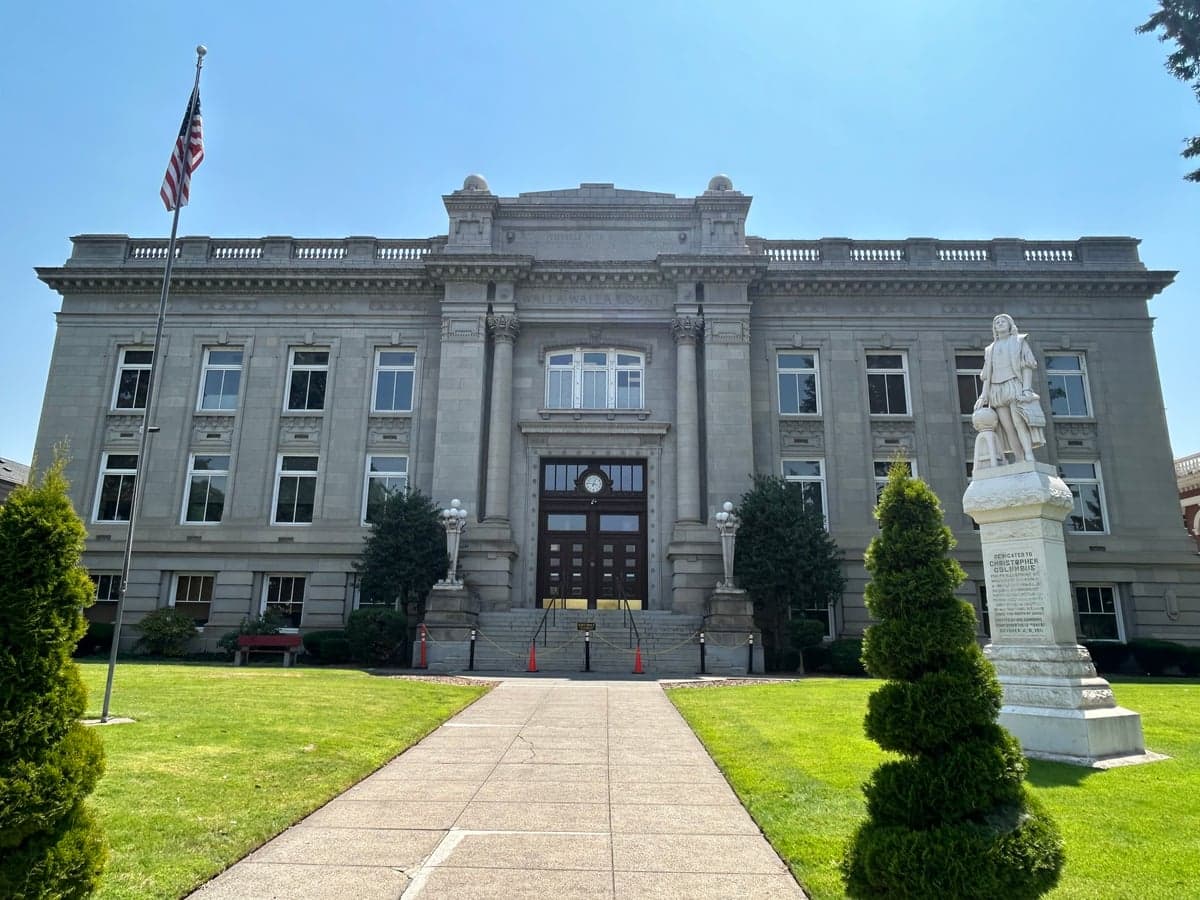
Photo: Wikipedia
Demographics of Walla Walla County
Affluence Level in Walla Walla County
A middle-class area roughly in line with national averages across income, home values, education, and employment.
People of Walla Walla County
The people of Walla Walla County today number roughly 62,000, forming a community that is predominantly white (68.4%) with a substantial Hispanic minority (23.4%) and small but established East/Southeast Asian and Black populations. The county retains a distinctly agricultural character, with its historic downtowns in Walla Walla, College Place, and Waitsburg serving as anchors for a population that values tradition, local governance, and a slower pace of life. Compared to Washington’s coastal metros, Walla Walla County is notably less diverse in its foreign-born share (4.8%) and more politically conservative, though the city of Walla Walla itself leans more moderate. This is a place where generational roots run deep, and newcomers are often drawn by the region’s wine industry, healthcare sector, and family-oriented communities.
Settlement & growth (pre-1960)
Long before European settlement, the Walla Walla Valley was home to the Nimiipuu (Nez Perce), Cayuse, and Walla Walla peoples, who used the confluence of the Walla Walla and Columbia Rivers as a seasonal trading and fishing hub. The Lewis and Clark Expedition passed through in 1805, and by the 1810s, fur traders had established Fort Nez Percés (near present-day Wallula). The first permanent American settlers arrived in the 1830s and 1840s, drawn by the Oregon Trail and the promise of fertile farmland. Marcus Whitman founded a mission near present-day Walla Walla in 1836, but tensions with the Cayuse over land and disease led to the Whitman Massacre of 1847 and subsequent Cayuse War, which cleared the way for American settlement.
The county was formally organized in 1854, and the city of Walla Walla quickly became the largest settlement in Washington Territory, serving as a supply hub for miners heading to the Idaho goldfields. The 1860s and 1870s saw an influx of German and Irish immigrants, who took up farming and small business in Walla Walla, College Place (home to Walla Walla University, founded by Seventh-day Adventists in 1892), and the smaller farm towns of Waitsburg and Prescott. Italian immigrants arrived in the 1880s and 1890s, many working as vineyard laborers and later establishing their own farms; their descendants remain concentrated in the Walla Walla Valley’s wine industry today. By 1900, the county’s population had reached roughly 28,000, with a mix of native-born white Americans, German and Irish immigrants, and a small number of Chinese laborers who had worked on the railroads and later faced expulsion under exclusion laws.
The early 20th century brought Japanese immigrants, who worked as farm laborers and later as independent truck farmers around Walla Walla and Dixie. Many were forcibly removed during World War II internment, and most did not return. The Dust Bowl and Great Depression of the 1930s pushed Okies and Arkies from the Southern Plains into the county, where they found work in wheat and pea fields. The post-World War II period saw a modest suburban expansion around Walla Walla and College Place, but the county never experienced the explosive growth seen in western Washington. By 1960, the population stood at roughly 47,000, with the agricultural economy—wheat, peas, apples, and the emerging wine industry—remaining the dominant force.
Modern era (post-1965)
The 1965 Hart-Cellar Act had a relatively muted effect on Walla Walla County compared to coastal Washington. The foreign-born share today is just 4.8%, well below the national average. The most significant demographic shift since the 1970s has been the growth of the Hispanic population, which rose from under 5% in 1980 to 23.4% today. This wave was driven by labor demand in agriculture—particularly vineyards, orchards, and onion fields—and later by family reunification. Mexican and Central American immigrants and their U.S.-born children now form a substantial community in Walla Walla, College Place, and the rural areas around Burbank and Touchet. Many work in the wine industry, food processing, and construction, and the community has established Spanish-language churches, markets, and cultural events.
The East/Southeast Asian population (1.6%) is small but stable, with roots in the pre-1965 Japanese farming community and a later influx of Filipino and Vietnamese families, many connected to the healthcare and education sectors. The Indian-subcontinent population (0.2%) is tiny, concentrated among professionals at Walla Walla University and Providence St. Mary Medical Center. The Black population (1.7%) has grown slightly since 2000, largely through military and professional relocations, but remains a small minority. Domestic migration has been modest: the county has attracted retirees and telecommuters from Seattle and Portland seeking lower housing costs and a quieter lifestyle, but it has not seen the rapid suburbanization of counties closer to the Interstate 5 corridor. The city of Walla Walla has gentrified somewhat around its historic downtown and Whitman College, but the county overall remains rural and agricultural in character.
The future
Walla Walla County is projected to grow slowly, reaching roughly 65,000–68,000 by 2040. The Hispanic share is expected to continue rising, potentially reaching 30–35% by mid-century, driven by higher birth rates and continued immigration from Mexico and Central America. The white population will likely decline as a share, though it will remain the majority for the foreseeable future. The East/Southeast Asian and Black populations are expected to grow modestly, primarily through professional recruitment in healthcare and education. The county is not becoming a major destination for new immigrant groups; its foreign-born share will likely remain below 10%.
Culturally, the county is becoming more bilingual and bicultural, with Spanish increasingly visible in public life, schools, and local media. This has created some tension in a historically conservative region, but the agricultural economy’s dependence on Hispanic labor has fostered a pragmatic coexistence. The wine industry continues to attract affluent newcomers, many from liberal urban areas, which is slowly shifting the political balance in Walla Walla city toward the center. The smaller towns—Waitsburg, Prescott, Dixie—remain more homogeneous and traditional.
For someone moving in now, Walla Walla County offers a stable, family-oriented environment with strong schools in Walla Walla and College Place, a growing wine and tourism economy, and a population that is gradually diversifying without undergoing rapid transformation. The county is becoming slightly more diverse and slightly more moderate, but it remains a place where agricultural rhythms, local institutions, and generational ties define daily life. Newcomers who respect those traditions and contribute to the community will find a welcoming, if reserved, reception.

* Values derived from national, state, county, city and local statistics and may differ in a specific area. Last updated: 2026-07-07T17:48:20.000Z
Narrative content on this page is AI-generated and may contain mistakes. Verify any details that matter before acting on them.
ReloMaps may earn a commission from affiliate links at no extra cost to you.

