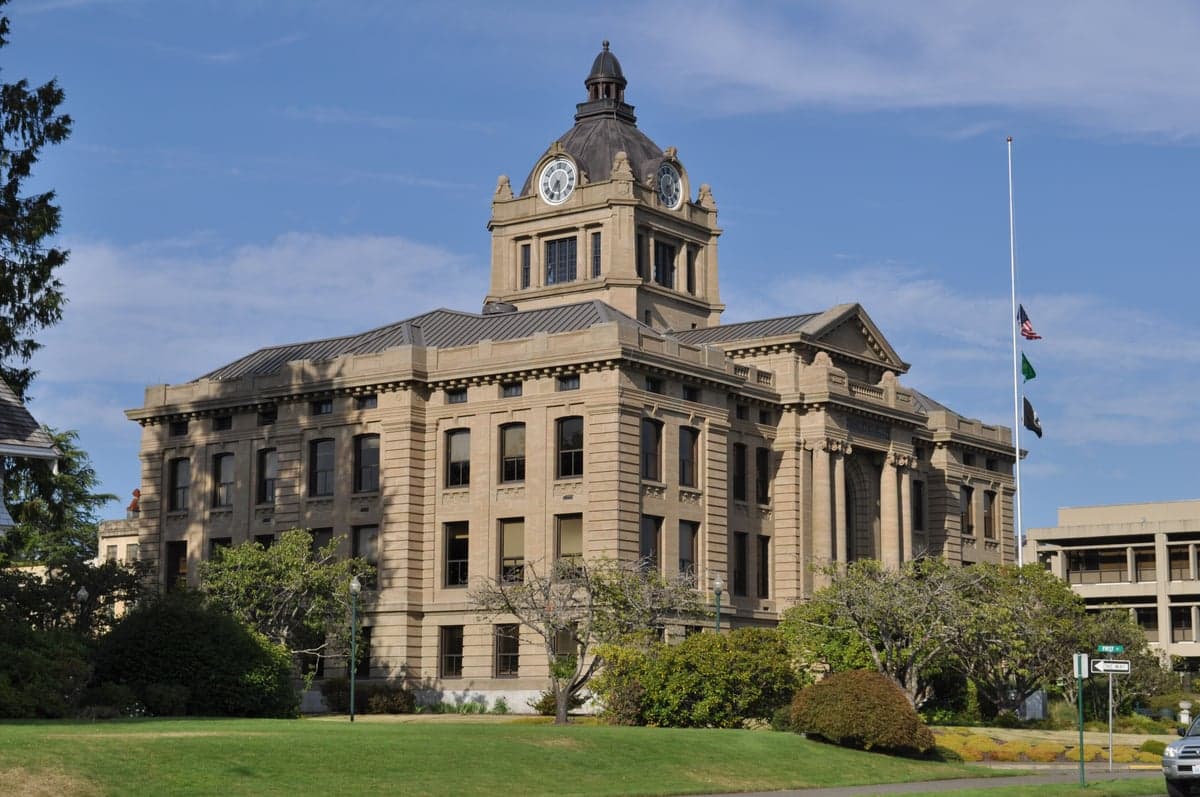
Photo: Wikipedia
Political ClimatePolitical Climate in Grays Harbor County
Showing district-level results — no local-only data available.
Local Political AnalysisPolitical Analysis of Grays Harbor County
Grays Harbor County leans solidly Democratic, with a Cook Partisan Voting Index (PVI) of D+10, but that number tells only part of the story. The county has been drifting rightward over the past decade, mirroring a broader trend across rural Western Washington. In 2020, Joe Biden won the county by roughly 13 points, down from Hillary Clinton’s 15-point margin in 2016 and Barack Obama’s 18-point win in 2012. The shift is most visible in the county’s timber and fishing communities, where economic frustration and cultural conservatism are pulling voters away from the national Democratic brand.
How it compares
Compared to Washington state as a whole, Grays Harbor is notably more Democratic than the state average, but it votes much more conservatively than the Seattle metro area. The county’s D+10 PVI stands in contrast to King County’s D+28, but it is significantly less blue than neighboring Thurston County (home to Olympia, D+8) and roughly on par with adjacent Pacific County (D+7). The real divergence within Grays Harbor County itself is between its small cities. Aberdeen and Hoquiam are the county’s blue anchors: Aberdeen went for Biden by 18 points in 2020, and Hoquiam by 11 points, fueled by unionized mill workers and a stable base of older Democratic loyalists. Ocean Shores, the coastal resort town, is a swing precinct—it voted for Donald Trump in 2016, then flipped to Biden in 2020 by just 2 points, reflecting its mix of retirees and second-home owners from both parties. Montesano and Elma are the red outliers: Montesano voted for Trump by 14 points in 2020, and Elma by 9 points, driven by strong evangelical churches and a population of loggers and fishermen who feel left behind by the state’s green economy push.
What this means for residents
For liberal residents, the D+10 lean means Democrats dominate county commission races and state legislative seats (both house districts in the county are held by Democrats). The county’s Democratic leadership has kept the doors open on local public health measures, and the county council passed a resolution in 2023 opposing the statewide ban on natural gas in new construction—a move that pleased moderates and frustrated progressives. For conservative residents, the county’s trajectory offers some hope: the margin of Democratic victories has narrowed steadily, and in 2024 the county’s Republican Party precinct committee officer slots saw a 40% increase in contested races. Practical effects include lower property tax increases than in neighboring Thurston County, few zoning restrictions on large-lot rural homes, and a general hands-off approach to timberland management that pro-development residents appreciate. The trade-off is that state-level environmental regulations, like the 2021 Salmon Recovery Plan, still preempt county rules, creating friction between local conservative sentiment and Seattle-centric state policy.
Culturally, Grays Harbor is a place where the “timber vs. tree-hugger” divide is still a living memory, but it’s softening. In Aberdeen, the annual Logger’s Playday in July draws families from both parties, and the county’s strong volunteer fire departments are a rare source of cross-political cooperation. The big policy distinction that defines daily life here is land use: Grays Harbor County allows unregulated accessory dwelling units on rural parcels, while cities like Olympia require conditional use permits. That difference matters to builders and retirees alike, and it’s something newcomers—whether from Seattle or Portland—notice quickly. Locals will tell you that political arguments here usually end with the same phrase: “We all need to get the fish out of the water and the trees out of the woods.” That’s the Grays Harbor ethos—practical, grudge-light, and slowly shifting toward the center.

State Political ClimatePolitical Climate in Washington
State Political AnalysisPolitical Environment in the State
Washington state leans solidly Democratic in statewide elections and major urban centers, but its political reality is far more divided than a simple "blue state" label suggests. Over the past 20 years, the state has shifted leftward on social issues and environmental policy, driven by explosive growth in the Seattle metro area and a steady influx of out-of-state residents. However, much of Eastern Washington and the rural, resource-dependent counties remain deeply conservative, creating a stark urban-rural chasm that defines nearly every policy debate. For a conservative relocator, the practical experience varies wildly depending on whether you land in King County or a town like Spokane or Wenatchee.
Urban vs. rural divide
The political map of Washington is a study in contrast. King County, home to Seattle, alone casts roughly 30% of the state’s vote and delivers margins of 70-80% for Democratic candidates. This metro dominance is reinforced by Pierce County (Tacoma) and Snohomish County (Everett), which have trended blue over the last decade. In contrast, the eastern half of the state is solidly Republican: Spokane County, while slowly purpling at its core, still votes red, and rural counties like Grant, Adams, and Yakima vote Republican by 20-30 points. The real story is the suburban and exurban ring around Puget Sound. Places like Sammamish, Redmond, and Bellevue are now reliably blue, but outlying communities like Maple Valley, Bonney Lake, and Graham in Pierce County lean conservative or are trending toward it as affordability drives people farther out. The political divide isn't just about Seattle vs. the rest—it's about the post-industrial timber towns like Aberdeen versus the tech-fueled growth poles.
Policy environment
Washington’s policy environment is shaped by three dominant features: no state income tax, a highly progressive tax structure reliant on sales and property taxes, and a strong regulatory hand in areas like housing, energy, and labor. The state has a statewide minimum wage of $16.28 per hour (2025), indexing to inflation, and a paid family and medical leave program funded by payroll deductions. Public schools are funded through a state property tax levy, but local districts add on via bonds and levies, meaning school quality correlates directly with property wealth. On election law, Washington conducts all elections by mail, with ballots automatically sent to all registered voters. There is no voter ID law beyond a signature verification system. For conservatives, the lack of income tax is a draw, but the high sales tax (6.5% state + local up to ~10.5% in some cities), combined with a capital gains tax on high earners (first of its kind in the state, effective 2022, currently under legal challenge), creates a mixed fiscal picture. Gun policy is strict: a 2023 law bans the sale of many semi-automatic rifles, and the state has a 10-day waiting period for all firearm purchases.
Recent policy direction
The past five years have seen Washington accelerate a leftward legislative agenda. In 2023, the legislature passed HB 1240, a ban on the manufacture, distribution, and sale of assault weapons, and HB 1143, requiring a firearm safety training course and a 10-day waiting period before purchasing any firearm. These laws face ongoing legal challenges but remain in effect. On education, the state has expanded "opt-out" mechanisms for sex education materials at the local level but also passed a law requiring that all public schools provide comprehensive sexual health education by 2025. Parental rights debates have centered on school boards, with some districts like Lake Washington and Northshore adopting policies that affirm transgender student rights and others in conservative areas resisting state mandates. On privacy, the state passed the Washington Privacy Act in 2021, but it lacks a private right of action, limiting enforcement. On property rights, the state's Growth Management Act continues to restrict development in rural areas, and a 2023 law (HB 1110) preempted single-family zoning in cities over 25,000 to allow for duplexes and fourplexes along transit corridors. On voting, the state expanded automatic voter registration and restoration of voting rights for felons upon release from prison. Tax direction points toward greater progressivity: the capital gains tax, despite a court challenge, reflects a broader trend that may lead to a wealth tax in the next decade.
Civil unrest & political movements
Washington has a history of intense political activism, from the Seattle WTO protests in 1999 to the 2020 CHAZ/CHOP occupation, which became a national flashpoint. The state is a sanctuary state for undocumented immigrants, with the 2019 Washington Law Against Discrimination extended to protect tenants' immigration status, and local law enforcement barred from cooperating with federal immigration enforcement unless presented with a judicial warrant. In eastern Washington, groups like the Constitutional Sheriffs and Peace Officers Association have influence, and there have been several instances of county sheriffs declaring they will not enforce certain state gun laws or public health mandates. Immigration politics are volatile: while King County shelters, the agricultural regions (Yakima Valley, Pasco, Moses Lake) rely heavily on immigrant labor, creating a pragmatic tension. Election integrity concerns are a live issue in conservative counties, with the state conducting a post-election audit pilot program in 2024. The secession and "Greater Idaho" movement—where rural Oregon counties propose joining Idaho—has some weak echo in Washington's conservative counties, but no serious legislative traction.
Projection
Looking five to ten years out, Washington’s political trajectory is firmly blueward, driven by continued in-migration of tech workers and professionals into the Puget Sound region. The state's population is aging but still growing fastest in the urban cores and their suburban exurbs. Affordable housing constraints will likely push more conservative-leaning residents outward to rural counties, but those counties are losing population share. The state will almost certainly see additional gun restrictions, a possible statewide carbon pricing mechanism, and continued expansion of paid leave and health mandates. The capital gains tax will likely survive legal challenge, and a broader wealth tax is a plausible next step. For a conservative moving in, the practical outlook is about where you choose to live: Spokane Valley or Wenatchee offer a political environment similar to many intermountain West towns, while a move to Bothell or Redmond means living in a blue suburb with high housing costs and progressive local governance. The state legislature will remain under Democratic control for the foreseeable future, and the governor's mansion will stay blue.
For a conservative relocator, the bottom line is that Washington offers a politically bifurcated experience. You can find communities where your values match the majority—but only if you accept the cost of living, the tax structure, and the broad state-level policy direction. The state’s leftward momentum is real, but it’s concentrated in the I-5 corridor. If you value no income tax, outdoor recreation, and a strong economy, you can make it work—but you’ll need to be comfortable living in a state where the legislature will continue to pass laws you likely disagree with. Pick your county carefully, because in Washington, the political climate changes more with the zip code than with the ballot box.
* Values derived from national, state, county, city and local statistics and may differ in a specific area. Last updated: 2026-09-14T09:46:48.000Z
Narrative content on this page is AI-generated and may contain mistakes. Verify any details that matter before acting on them.
ReloMaps may earn a commission from affiliate links at no extra cost to you.

