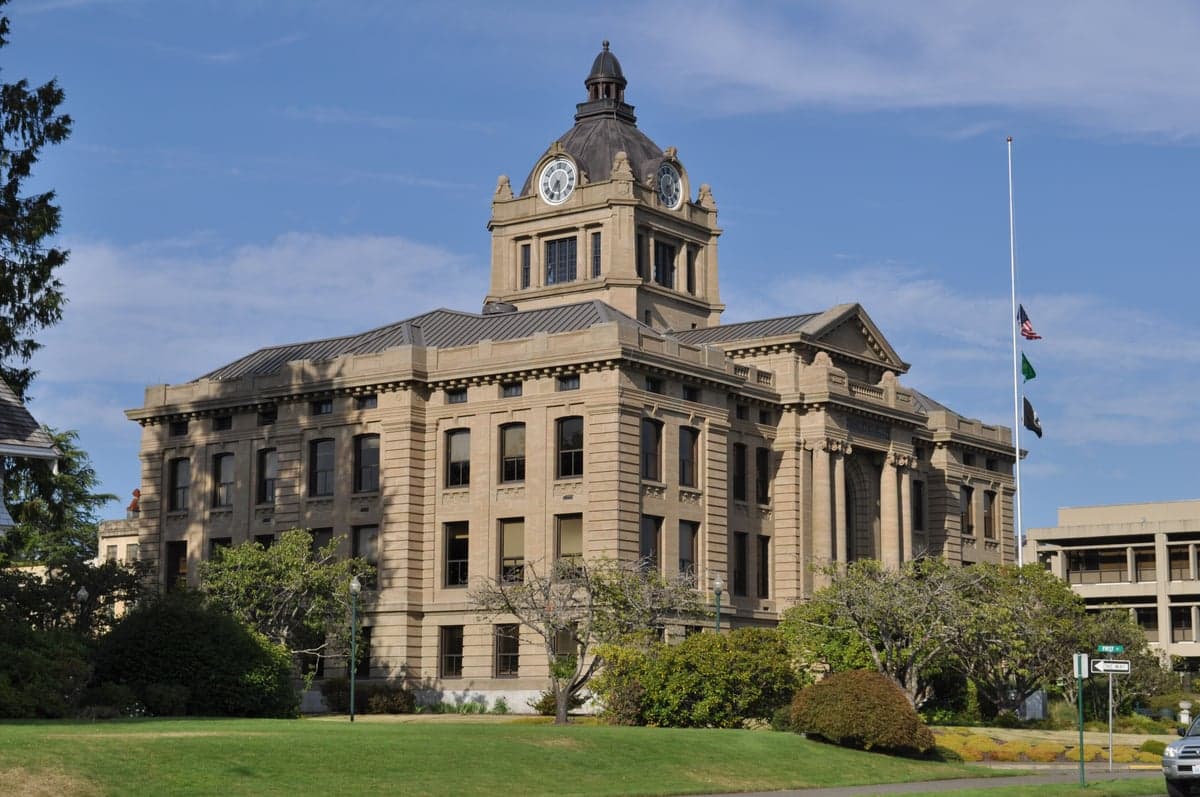
Photo: Wikipedia
Demographics of Grays Harbor County
Affluence Level in Grays Harbor County
A middle-class area roughly in line with national averages across income, home values, education, and employment.
People of Grays Harbor County
Today, the people of Grays Harbor County are a predominantly white, working-class population shaped by a century of resource extraction and small-town life, totaling 76,397 residents. The county is notably homogeneous, with 77.3% identifying as white alone and a median age that skews older than the state average, reflecting an economy that has struggled to retain younger generations. A distinctive identity persists: a proud, self-reliant culture rooted in logging, fishing, and coastal living, with a strong sense of local history centered on the Chehalis and Quinault Rivers. The area remains lightly populated, with most residents concentrated in the twin cities of Aberdeen and Hoquiam, along with the smaller communities of Montesano, Elma, and Ocean Shores.
Settlement & growth (pre-1960)
Long before European settlement, the region was home to the Quinault Indian Nation and the Chehalis people, who lived along the rivers and coast for thousands of years, sustained by salmon runs and cedar forests. The first non-Native contact came with Spanish and British explorers in the late 18th century, but permanent settlement by Euro-Americans did not begin until the mid-19th century, following the Oregon Treaty of 1846 that established American control. The county was formally organized in 1854, named after the Grays Harbor estuary, itself named for American explorer Robert Gray.
The first major wave of American settlers arrived in the 1850s and 1860s, largely from the Northeast and Midwest, drawn by the promise of abundant timber and access to Pacific trade. These early pioneers established the towns of Montesano (the county seat, founded 1854) and Elma (founded 1869) along the Chehalis River, where they built sawmills and general stores. The harbor itself, protected by a long sand spit, became a hub for shipping lumber to San Francisco and beyond.
The decisive population surge came with the timber boom from the 1880s through the 1910s. The Northern Pacific Railway reached the harbor in 1890, and suddenly the deep-water port at Aberdeen (incorporated 1890) and Hoquiam (incorporated 1891) exploded into rough-and-tumble mill towns. Scandinavian immigrants—Swedes, Norwegians, Finns, and Danes—arrived in large numbers, bringing logging and shipbuilding skills. By 1910, Grays Harbor was one of the world's leading lumber ports, and its population had swelled to over 35,000. These Nordic immigrants established tight-knit communities in Aberdeen and Hoquiam, with churches, fraternal lodges, and socialist labor halls that shaped local politics for decades.
Smaller numbers of Germans, Irish, and French Canadians also arrived in this period, working in the mills or on the logging railroads. A smaller black population, perhaps 1-2% by 1920, came as railroad workers and mill hands, but racial segregation was informal and persistent. The pre-1960 population was overwhelmingly Northern European in ancestry, with a distinctly Scandinavian flavor that survives in surnames, Lutheran churches, and annual festivals like the Scandinavian Midsummer Festival in Ocean Shores.
The timber economy, however, proved volatile. By the 1920s, overcutting and the Great Depression led to mill closures and population stagnation. World War II briefly revived the shipyards, but the post-war era saw a slow decline. The county never became a destination for the Dust Bowl Okie migration or the Great Migration of African Americans from the South; instead, it remained an isolated, ethnically homogenous corner of Washington. Cosmopolis and Westport grew as fishing ports, but the population base continued to center on Aberdeen and Hoquiam.
Modern era (post-1965)
The 1965 Hart-Cellar Act had little immediate impact on Grays Harbor County, as the region was not a draw for the new waves of Asian or Latin American immigration that transformed Seattle and other West Coast cities. The foreign-born population today stands at just 3.3%, far below the Washington state average of 14%. The county's demographic change has instead come from internal migration and gradual shifts within existing groups.
The most notable post-1965 change has been the growth of the Hispanic population, now at 10.8%. This increase began in the 1990s, driven by demand for labor in timber, agriculture, and the seafood processing plants in Westport and Tokeland. Most Hispanic residents have roots in Mexico and Central America, and they are concentrated in Aberdeen and Montesano, where they work in fish processing and construction. A small Hispanic enclave has emerged in Ocean Shores, where some work in tourism and hospitality.
The East/Southeast Asian population remains tiny at 1.2%, a fraction of what neighboring Thurston or King counties have. Most are Filipino and Vietnamese families who arrived in the 1980s and 1990s, often as second-wave refugees or through family reunification, settling primarily in Aberdeen and Hoquiam to work in healthcare and the fishing industry. The Indian-subcontinent population is negligible at 0.1%, largely a few professionals in medicine or engineering at the local hospital.
The black population, at 1.6%, is small but stable, with most families having roots in the military or railroad work that brought them to the area in the 1960s and 1970s. They live primarily in Aberdeen and Elma, where the railroad depot was historically a point of entry. Suburbanization has been limited; the only significant post-1965 growth has been in Ocean Shores, a coastal resort town founded in 1970 that has attracted retirees and second-home owners from the Seattle area, adding a modest influx of more educated and affluent residents.
The future
Grays Harbor County is projected to continue its slow population decline or stagnation, as young people leave for jobs in Olympia, Seattle, or Portland. The Hispanic population is expected to grow modestly, potentially reaching 15-18% over the next two decades, as younger families have higher birth rates and labor demand persists in agriculture and seafood processing. However, the white population, now at 77.3%, will likely shrink further due to aging and out-migration. The county will remain one of Washington's least diverse regions, with only slight increases in small Asian and black communities if new industrial projects—such as the planned offshore wind terminals at the Port of Grays Harbor—attract a slightly more diverse workforce.
Geographic dispersion will likely continue, with Ocean Shores and the southern coastal area attracting retirees and remote workers, while the traditional timber towns of Aberdeen, Hoquiam, and Montesano age in place. No new large immigrant enclaves are expected; the county lacks the job diversity and urban amenities that drive international migration. The Quinault Indian Nation may see modest population growth as tribal enterprises develop, but this will not dramatically shift county demographics.
Culturally, Grays Harbor County will likely retain its working-class Scandinavian and timber-town character, even as the Hispanic share grows. Political conservatism, strong unions, and a live-and-let-live attitude toward newcomers are likely to persist. The county's identity is increasingly rural and coastal, with less influence from the liberal, tech-driven growth of the Puget Sound region.
For someone moving in now, Grays Harbor County offers a deeply rooted, slow-paced community where long-term residents are skeptical of rapid change. New arrivals will find a place that treasures its history and struggles with economic renewal, but where the sense of place remains strong; the population is projected to remain overwhelmingly white, older, and working-class, with gradual Hispanic growth the main demographic shift on the horizon.

* Values derived from national, state, county, city and local statistics and may differ in a specific area. Last updated: 2026-09-14T09:46:48.000Z
Narrative content on this page is AI-generated and may contain mistakes. Verify any details that matter before acting on them.
ReloMaps may earn a commission from affiliate links at no extra cost to you.

