Political ClimatePolitical Climate in Suffolk City County
Showing district-level results — no local-only data available.
Local Political AnalysisPolitical Analysis of Suffolk City County
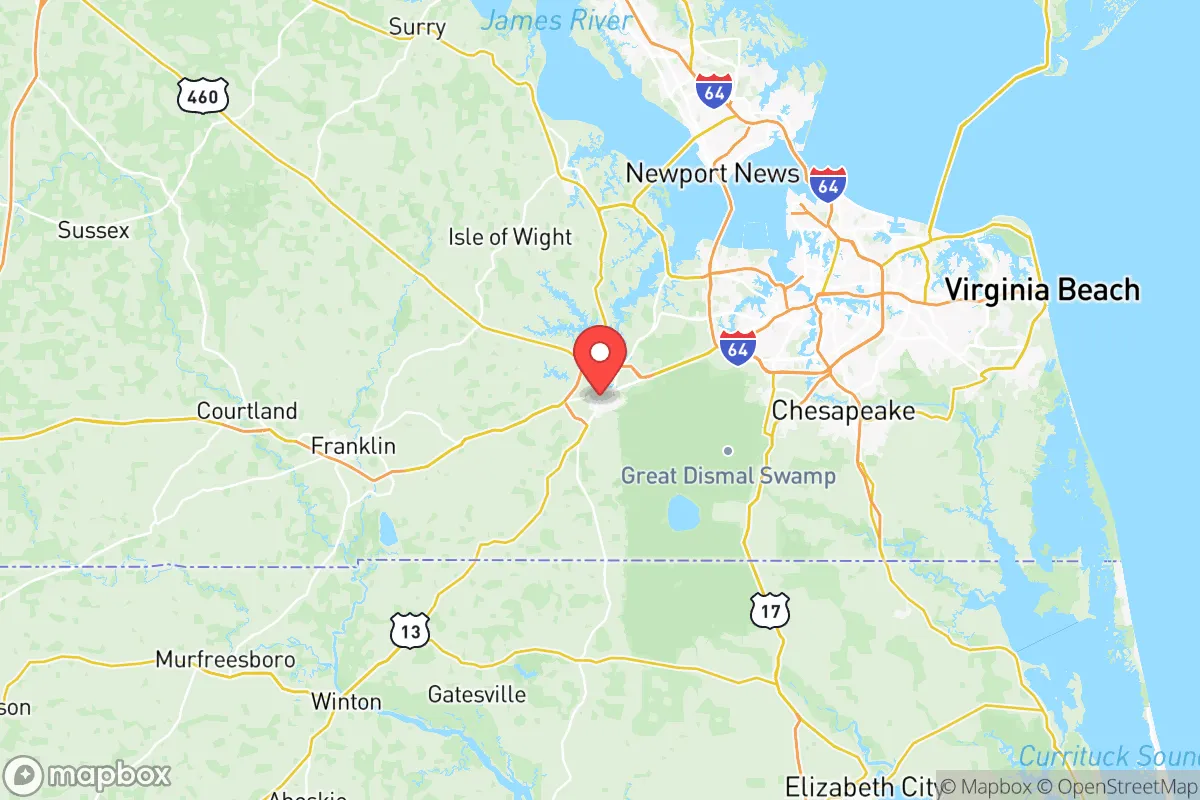
Suffolk City County, Virginia, sits right in the political middle, with a Cook Partisan Voting Index (PVI) of EVEN, making it one of the few true swing jurisdictions in a state that leans Democratic by D+4. This isn't a place where one party dominates; instead, elections here are regularly decided by a few hundred votes, and the county has a history of flipping between red and blue in presidential and statewide races. In 2020, Joe Biden carried Suffolk by a narrow 1.2-point margin, while in 2024, Donald Trump flipped it back by a similar razor-thin margin, reflecting the area's deep ambivalence and its role as a bellwether for Virginia's broader political shifts.
How it compares
Suffolk's EVEN rating stands in stark contrast to Virginia's overall D+4 PVI, meaning the county is significantly more conservative than the state as a whole. While Virginia has trended blue in recent cycles—driven by the explosive growth of Northern Virginia suburbs like Fairfax and Loudoun—Suffolk has remained stubbornly competitive. The county's political geography explains this: the rural northern and western parts, around the towns of Holland and Whaleyville, lean heavily Republican, often voting 65-70% for GOP candidates. In contrast, the more urbanized areas near downtown Suffolk and the Harbour View neighborhood along the Nansemond River tilt Democratic, with precincts like Nansemond River High School and King's Fork regularly going 55-60% blue. The swing precincts that decide elections are in the central and southern parts of the county, particularly around Driver and Chuckatuck, where independent and moderate voters make up a large share of the electorate. This internal split means Suffolk is less influenced by the statewide trends of Northern Virginia's blue wave or Southwest Virginia's red wall, instead charting its own centrist course.
What this means for residents
For conservative residents, Suffolk's swing status means their votes genuinely matter, and local GOP candidates often win by focusing on bread-and-butter issues like taxes, public safety, and rural land use rather than national culture wars. The county's Republican-leaning School Board and City Council majorities in recent years have kept property tax rates relatively low compared to neighboring Chesapeake and Virginia Beach, and development in the rural west has been slower than in the Democratic-leaning east. For liberal residents, the close margins mean that grassroots organizing and turnout in Harbour View and downtown precincts can flip a race, and the county's growing diversity—Suffolk's population is now about 40% Black—has created a reliable Democratic base that keeps the county competitive. Both sides have learned to campaign on local issues: the expansion of the Hampton Roads Bridge-Tunnel and the proposed Walmart distribution center near Route 58 have been flashpoints that cut across party lines. The practical result is a political culture that is less polarized than in many parts of Virginia, where neighbors with different yard signs still talk to each other at the Suffolk Peanut Festival or the Farmers Market on Main Street.
Cultural and policy distinctions
Suffolk's political identity is shaped by its unique blend of rural farmland and suburban sprawl, a combination that creates policy tensions you don't see in more homogeneous parts of Virginia. The county has been slower to adopt the kind of transit-oriented development and zoning reforms that are common in Northern Virginia or Richmond, with the Board of Supervisors often siding with agricultural and conservation interests over developers. This has kept large swaths of the county—especially around the Nansemond River and the Great Dismal Swamp—relatively undeveloped, preserving a rural character that appeals to both conservative property-rights advocates and liberal environmentalists. At the same time, the county's growing logistics and warehousing sector, anchored by the Port of Virginia's expansion in nearby Portsmouth, has brought a wave of new residents from outside the region, many of whom are younger and more diverse. This demographic shift is slowly pulling the county's politics toward the center-left, but the rural vote in Holland and Whaleyville remains a powerful counterweight. Culturally, Suffolk feels more like a small Southern town than a Hampton Roads suburb, with a slower pace and a strong sense of local identity that resists the homogenization seen in neighboring cities. For anyone moving here, the key takeaway is that your vote will count more than it would in a deep-blue or deep-red part of Virginia, and the community expects you to show up and engage.

State Political ClimatePolitical Climate in Virginia
State Political AnalysisPolitical Environment in the State
Virginia has shifted from a reliably purple swing state to a solidly Democratic-leaning one, with a Cook PVI of D+4, but that number hides a deeply divided commonwealth. The shift has been driven overwhelmingly by the explosive growth of Northern Virginia suburbs like Arlington, Alexandria, and Loudoun County, which have turned the state blue in every presidential election since 2008. Over the last 10-20 years, the old "Virginia is for Lovers" moderate conservatism has been replaced by a two-party trench war, where control of the Governor's mansion and General Assembly flips every few cycles, but the underlying demographic trend points steadily leftward.
Urban vs. rural divide
The political map of Virginia is a textbook case of the urban-rural chasm. The entire Democratic majority is generated in a handful of jurisdictions: Fairfax County alone has more people than the entire western half of the state, and it votes like a New York City suburb. Richmond and Norfolk/Virginia Beach add more blue votes, while the sprawling exurbs of Prince William County have flipped from red to blue over the past decade. Meanwhile, rural and small-town Virginia — places like Roanoke, Lynchburg, and the Shenandoah Valley — vote overwhelmingly Republican, often by 60-70% margins. The result is a state where a conservative living in Virginia Beach might feel politically homeless in their own city council, while a liberal in Lynchburg would face the opposite problem. The divide isn't just cultural; it's economic, with the urban crescent along I-95 and the DC metro area pulling away from the rest of the state in wealth, education, and political power.
Policy environment
Virginia's policy environment is a mixed bag that reflects its split government. The state has a relatively low flat income tax rate of 5.75%, but property taxes are set locally and can be high in the urban crescent — Loudoun County homeowners pay some of the highest effective rates in the South. Sales tax is moderate at 5.3% (plus local add-ons). On regulation, Virginia is generally business-friendly, with a right-to-work law and a growing tech economy, but the regulatory posture varies wildly by locality. Education policy has been a battlefield: the state abolished its Standards of Learning (SOL) graduation requirement in 2023, and school choice options like charter schools and vouchers are limited compared to states like Florida or Texas. Healthcare is dominated by the expansion of Medicaid under the Affordable Care Act, which Virginia adopted in 2019 under a divided government. Election laws are moderately restrictive: voter ID is required, but early voting and no-excuse absentee voting are available. The state does not have a "stand your ground" law, and gun laws have tightened significantly in recent years.
Recent policy direction
Over the last five years, Virginia has lurched leftward on several key fronts, then partially pulled back when Republicans won the Governor's mansion in 2021. On gun and self-defense law, the 2020 Democratic trifecta passed a package including universal background checks, a red flag law, a one-handgun-per-month limit, and a ban on assault weapons for those under 21 — but the 2021 election of Governor Glenn Youngkin halted further restrictions. On parental and education rights, Youngkin made "parents' rights" a central issue, signing executive orders on transparency in school curricula and banning critical race theory from K-12 classrooms, though the actual legislative impact has been limited by the Democratic-controlled Senate. On speech and privacy, Virginia passed the Consumer Data Protection Act in 2021, one of the strongest state privacy laws in the country. On medical and bodily autonomy, the state has become a safe haven for abortion access in the South, with no gestational ban and protections codified into law in 2023. On property rights, Virginia has strong eminent domain protections after the 2005 Kelo backlash, but zoning fights in the suburbs — especially over missing-middle housing in Arlington — are intense. On taxation, the trend has been toward modest cuts: Youngkin signed a $1 billion tax cut package in 2022, including a reduction in the income tax rate and an increase in the standard deduction. On voting and ballot access, the state has expanded early voting and no-excuse absentee voting, but voter ID remains in place. The overall direction is a tug-of-war: Democrats push for more regulation and social spending, Republicans push back on cultural issues and taxes, but the long-term trajectory is toward a more progressive policy environment, especially on social issues.
Civil unrest & political movements
Virginia has been a flashpoint for national political movements. The 2017 Unite the Right rally in Charlottesville — and the violent clashes that followed — put the state on the map as a battleground over Confederate monuments and white nationalism. That event galvanized both the left and the right, leading to the removal of many Confederate statues across the state, including the massive Robert E. Lee monument in Richmond. On the left, the "Blue Wave" of 2017-2019 was fueled by suburban women and grassroots activism, particularly in Fairfax County and Loudoun County, where school board meetings became national news over critical race theory and transgender policies. On the right, the "Parents Matter" movement and the 2021 Youngkin campaign successfully mobilized rural and exurban voters, but also tapped into election integrity concerns — though Virginia's 2020 election was widely regarded as secure and well-administered. Immigration politics are less heated than in border states, but Prince William County has been a flashpoint over sanctuary policies, with the county board voting in 2020 to limit cooperation with ICE. The state has also seen significant protests over police reform, particularly after the 2020 murder of George Floyd, leading to the passage of a police reform bill in 2020 that banned chokeholds and no-knock warrants. A new resident would notice that political activism is highly visible in the urban areas, with yard signs, bumper stickers, and community organizing common, while rural areas are quieter but deeply conservative.
Projection
Over the next 5-10 years, Virginia will continue to trend blue, but the pace will depend on in-migration patterns. The DC suburbs are growing faster than the rest of the state, and the influx of highly educated, socially liberal professionals from other states will push the PVI further left. However, there are countervailing forces: the exurbs of Prince William County and Stafford County are seeing an influx of more conservative-leaning families from the DC area, and the rural areas are holding steady. The wild card is the 2030 redistricting cycle, which could reshape the congressional map. For a conservative relocator, the practical reality is that the state will likely remain under divided government for the foreseeable future, with Democratic control of the state Senate and the governorship flipping between parties. That means policy will continue to be a tug-of-war: no major gun control expansions, but no repeal of existing ones; no major tax cuts, but no large tax hikes; and continued cultural battles over education and parental rights. For a liberal relocator, the state offers a relatively stable progressive environment on social issues, but with the understanding that the rural-urban divide means not every part of the state will feel welcoming.
For someone moving to Virginia, the bottom line is that you are choosing a state that is politically split down the middle, but with a clear long-term trajectory toward the left. Your day-to-day experience will depend heavily on where you live: a conservative in Virginia Beach or Roanoke will find plenty of like-minded neighbors and a local government that reflects their values, while a liberal in those same cities will feel like a minority. Conversely, a liberal in Arlington or Richmond will feel at home, while a conservative there will need to adjust to being in the minority. The state's policy environment is moderate overall, but the cultural and political temperature varies wildly by locality. If you are looking for a state where your vote will consistently matter in statewide elections, Virginia still delivers — but the margins are getting wider, and the direction is clear.
* Values derived from national, state, county, city and local statistics and may differ in a specific area. Last updated: 2026-07-12T08:27:54.000Z
Narrative content on this page is AI-generated and may contain mistakes. Verify any details that matter before acting on them.
ReloMaps may earn a commission from affiliate links at no extra cost to you.

