Personal Sovereignty in Suffolk City County
Viable for self-reliance. Generally workable, though some barriers may limit total independence.
What does Personal Sovereignty tell us?
Personal Sovereignty measures your capacity for self-reliance and independence with minimal government friction. Higher scores mean fewer barriers between you and the way you want to live... but it assumes you have the space you need and good neighbors.
What does this tell us?
Personal Sovereignty measures your capacity for self-reliance and independence with minimal government friction. Higher scores mean fewer barriers between you and the way you want to live... but it assumes you have the space you need and good neighbors.
State Policy
Energy independence: Importer (20% of energy produced in-state)
Personal Liberty
Homesteading

Personal Liberty Analysis
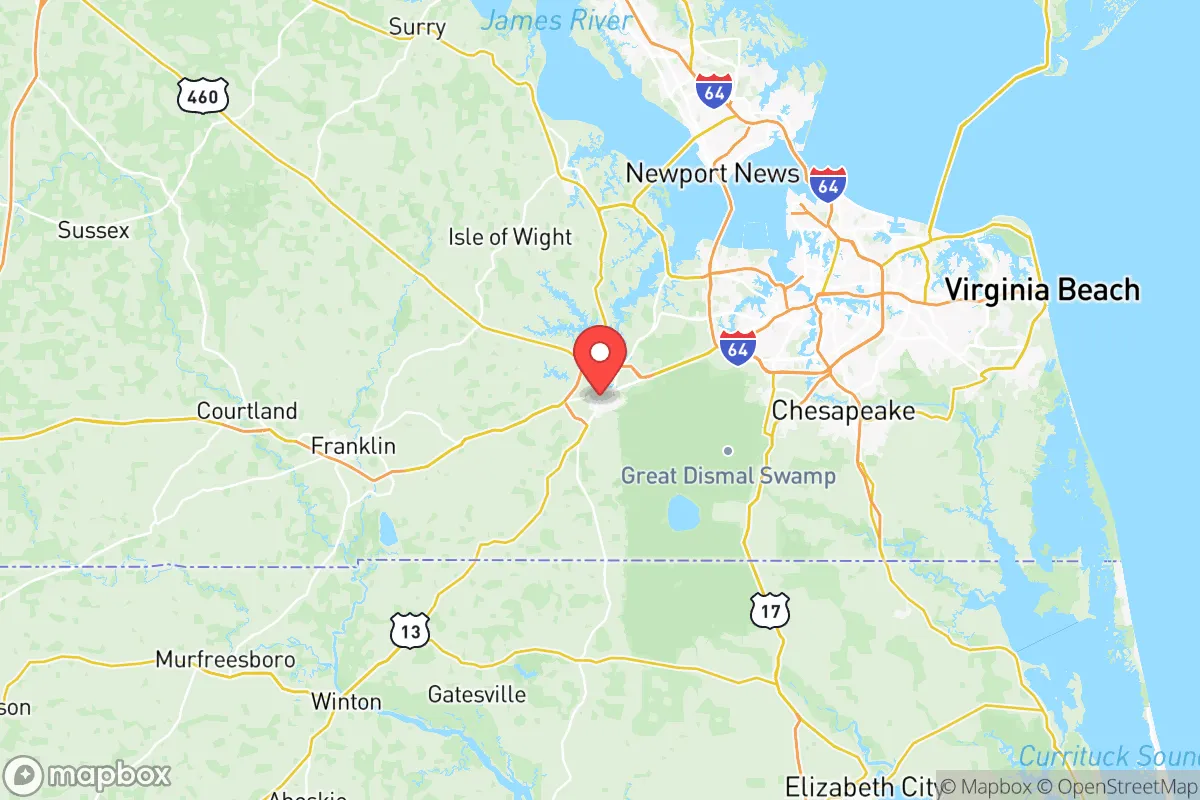
Suffolk City County, Virginia, presents a nuanced personal sovereignty environment that blends Virginia’s traditional commonwealth legal framework with a rapidly suburbanizing landscape. While the city itself operates under a council-manager government with moderate regulatory oversight, its location in the Hampton Roads region and proximity to the Great Dismal Swamp create pockets where self-reliance is more feasible than in denser urban cores like Norfolk or Virginia Beach. For individuals and families prioritizing autonomy, the key trade-offs involve navigating state-level preemptions on gun laws and property rights against local zoning codes that increasingly favor planned developments over rural homesteads.
Tax burden and regulatory posture in Suffolk City County
Virginia’s tax structure is generally favorable for those seeking lower fiscal interference, but Suffolk’s local add-ons require scrutiny. The state income tax is a flat 5.75% on all taxable income, with no local income tax—a clear advantage over states like Maryland or New York. Property taxes in Suffolk are assessed at a rate of $1.05 per $100 of assessed value (2025 rate), which is competitive within Hampton Roads but higher than rural counties like Isle of Wight or Southampton. The city’s regulatory posture is moderate: building permits are required for most structural changes, and the zoning code enforces minimum lot sizes of 20,000 square feet in agricultural districts (A-1) and 10,000 square feet in suburban residential zones (R-7). This is lighter than the 5,000-square-foot minimums common in Chesapeake or Virginia Beach, but heavier than unincorporated areas of Surry County to the west. Business licensing is straightforward for home-based enterprises, though the city does require a business tax receipt for any operation generating over $2,000 in annual gross receipts. For those seeking minimal regulatory friction, the rural northern reaches near Holland and Whaleyville offer more lenient enforcement than the southern corridor along Route 58 near Downtown Suffolk and Harbour View.
Self-defense and gun law specifics in Suffolk City County
Virginia is a “shall-issue” state for concealed handgun permits, meaning Suffolk’s circuit court must issue a permit to any qualified applicant who passes a background check and completes a 10-hour training course. The city itself has no additional firearm ordinances beyond state law—no magazine capacity limits, no assault weapon bans, and no waiting periods beyond the state’s instant background check system. Open carry is legal for anyone 18 or older who can legally possess a firearm, though local police in Downtown Suffolk and Harbour View may respond to calls from unfamiliar residents. The state preempts all local gun regulations, so Suffolk cannot enact its own bans or restrictions—a critical protection for gun owners. Stand-your-ground laws apply statewide, with no duty to retreat in any place where a person has a legal right to be. However, Virginia does require a five-day waiting period for handgun purchases (effective July 2023), and private sales now require a background check through a licensed dealer. For those prioritizing self-defense, the rural areas around Driver and Nansemond offer more privacy for range practice on private land, while the suburban neighborhoods near Kings Fork have stricter homeowners’ association rules that may restrict firearm storage or discharge.
Self-reliance and homesteading viability in Suffolk City County
Homesteading potential varies dramatically across Suffolk’s 430 square miles. The city’s agricultural zoning (A-1) permits livestock, poultry, and crop cultivation on lots of at least 20,000 square feet, with no limit on the number of animals as long as waste management and noise ordinances are followed. Areas like Whaleyville and Holland still have working farms and active 4-H programs, making them viable for serious homesteaders. Off-grid living is legally constrained: Virginia law requires connection to public water and sewer where available, but in rural Suffolk, many properties rely on private wells and septic systems. The city does not mandate grid-tied electricity, so solar panels with battery storage are permissible, though building permits are required for structural installations. Rainwater collection is legal and encouraged, with no state-level restrictions. However, Suffolk’s zoning code prohibits “primitive” dwellings—any habitable structure must meet the Virginia Uniform Statewide Building Code, which effectively bans tiny houses on wheels or yurts as primary residences. For those seeking maximum self-reliance, the unincorporated areas near Chuckatuck and Bennett’s Creek offer the best balance of large lots (1-5 acres common) and minimal code enforcement, while the planned communities around Eclipse and North Suffolk have HOA covenants that restrict livestock, outbuildings, and even clotheslines.
Personal liberties in Suffolk City County
Parental rights in Virginia are generally strong, with state law affirming parents’ authority to direct their children’s education and medical care. Suffolk Public Schools allows homeschooling under the state’s homeschool statute (Code of Virginia §22.1-254.1), requiring only a notice of intent and a basic curriculum description—no standardized testing or portfolio review is mandated. Medical autonomy is more constrained: Virginia requires parental consent for minors’ medical treatment, but the state’s vaccine mandate for school attendance (including COVID-19 and HPV for certain grades) has been a flashpoint for families seeking opt-outs. Religious exemptions are available but require a notarized statement from a clergy member. Speech and property rights are protected under the Virginia Constitution, which includes a specific provision for free exercise of religion. Suffolk has no local noise ordinances that restrict amplified speech beyond state nuisance laws, and the city’s sign code allows political yard signs 30 days before an election and 7 days after. Property rights are bolstered by Virginia’s right-to-farm law, which protects agricultural operations from nuisance lawsuits if they have been operating for more than one year—a key protection for homesteaders near suburban encroachment. However, Suffolk’s comprehensive plan designates large swaths of land for future residential development, meaning property taxes may rise as land values increase, particularly near Harbour View and North Suffolk.
Overall, Suffolk City County offers a moderate-to-high level of personal sovereignty compared to other Virginia localities, especially when contrasted with the more restrictive environments of Arlington or Fairfax County. The city’s regulatory posture is lighter than urban Hampton Roads but heavier than truly rural counties like Sussex or Southampton. For families and individuals who prioritize self-defense, homesteading, and parental rights, the northern and western rural areas—Whaleyville, Holland, Driver, and Chuckatuck—provide the greatest autonomy, while the suburban southern corridor near Harbour View and Downtown Suffolk offers convenience at the cost of tighter zoning and HOA restrictions. The key takeaway for relocation-minded readers: Suffolk is a viable option for those seeking a balance of personal freedom and access to coastal Virginia’s economy, but the specific neighborhood choice will determine how much of that sovereignty is realized in daily life.

* Values derived from national, state, county, city and local statistics and may differ in a specific area. Last updated: 2026-07-12T08:27:54.000Z
Narrative content on this page is AI-generated and may contain mistakes. Verify any details that matter before acting on them.
ReloMaps may earn a commission from affiliate links at no extra cost to you.

