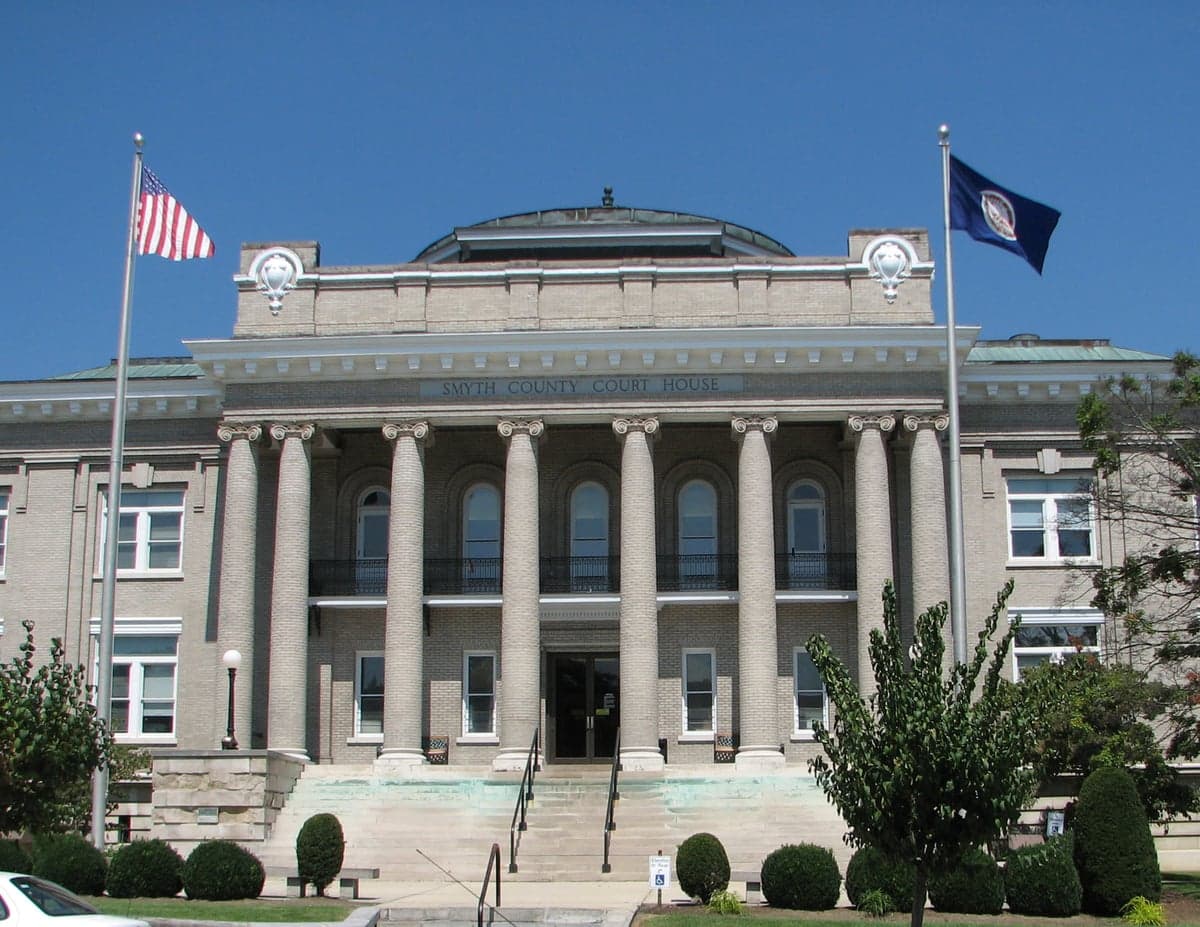
Photo: Wikipedia
Political ClimatePolitical Climate in Smyth County
Showing county-level results — no local-only data available.
Lean and PVI are calculated from this county’s 2020 and 2024 presidential results, Cook-style.
Political rankings in Virginia
- Most Conservative Cities in Virginia
- Most Liberal Cities in Virginia
- Best Liberal-Leaning Towns in the South
- Best Liberal-Leaning Towns in Appalachia
- Best Conservative-Leaning Towns in the Mid-Atlantic
- Safest Liberal-Leaning Towns in the South
- Safest Conservative-Leaning Towns in the South
- Safest Conservative-Leaning Towns on the East Coast
- Most Conservative Counties in Virginia
- Most Liberal Counties in Virginia
Local Political AnalysisPolitical Analysis of Smyth County
Smyth County, Virginia, is a deeply conservative stronghold with a Cook Partisan Voting Index of R+22, meaning it votes about 22 points more Republican than the national average. This stands in stark contrast to Virginia as a whole, which has shifted to a D+4 rating, reflecting the influence of the fast-growing, vote-rich suburbs of Northern Virginia and Richmond. While the state has trended blue over the past two decades, Smyth County has only dug in deeper, with Republican presidential candidates routinely winning here by 40-point margins or more. The county’s political identity is rooted in its rural, working-class character, with a strong tradition of support for conservative economic and social policies.
How it compares
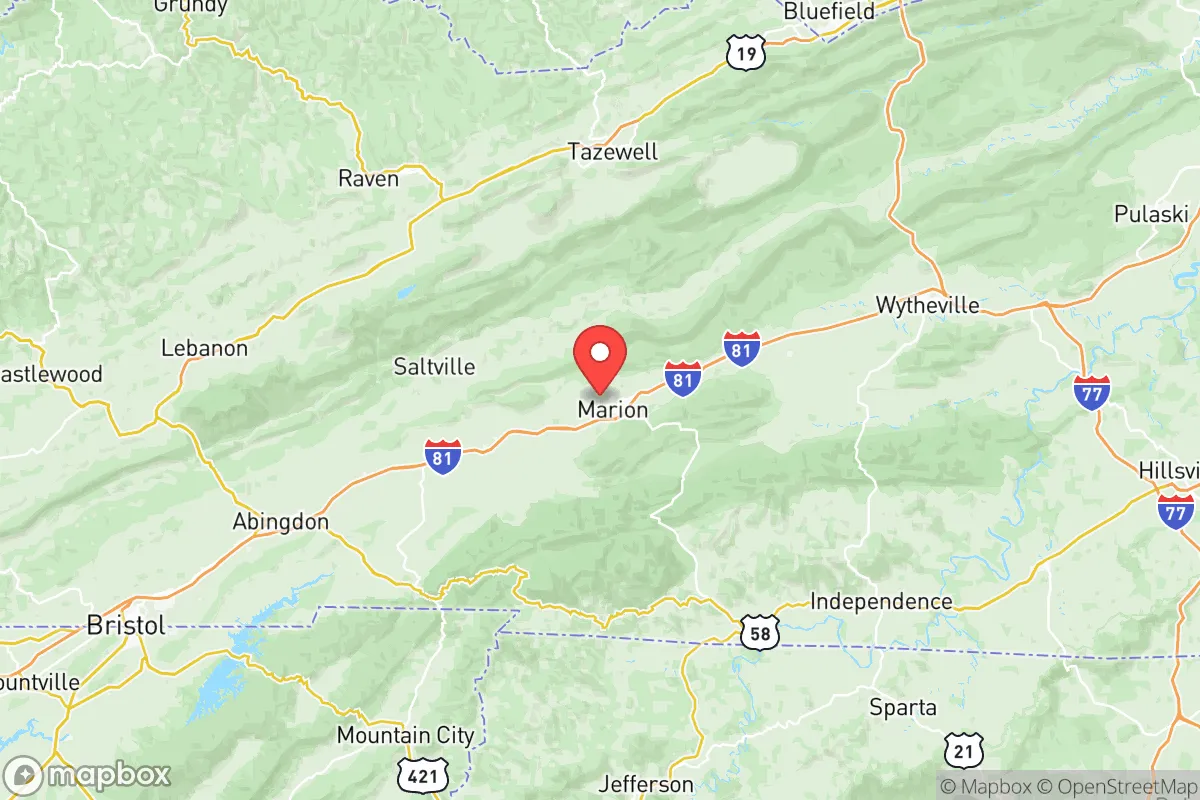
The gap between Smyth County and the rest of Virginia is one of the widest in the state. While the commonwealth’s D+4 rating is driven by the Democratic strongholds of Fairfax County, Arlington, and Alexandria, Smyth County’s R+22 places it among the most Republican-leaning counties in Southwest Virginia. Within the county itself, there is some variation. The town of Marion, the county seat and home to the largest population center, tends to be slightly more moderate, with pockets of Democratic-leaning voters, particularly around the historic downtown and near the Virginia Highlands Community College campus. In contrast, Chilhowie and Saltville are reliably deep red, often delivering 70-75% of the vote for Republican candidates. The swing precincts are few and far between, but the Atkins area and parts of rural Rural Retreat can occasionally see closer races in local elections, especially when a popular independent or moderate Democrat runs for county supervisor. Statewide, Smyth County’s votes are almost entirely symbolic in statewide races—its Republican margins are easily swamped by the blue wave from Northern Virginia.
What this means for residents
For conservative residents, Smyth County feels like a political safe haven. Local government, school boards, and law enforcement are overwhelmingly Republican, and conservative values are the default in public discourse. Gun rights, lower taxes, and traditional social policies are widely supported. For liberal or moderate residents, the reality is more isolating. They often feel politically invisible, with few like-minded neighbors and little representation in local office. However, the county is not a monolith—Marion’s small but active Democratic committee and the presence of a few progressive-leaning faculty at Virginia Highlands College provide some counterbalance. In practice, most political disagreements here are civil, as neighbors tend to prioritize community ties over partisan fights, but the cultural divide with the rest of Virginia is palpable. When state policy shifts left—on gun laws, education funding, or environmental regulations—Smyth County often feels it is being governed by a distant, alien force in Richmond.
Culturally, Smyth County stands apart from the rest of Virginia in its slower pace of life, strong church attendance, and emphasis on local traditions like the Wayne C. Henderson Music Festival and the Hungry Mother State Park. There is a palpable skepticism of the rapid growth and progressive politics seen in Northern Virginia, and many residents feel the state government does not understand or care about rural communities. This has fueled a quiet but persistent undercurrent of support for local control and even occasional talk of secession from the state, though that remains fringe. For anyone moving here, the key takeaway is simple: if you lean conservative, you will feel right at home; if you lean liberal, you will need to find your community in Marion or through regional networks in nearby Abingdon or Bristol. The county’s political trajectory shows no signs of moderating, and as Virginia continues to trend blue, Smyth County will only become more of an outlier—a place where the old Virginia still lives on, for better or worse.

State Political ClimatePolitical Climate in Virginia
State Political AnalysisPolitical Environment in the State
Virginia has shifted from a reliably purple swing state to a solidly Democratic-leaning one, with a Cook PVI of D+4, driven primarily by explosive growth in the Washington, D.C. suburbs. Over the last 10-20 years, the state has moved decisively leftward at the presidential and statewide level, though it still elects Republican governors in off-years and maintains a deeply divided legislature. The dominant coalition is a mix of urban professionals, federal employees, and minority voters in Northern Virginia, Richmond, and Hampton Roads, while the rest of the state—particularly Southside, Southwest, and the Shenandoah Valley—remains staunchly Republican. This isn't a deep-blue state like Maryland or Massachusetts; it's a state where the political center of gravity has moved, but the fight is still real.
Urban vs. rural divide
The political map of Virginia is a tale of two commonwealths. The Democratic stronghold is Northern Virginia, specifically the counties of Fairfax, Loudoun, Prince William, and Arlington, plus the cities of Alexandria and Falls Church. These areas are home to a dense concentration of federal employees, tech workers, and immigrants, and they vote Democratic by margins of 20-40 points. Richmond and Hampton Roads (Norfolk, Virginia Beach, Newport News) are also reliably blue, though Virginia Beach is more competitive. In contrast, the rural Southside (Danville, Martinsville) and Southwest Virginia (Bristol, Abingdon, Wise) vote Republican by similar margins. The Shenandoah Valley (Harrisonburg, Staunton, Winchester) is a mix—Harrisonburg is a blue island due to its university and immigrant population, while the surrounding counties are deep red. The key battleground has been the exurban crescent around Richmond and the I-95 corridor, where fast-growing counties like Spotsylvania and Stafford have flipped from red to purple to light blue over the past decade. The 2021 gubernatorial election saw Republican Glenn Youngkin win by running up huge margins in rural areas and holding the suburbs closer than expected, but the underlying demographic trend favors Democrats as Northern Virginia continues to grow.
Policy environment
Virginia's policy environment is a patchwork of progressive and conservative elements, reflecting its divided government. The state has a flat income tax rate of 5.75% and a sales tax of 5.3% (higher in some localities), which is moderate by national standards. Property taxes are set locally and vary widely—Loudoun County has some of the highest rates in the state, while Pittsylvania County is much lower. The regulatory posture is business-friendly in some areas (right-to-work state, no state-level minimum wage above federal until 2021), but has become more progressive on labor and environmental issues under Democratic control. Education policy is a flashpoint: the state has a strong public school system, but recent battles over critical race theory, transgender policies, and library books have been intense. Youngkin's 2022 executive order on "inherently divisive concepts" and the subsequent fight over the state's history standards show the divide. Healthcare is a mixed bag: Virginia expanded Medicaid under the Affordable Care Act in 2018, but the state does not have a public option. Election laws are relatively accessible—no-excuse absentee voting, same-day registration, and early voting are all available—but voter ID is required. The state has no stand-your-ground law, but it does have a "castle doctrine" and permits open carry of handguns without a permit as of 2021.
Recent policy direction
The last five years have seen Virginia lurch leftward on social and criminal justice issues, then partially pull back under Youngkin. On gun and self-defense law, Democrats passed a package of gun-control bills in 2020—including universal background checks, a red-flag law, and a one-handgun-per-month limit—but Youngkin has not been able to roll them back due to a Democratic-controlled Senate. On parental and education rights, Youngkin issued executive orders banning critical race theory in K-12 schools and creating a tip line for parents to report "divisive" teaching, though the practical impact has been limited. On speech and privacy, Virginia passed the Consumer Data Protection Act in 2021, one of the strongest state-level privacy laws in the country. On medical and bodily autonomy, the state has become a haven for abortion access in the South, with no gestational limit on abortion until the third trimester, and a 2020 law removing many restrictions on clinics. On property rights, Virginia has no statewide rent control, but localities can impose it, and the state has a strong eminent domain framework. On taxation, Youngkin proposed a 1% cut to the income tax rate in 2023, but it was blocked by Democrats. On voting and ballot access, the state has moved toward easier access—no-excuse absentee voting was made permanent in 2021—but the 2020 election saw intense controversy over ballot drop boxes and signature verification, leading to a 2021 law requiring photo ID for absentee ballots.
Civil unrest & political movements
Virginia has been a flashpoint for political movements on both sides. The 2017 Unite the Right rally in Charlottesville remains a defining moment, leading to a statewide ban on firearms at public demonstrations and a push to remove Confederate monuments. The 2020 George Floyd protests in Richmond saw the toppling of a statue of Jefferson Davis and a sustained occupation of the Capitol grounds. On the right, the 2021 "Parents Matter" movement in Loudoun County—sparked by a sexual assault case in a school bathroom—galvanized suburban conservatives and helped elect Youngkin. Immigration politics are less heated than in border states, but Prince William County has been a battleground over sanctuary policies, with the board of supervisors flipping between pro- and anti-sanctuary positions. Election integrity remains a live issue: the 2020 election saw no widespread fraud, but Republican activists continue to push for stricter voter ID and ballot security measures. The 2022 "Virginia Way" movement, a coalition of moderate Republicans and business groups, has tried to steer the party away from culture wars, with mixed success.
Projection
Over the next 5-10 years, Virginia will likely continue its slow drift leftward, but not as fast as some predict. The key demographic driver is Northern Virginia, which is adding population faster than the rest of the state and is becoming more diverse and more Democratic. The exurban counties around Richmond and the I-95 corridor are also trending blue, though more slowly. However, the state's off-year election cycle—where turnout is lower and more Republican—means that the governorship and legislature will remain competitive. A conservative relocator moving to Virginia Beach or Chesterfield County today can expect to see their area become more purple over the next decade, while someone moving to Loudoun County will find themselves in an increasingly blue environment. The wild card is the federal workforce: if the next president moves many federal jobs out of the D.C. area, Northern Virginia's growth could slow, and the state could become more competitive. But the baseline expectation is a state that is D+4 today and D+6 or D+7 by 2035.
For a new resident, the bottom line is this: if you're conservative, you'll find plenty of like-minded communities in the Shenandoah Valley, Southside, or Southwest Virginia, but you'll be living in a state where the governor's mansion and the legislature are often controlled by the other side. If you're liberal, you'll feel at home in Northern Virginia or Richmond, but you'll need to accept that the state's rural areas are deeply conservative and that statewide elections are still competitive. Virginia is not a place where either side can take victory for granted—it's a state where the fight is ongoing, and your vote actually matters.
* Values derived from national, state, county, city and local statistics and may differ in a specific area. Last updated: 2026-11-05T03:08:38.000Z
Narrative content on this page is AI-generated and may contain mistakes. Verify any details that matter before acting on them.
ReloMaps may earn a commission from affiliate links at no extra cost to you.

