
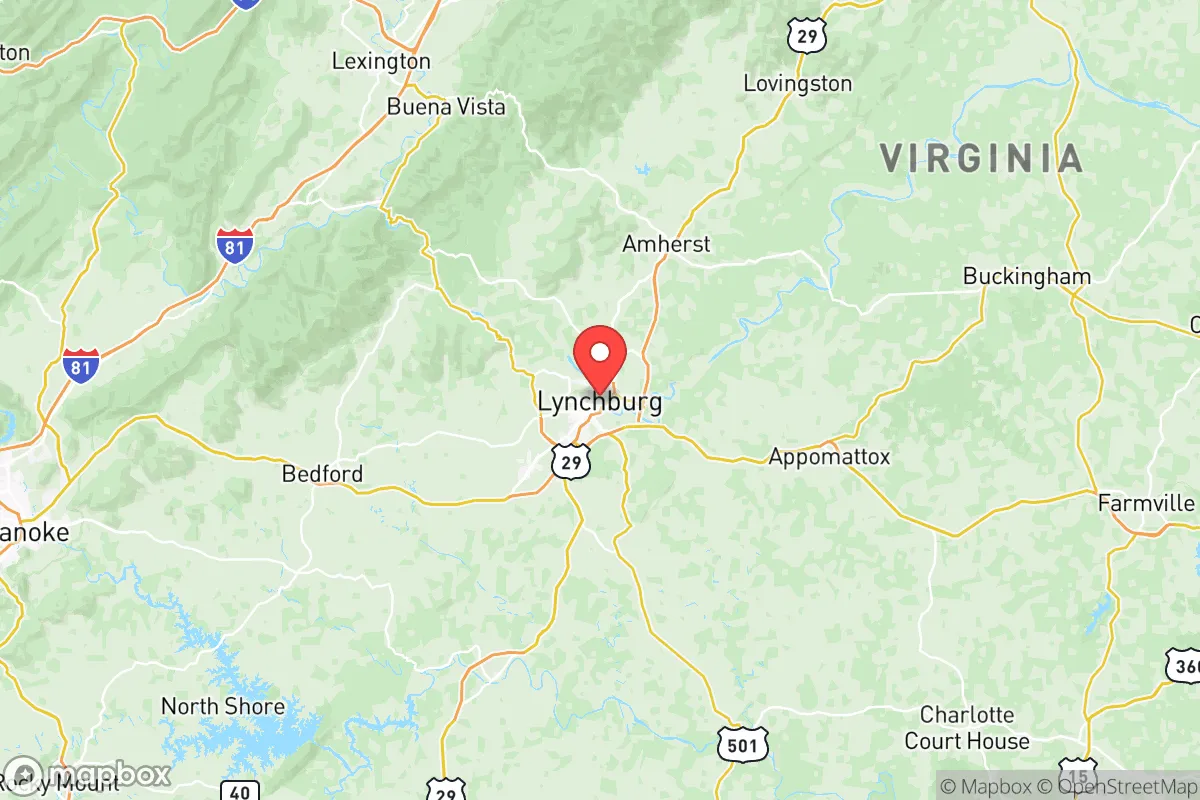
Photo by Lukas Souza on Unsplash
Political ClimatePolitical Climate in Lynchburg City County
Showing district-level results — no local-only data available.
Local Political AnalysisPolitical Analysis of Lynchburg City County
Lynchburg City County leans solidly Republican, carrying a Cook Partisan Voting Index of R+6, which puts it about ten points to the right of Virginia as a whole, where the statewide PVI is D+4. That gap isn't just a number — it means Lynchburg has voted for the GOP presidential candidate by comfortable margins in every election this century, while the state has swung blue in four of the last five cycles. The city itself is a conservative stronghold in a region that's even redder, but it's not a monolith: the precincts around the University of Lynchburg and Liberty University's campus often split, with student-heavy areas and some downtown neighborhoods showing more competitive numbers, while the western and southern edges of the city — places like the Boonsboro and Fort Hill areas — vote reliably Republican by double digits.
How it compares
Virginia's D+4 statewide PVI masks a deep urban-rural divide. Lynchburg's R+6 puts it in the same conservative tier as places like Roanoke County and the Shenandoah Valley, but it's notably more Republican than the state's major metros: Richmond (D+12), Northern Virginia's Fairfax County (D+18), and Virginia Beach (D+2). What makes Lynchburg distinct is that its Republican lean is both longstanding and culturally reinforced — Liberty University, the city's largest employer and a major evangelical institution, has a visible influence on local politics, from city council races to school board elections. That said, the city has drifted slightly leftward since 2016, mirroring a national trend among college towns; the Democratic share of the presidential vote in Lynchburg has crept up from about 33% in 2012 to roughly 40% in 2024, while the surrounding rural counties of Bedford and Campbell remain deeply red, often voting 70%+ Republican.
What this means for residents
For conservative residents, Lynchburg's political climate means local government and school policy generally align with their values — the city council has been majority Republican for decades, and social conservative positions on issues like abortion and religious freedom are common in public discourse. For liberal residents, the reality is more about finding community in specific pockets: the downtown arts district, the neighborhoods around Rivermont Avenue, and the university areas tend to be more politically mixed, and there are active Democratic and progressive groups that organize around affordable housing and environmental issues. Practically, the political lean affects things like tax policy — Lynchburg's real estate tax rate is $1.11 per $100 of assessed value, lower than Richmond's $1.20 and well below Northern Virginia rates — and development priorities, with the city emphasizing business-friendly zoning and infrastructure over transit or public housing expansions.
Culturally, Lynchburg's conservatism is more traditional than confrontational — it's a place where church attendance is high, gun ownership is common, and the phrase "Virginia is for lovers" feels less applicable than "Virginia is for liberty." The city has a dry history (it was officially dry until 2004, and some precincts still vote against alcohol sales in referendums), and while you can now buy beer and wine in grocery stores, the local restaurant scene reflects a family-friendly, non-nightlife ethos. For newcomers, the biggest adjustment is often the pace: Lynchburg is a city of about 80,000 that feels smaller, where political disagreements are usually civil and the biggest local controversies involve development projects or school funding rather than culture war flashpoints. The trajectory is toward slow, steady diversification — both demographically and politically — but the R+6 PVI is likely to hold for the foreseeable future, anchored by the university's institutional weight and the surrounding rural counties' deep Republican roots.

State Political ClimatePolitical Climate in Virginia
State Political AnalysisPolitical Environment in the State
Virginia has shifted from a reliably purple swing state to a solidly Democratic-leaning one over the past two decades, carrying a Cook PVI of D+4. The transformation has been driven primarily by explosive population growth in the Washington, D.C. suburbs, which now dominate state elections and have pulled the state legislature and governorship leftward. While the state still elects Republican governors in off-years—Glenn Youngkin won in 2021—the underlying trend is clear: the urban crescent from Northern Virginia down through Richmond to Hampton Roads now sets the political agenda, and the rural south and southwest have lost influence proportionally.
Urban vs. rural divide
The political map of Virginia is a textbook case of the urban-rural split. The D.C. suburbs—Arlington, Alexandria, Fairfax County, and Loudoun County—are the engine of Democratic power, producing massive vote margins that swamp the rest of the state. Fairfax County alone cast over 500,000 votes in the 2024 presidential election, with Democrats winning it by roughly 40 points. Richmond and Norfolk/Virginia Beach add another layer of Democratic strength, while college towns like Charlottesville (home to UVA) and Blacksburg (Virginia Tech) are reliably blue. In contrast, rural and exurban areas—Roanoke, Lynchburg, the Shenandoah Valley, and Southside Virginia—vote heavily Republican. A notable recent shift: Prince William County, once a bellwether, has moved decisively Democratic as its population has diversified and become more suburban. The result is a state where statewide Democrats rarely lose, but Republicans hold most of the legislative seats outside the I-95 corridor.
Policy environment
Virginia's policy environment reflects its divided government and recent Democratic control. The state income tax is a flat 5.75%, with a standard deduction that has been gradually increased. Sales tax is 5.3% (plus local add-ons), and property taxes are set locally, averaging around 0.8-1.0% of assessed value—moderate by national standards. Under Governor Youngkin, the state eliminated the 1.5% grocery tax and suspended the gas tax for a period, but the Democratic legislature has resisted broader tax cuts. Education policy is a major battleground: Youngkin pushed for expanded school choice and "parental rights" in curriculum, while Democrats have defended public school funding and opposed voucher expansion. Healthcare policy leans left: Virginia expanded Medicaid under the ACA in 2018, and the state has some of the strongest insurance market regulations in the South. Election laws are moderately accessible: no-excuse absentee voting, same-day registration, and early voting are all available, but voter ID is required. The state does not have a "stand your ground" law, and gun laws have tightened under Democratic control, including universal background checks and a "red flag" law passed in 2020.
Recent policy direction
The last five years have seen Virginia move decisively left on several fronts, though with some moderation under Youngkin. On gun and self-defense law, the 2020 Democratic trifecta passed a package including universal background checks, a one-handgun-per-month limit, and a red flag law; concealed carry remains shall-issue, but permitless carry was rejected. Parental and education rights have been a flashpoint: Youngkin's 2021 campaign centered on critical race theory and transgender policies in schools, and his administration issued model policies requiring parental notification of LGBTQ+ curriculum changes, though local school boards vary widely. Medical and bodily autonomy is a key differentiator: Virginia has codified abortion access up to 26 weeks, with no waiting period or mandatory counseling, making it one of the most protective states in the South. Property rights are generally strong, though zoning reform is a live issue in Northern Virginia, where housing costs have soared. Voting and ballot access expanded under Democratic control: no-excuse absentee voting, 45 days of early voting, and automatic voter registration at the DMV are now law. The overall direction is a state that protects individual liberties on the left's terms (abortion, voting access) while restricting them on the right's (guns, school choice), creating a patchwork that depends heavily on which party controls the governorship.
Civil unrest & political movements
Virginia has been a stage for some of the most visible political flashpoints in the country. The 2017 "Unite the Right" rally in Charlottesville and the subsequent violence left a lasting scar and made the city a symbol of racial and political conflict. In 2020, Richmond saw massive protests following George Floyd's murder, including the toppling of Confederate statues on Monument Avenue, which the state later removed entirely. The debate over Confederate memorials remains active in smaller cities like Danville and Fredericksburg. On the right, the "parents' rights" movement has been particularly strong in Loudoun County, where school board meetings became national news over transgender policies and COVID-19 restrictions. Immigration politics are less heated than in border states, but Northern Virginia's sanctuary policies—Fairfax County limits cooperation with ICE—are a recurring legislative target. Election integrity controversies flared after 2020, with some rural counties calling for audits, but no major fraud was found. The overall climate is one of high political engagement and occasional street-level conflict, but most of the state is calm day-to-day, with the tension concentrated in the suburbs and college towns.
Projection
Over the next 5-10 years, Virginia will likely continue its leftward drift, but at a slower pace. The D.C. suburbs are still growing, and the demographic trends—more college-educated, more diverse, more secular—favor Democrats. However, the state's off-year gubernatorial elections (2025, 2029) give Republicans a recurring chance to win, as they did with Youngkin. The key question is whether the rural-urban divide will widen or stabilize. If Northern Virginia continues to grow and the rest of the state stagnates, the Democratic lean will deepen. If remote work disperses population to smaller cities like Harrisonburg or Winchester, the map could shift slightly. On policy, expect continued battles over education funding, gun laws, and abortion access, with the outcome depending on who holds the governor's mansion. A new resident moving in now should expect a state where their local experience will vary dramatically by county: a conservative family in Virginia Beach will live under different school policies and tax rates than a liberal one in Arlington.
For a relocator, the bottom line is that Virginia offers a genuinely mixed political environment. If you lean conservative, you'll find like-minded communities in the Shenandoah Valley, Southside, and parts of Hampton Roads, but you'll be voting in a state where your preferred candidates rarely win statewide. If you lean liberal, you'll feel at home in the suburbs and cities, but you'll pay higher taxes and housing costs. The state's political climate is best understood as a series of local realities rather than a single statewide culture, and your experience will depend more on your chosen county than on the state as a whole.
* Values derived from national, state, county, city and local statistics and may differ in a specific area. Last updated: 2026-06-15T20:40:40.000Z
Narrative content on this page is AI-generated and may contain mistakes. Verify any details that matter before acting on them.
ReloMaps may earn a commission from affiliate links at no extra cost to you.

