
Photo by Lukas Souza on Unsplash
Quality of Life in Lynchburg City County
A livable area that tracks near national norms for affordability, walkability, and neighborhood health.
What does Quality of Life tell us?
Quality of Life measures an area by evaluating factors like cost of living, nearby amenities, country club access, airport proximity, socioeconomic signals and neighborhood character. For large states, this is a general average — quality of life can vary dramatically between metro areas, suburbs, and rural communities within the same state.
What does this tell us?
Quality of Life measures an area by evaluating factors like cost of living, nearby amenities, country club access, airport proximity, socioeconomic signals and neighborhood character. For large states, this is a general average — quality of life can vary dramatically between metro areas, suburbs, and rural communities within the same state.
Cost of Living
16% below national average
99%
The Real Cost of Living in Lynchburg City County for 2026
| Tier | Individual | Family (4) |
|---|---|---|
| Survival | $17k | $31k |
| Comfortable | $41k | $60k |
| Luxury | $107k+ | $165k+ |
| Elite (Top 5%) | $125k+ | $195k+ |
Quality-of-Life Analysis
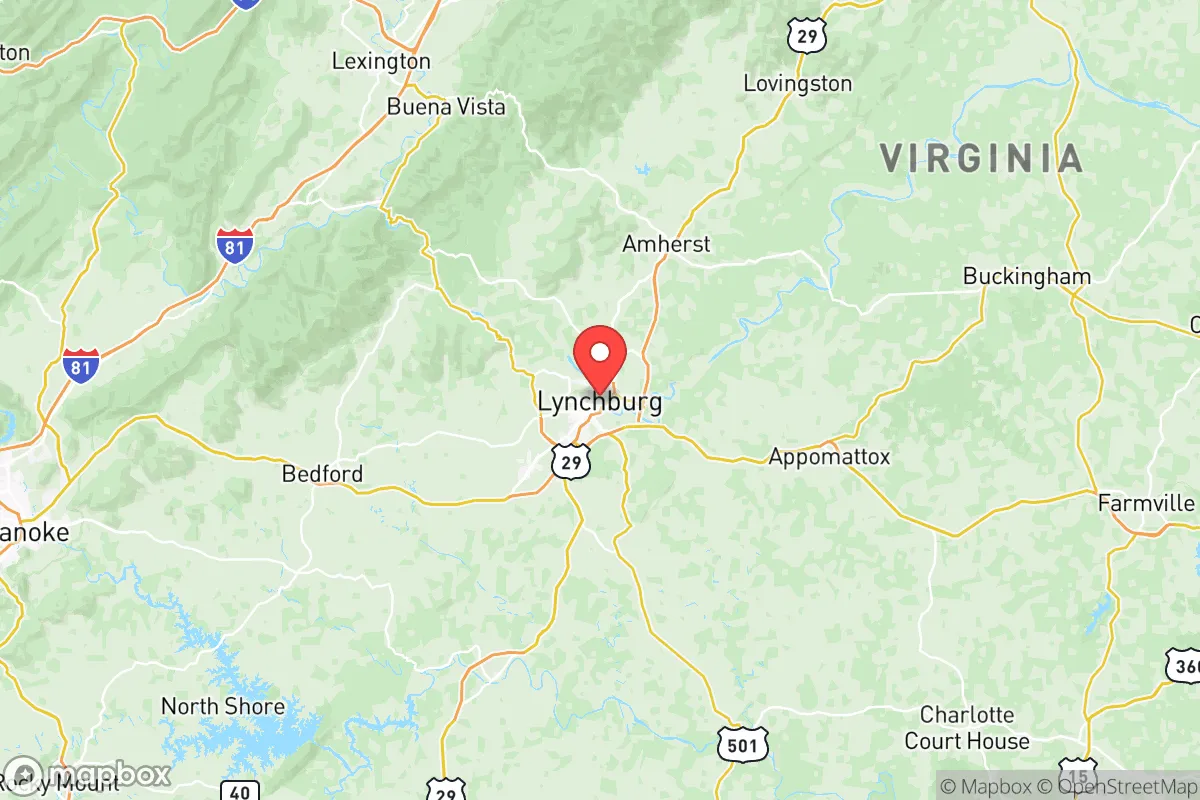
Lynchburg City County, Virginia, is a geographically compact independent city that functions as a self-contained county-equivalent, offering a surprisingly broad spectrum of quality-of-life options within its 49 square miles. The county draws a diverse mix of residents: college students and academics affiliated with its five institutions of higher learning, healthcare professionals tied to the region's major medical systems, and families seeking affordable homeownership in a mid-sized Southern city. The character shifts noticeably from the walkable, historic core of downtown to the suburban-style neighborhoods along the Wards Road corridor and the more rural, wooded fringes near the city's boundaries with Bedford and Campbell counties.
Largest town(s) & population centers
The city of Lynchburg itself is the sole incorporated municipality and the dominant population center, home to roughly 80,000 residents. Daily life here is defined by a compact urban core and distinct commercial corridors. Downtown Lynchburg, centered around Church Street and the James River waterfront, has seen a revival with loft apartments, breweries like Three Roads Brewing, and the Academy Center of the Arts. This area appeals to professionals and Liberty University faculty who want walkability. The Wards Road and Candlers Mountain Road corridors form the city's primary retail and commercial spine, anchored by River Ridge Mall and big-box stores; this area is heavily trafficked by Liberty University students and families living in nearby subdivisions like Boonsboro and Fort Hill. The historic Boonsboro neighborhood offers tree-lined streets and older homes, while the area around Lynchburg General Hospital and Centra's medical campus draws healthcare workers who value a short commute — the city's average commute is just under 17 minutes, well below the national average.
Smaller towns & rural pockets
While Lynchburg City County has no separately incorporated towns, several distinct neighborhoods and unincorporated communities create a small-town feel within the city limits. The historic Diamond Hill neighborhood, just south of downtown, features restored Victorian homes and a growing arts scene. The Tinbridge Hill area, near the city's western edge, retains a quieter, almost rural character with older ranch-style homes on larger lots. The city's southern reaches, near the Campbell County line, transition into wooded, low-density residential pockets where properties often sit on an acre or more. These areas lack sidewalks and streetlights, offering a semi-rural lifestyle while still being within a 10-minute drive of grocery stores and schools. The community of Forest, though technically just over the line in Bedford County, is closely tied to Lynchburg's daily life and represents the suburban-rural fringe that many residents seek when they want more land without leaving the city's orbit.
Cost & lifestyle range
The cost of living across Lynchburg City County is consistently low by national standards, with a composite index of 84 (100 = U.S. average), but the range of housing options creates meaningful lifestyle differences. At the lower end, neighborhoods like Fairview Heights and parts of the Fifth Ward offer median home values well below the citywide median of $211,800, with some fixer-upper homes available in the $120,000–$150,000 range. Median rent sits at $1,043, making apartments near Liberty University or downtown affordable for students and young professionals. At the upper end, the Boonsboro and Rivermont historic districts feature homes in the $350,000–$600,000 range, with larger lots and proximity to the James River. The Wards Road area offers newer townhomes and apartments with rents closer to $1,200–$1,400, appealing to those who want modern amenities and retail access. Property taxes are moderate, and Virginia's income tax structure is flat, so the overall tax burden remains manageable across all income levels. The trade-off is clear: lower-cost areas may have older housing stock and fewer nearby amenities, while pricier neighborhoods offer walkability, historic character, or newer construction.
Lynchburg City County works best for people who want the affordability and convenience of a mid-sized Southern city without sacrificing access to higher education, healthcare employment, or outdoor recreation along the James River. Families and retirees who prioritize a low cost of living and short commutes will find the city's suburban and rural pockets appealing, while students and professionals drawn to the downtown revival will appreciate the walkable core. The county's compact size means that no matter where you live, you are rarely more than 20 minutes from work, school, or the Blue Ridge Parkway.

Crime in Lynchburg City County
Generally safer than 60% of comparable U.S. locations.
Violent CrimeViolent Crime Analysis
Property CrimeProperty Crime Analysis
Crime Analysis
Lynchburg City County, Virginia, reports a violent crime rate of 209 incidents per 100,000 residents and a property crime rate of 1,389.4 per 100,000, placing it in a moderate safety tier relative to both state and national averages. While these figures indicate a lower likelihood of violent victimization compared to many peer cities, the property crime rate warrants attention from prospective residents, particularly those considering neighborhoods near the city’s core or major transit corridors. The city’s overall safety profile is shaped by a mix of stable residential areas, a growing university population, and localized crime clusters that vary significantly by district.
Crime in context
Lynchburg’s violent crime rate of 209 per 100,000 sits well below the national average of approximately 380 per 100,000 and is roughly on par with the Virginia state average of 201 per 100,000. Property crime, at 1,389.4 per 100,000, is slightly above the state average of 1,280 but remains below the national figure of 1,954. These comparisons place Lynchburg in a more favorable position than larger Virginia metros like Richmond or Norfolk, where violent crime rates exceed 400 per 100,000. However, the city’s property crime rate is notably higher than in nearby smaller communities such as Forest and Madison Heights, which benefit from lower population density and less commercial foot traffic. The presence of Liberty University and Central Virginia Community College contributes to a transient population that can influence both crime reporting and opportunistic theft, particularly in areas adjacent to campus.
What residents experience
Residents in Lynchburg’s safer neighborhoods, such as the Boonsboro and Rivermont historic districts, report minimal violent crime and a strong sense of community watchfulness, with most incidents limited to minor property offenses like vehicle break-ins. In contrast, areas near the intersection of Fifth Street and Memorial Avenue, as well as parts of the downtown corridor around Church Street, experience higher concentrations of drug-related arrests and larceny. The city’s police department has emphasized community-oriented policing and data-driven patrol allocation, which has helped keep violent crime low even as property crime fluctuates. Lynchburg’s judicial system, operating under the Lynchburg Circuit Court, has maintained a generally conservative approach to sentencing, with local prosecutors prioritizing repeat offenders and drug-related property crime. This contrasts with more progressive jurisdictions in Northern Virginia, where lenient pretrial release policies have been linked to rising recidivism and public frustration. Residents in Lynchburg benefit from a legal environment that tends to hold offenders accountable, reducing the likelihood of chronic property crime cycles seen in cities with more permissive district attorneys.
Neighborhood-level variation is pronounced, with the safest areas concentrated in the western and southern quadrants of the city. The Wyndhurst and Peakland neighborhoods, for example, report violent crime rates below 100 per 100,000 and property crime rates under 800 per 100,000, making them comparable to the safest suburbs in the region. Conversely, the Fairview Heights and Tinbridge Hill areas experience elevated property crime, driven largely by proximity to major thoroughfares and lower median household incomes. Prospective residents should examine block-level data for specific streets, as Lynchburg’s crime distribution is highly localized. Overall, the city offers a balanced safety profile for those who choose established residential districts, while caution is warranted in higher-traffic zones and older commercial corridors where property crime is more common.
* Values derived from national, state, county, city and local statistics and may differ in a specific area. Last updated: 2026-06-15T20:40:40.000Z
Narrative content on this page is AI-generated and may contain mistakes. Verify any details that matter before acting on them.
ReloMaps may earn a commission from affiliate links at no extra cost to you.

