
Photo by Lukas Souza on Unsplash
Demographics of Lynchburg City County
Affluence Level in Lynchburg City County
A middle-class area roughly in line with national averages across income, home values, education, and employment.
People of Lynchburg City County
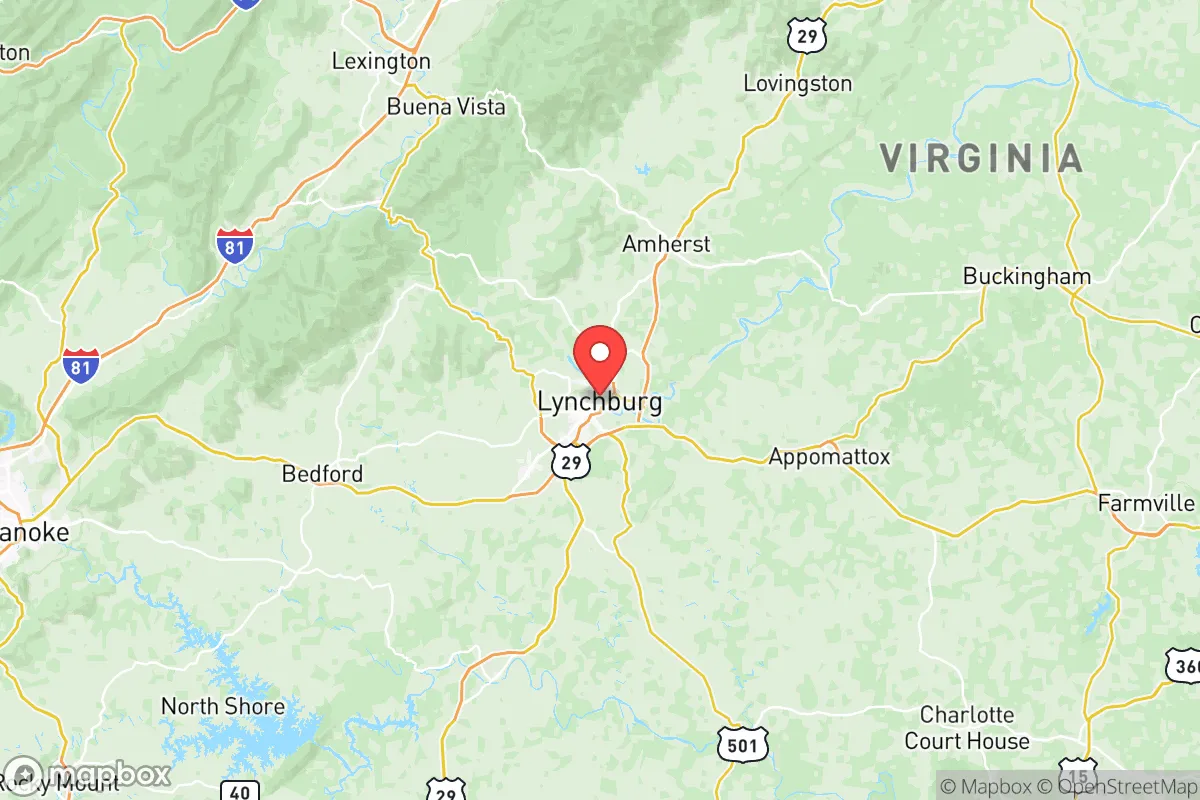
Lynchburg City County, Virginia, is home to 79,255 residents, a population that is 60.6% White and 27.4% Black, with a small but growing Hispanic community at 4.9% and a foreign-born population of just 2.7%. The city’s character is shaped by its history as a manufacturing and transportation hub in the foothills of the Blue Ridge Mountains, giving it a stable, working-class identity with a strong evangelical Christian influence. Unlike many Virginia cities, Lynchburg has not experienced explosive suburban growth, retaining a compact urban core surrounded by rolling hills. Its people are predominantly native-born, with a notable concentration of families who have lived in the region for generations, creating a tight-knit, socially conservative atmosphere.
Settlement & growth (pre-1960)
Long before European settlers arrived, the area now known as Lynchburg was part of the homeland of the Monacan people, a Siouan-speaking tribe who lived in villages along the James River. By the early 1700s, English colonists had pushed westward, and the Monacan were largely displaced or absorbed into other tribes. The first permanent European settlement in what is now Lynchburg City County began in the 1750s, when Scots-Irish and English farmers moved into the Piedmont region, drawn by fertile land and access to the James River. John Lynch, a Quaker, established a ferry across the James in 1757, and the settlement that grew around it was officially founded as Lynchburg in 1786.
Throughout the 19th century, Lynchburg grew as a tobacco and manufacturing center, attracting a mix of free and enslaved Black laborers who worked in the city’s tobacco warehouses and iron foundries. By 1860, nearly half of Lynchburg’s population was Black, a legacy of the plantation economy. After the Civil War, freedmen and their families concentrated in neighborhoods like Daniels Hill and Diamond Hill, where they built churches, schools, and businesses. The city’s industrial boom in the late 1800s and early 1900s—driven by railroads, iron production, and textile mills—drew White migrants from rural Appalachia and the surrounding counties of Bedford, Campbell, and Amherst. These newcomers settled in working-class districts such as Boonsboro and Fort Hill, where many descendants still live today.
Immigration to Lynchburg was minimal compared to Northern industrial cities. A small number of German and Irish immigrants arrived in the mid-1800s, but they were quickly absorbed into the broader White population. The city’s Black population remained substantial, though the Great Migration (1910–1970) saw many Black families leave for Northern cities like Philadelphia and New York. By 1960, Lynchburg was a racially divided but stable city of roughly 55,000 people, with a White majority and a Black minority concentrated in historically Black neighborhoods like Garland Hill and Fifth Street.
Modern era (post-1965)
The 1965 Hart-Cellar Act had a limited impact on Lynchburg. The city’s foreign-born population remains low at 2.7%, far below the national average. The small immigrant community that did arrive after 1965 consists primarily of East and Southeast Asian groups (1.7% of the population), including Vietnamese and Chinese families who settled in the Wards Corner and Timberlake areas. Indian subcontinent residents make up just 0.4% of the population, with most working in healthcare or academia at Liberty University or Centra Health. Hispanic residents, now 4.9% of the population, began arriving in the 1990s and 2000s, drawn by construction and service jobs; they are concentrated in the Wyndhurst and Downtown neighborhoods.
Domestic migration has been more significant. Since the 1980s, Lynchburg has attracted White families from the Rust Belt and the Northeast, seeking lower taxes, conservative values, and a slower pace of life. Many of these newcomers have settled in newer subdivisions in the Forest and Boonsboro areas, which have seen the most residential development. The city’s Black population, which was 27.4% as of the latest data, has remained relatively stable, though some younger Black families have moved to nearby counties like Campbell and Bedford for more affordable housing. Suburbanization has been modest; Lynchburg’s city limits have not expanded significantly, and the urban core has retained its historic character, with neighborhoods like Diamond Hill undergoing gradual gentrification.
The presence of Liberty University, founded in 1971, has been a major demographic force. The university attracts conservative Christian students from across the country, many of whom stay in the area after graduation, contributing to the city’s high proportion of college-educated residents (38.5%). This influx has reinforced Lynchburg’s socially conservative identity while also bringing a younger, more transient population to the Downtown and Rivermont areas.
The future
Lynchburg’s population is projected to grow slowly, with most gains coming from domestic migration rather than international immigration. The city is likely to become slightly more diverse, as the Hispanic and Asian populations continue to grow from a small base, but it will remain overwhelmingly White and Black for the foreseeable future. The Black population share is expected to hold steady or decline slightly, as younger Black residents move to larger metro areas like Richmond or Charlotte for more economic opportunities. The White population, while still the majority, may see a modest decline in share as other groups grow.
New residential development is concentrated in the Wyndhurst and Forest areas, where mixed-use communities are attracting families and retirees. The urban core, particularly Downtown and Diamond Hill, is seeing reinvestment, with new apartments and retail drawing younger professionals. However, Lynchburg is unlikely to experience the rapid diversification seen in larger Virginia cities like Northern Virginia or Richmond. Its cultural identity will remain rooted in its evangelical Christian heritage, with Liberty University continuing to shape the city’s social and political landscape.
For someone moving to Lynchburg today, the city offers a stable, family-oriented community with a strong sense of history and a conservative ethos. The population is not changing rapidly, so newcomers should expect a place where longstanding social networks and traditions still hold sway. The city’s modest growth and low immigration mean that new residents will find a community that is welcoming but not dramatically transforming—a place where the past and present coexist in a quiet, steady rhythm.

* Values derived from national, state, county, city and local statistics and may differ in a specific area. Last updated: 2026-06-15T20:40:40.000Z
Narrative content on this page is AI-generated and may contain mistakes. Verify any details that matter before acting on them.
ReloMaps may earn a commission from affiliate links at no extra cost to you.

