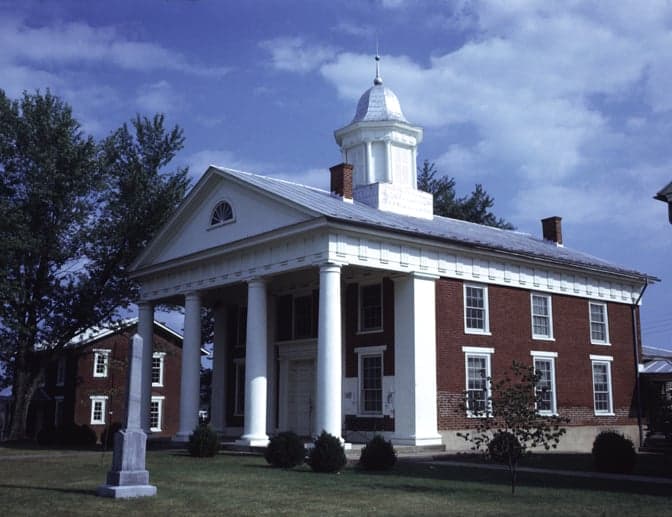

Photo: Wikipedia
Political ClimatePolitical Climate in Greene County
Showing state-level results — no local-only data available.
Local Political AnalysisPolitical Analysis of Greene County
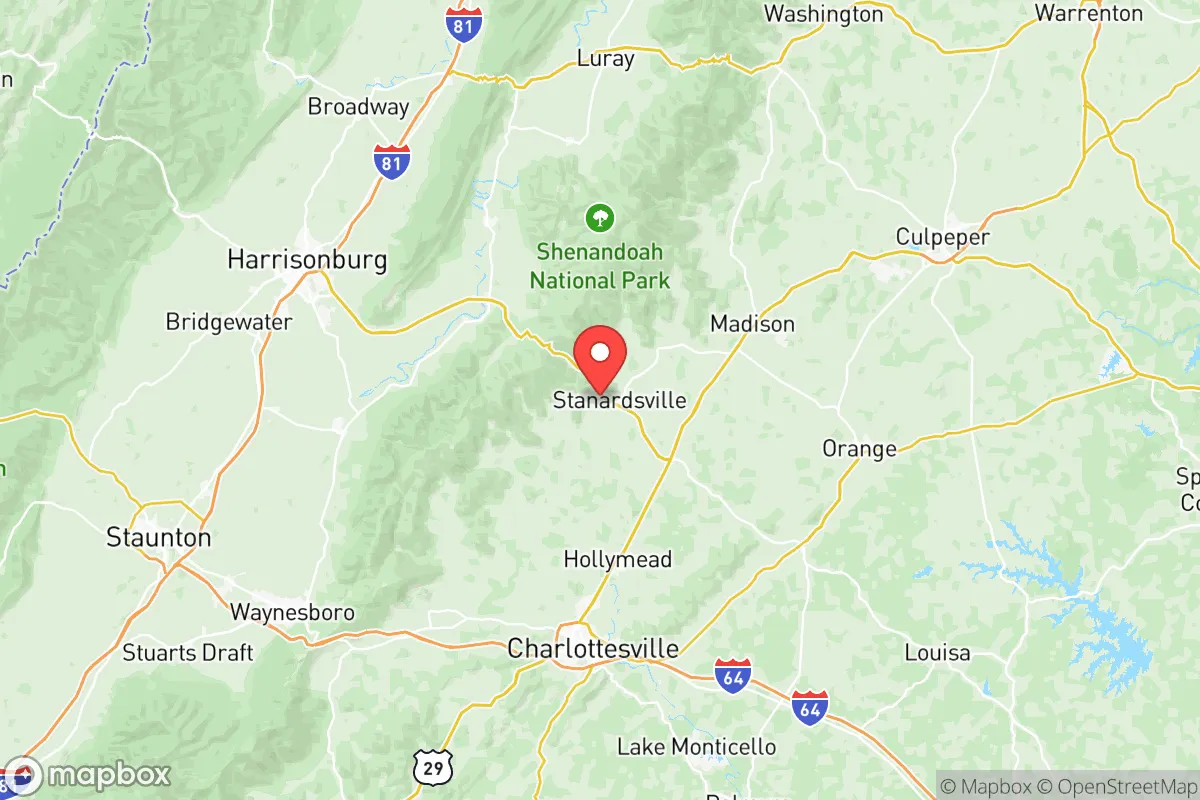
Greene County, Virginia, sits just a shade to the left of the national average with a Cook Partisan Voting Index (PVI) of D+2, making it a genuine swing county in a state that leans slightly more Democratic at D+4. This isn't a deep-blue enclave; it's a place where elections are won on the margins, and the political temperature varies noticeably from the foothills of the Blue Ridge to the more suburban stretches near the county line. The trajectory here is subtle but real: as the county grows, especially around the Ruckersville and Stanardsville areas, the old Republican lean has softened, and the county has become a true battleground where both parties have to work for every vote.
How it compares
Compared to Virginia as a whole, Greene County is a more conservative version of the state's overall tilt. While the state's D+4 PVI is driven by the massive Democratic margins in Northern Virginia, Richmond, and Hampton Roads, Greene County's D+2 reflects a much tighter split. In practice, this means that a statewide Democratic candidate like a governor or senator will likely carry Greene, but by a smaller margin than they do statewide. The real contrast is internal: the town of Stanardsville, the county seat, tends to vote more Democratic, buoyed by a mix of local government employees, retirees, and newer residents drawn to its walkable historic core. Meanwhile, the more rural precincts around Dyer and Pine Grove lean reliably Republican, with strong turnout driven by gun rights and lower-tax concerns. The swing precincts are in the Ruckersville area, where a mix of commuters to Charlottesville and local families create a volatile electorate that can tip either way in a given cycle.
What this means for residents
For conservative residents, Greene County offers a political environment where their views are still competitive and often influential, especially in local races for the Board of Supervisors and School Board. They can expect to see Republican candidates actively campaigning in the county, and their concerns about land use, school curriculum, and taxes are taken seriously. For liberal residents, the county is not a hostile environment, but it's not a safe space either. They can find like-minded neighbors in Stanardsville and parts of Ruckersville, and they benefit from the county's proximity to Charlottesville for more progressive cultural and political events. The practical reality is that most local issues—like the pace of development, school funding, and broadband expansion—are debated on their merits rather than along strict party lines, though national politics can sometimes bleed into school board meetings and zoning hearings.
Culturally, Greene County retains a distinct Appalachian-tinged identity that sets it apart from the more cosmopolitan vibe of Charlottesville. You'll find a stronger emphasis on hunting, fishing, and outdoor recreation as shared community values, and the local fairs and festivals (like the Greene County Fair) are apolitical gathering points. Policy-wise, the county has been slower to adopt some progressive state mandates, such as those on renewable energy siting or affordable housing requirements, reflecting a local preference for local control. The gun culture is more visible here than in the state as a whole, with "Gun Rights" signs common on rural properties. At the same time, the growing number of telecommuters and second-home owners from Northern Virginia is slowly nudging the county's cultural and political center of gravity, making Greene a fascinating place to watch as Virginia's political map continues to evolve.

State Political ClimatePolitical Climate in Virginia
State Political AnalysisPolitical Environment in the State
Virginia has shifted from a reliably purple swing state to a solidly Democratic-leaning one over the past two decades, with a Cook PVI of D+4. The transformation is driven almost entirely by explosive growth in the Washington, D.C. suburbs—particularly Loudoun, Prince William, and Fairfax counties—which now deliver massive Democratic margins that swamp the rest of the state. While Republicans still dominate in rural Southside and Southwest Virginia, and hold competitive ground in the Richmond and Hampton Roads suburbs, the statewide trajectory has been a steady leftward march since 2008, when Barack Obama became the first Democrat to carry Virginia since 1964.
Urban vs. rural divide
The political map of Virginia is a textbook case of the urban-rural chasm. Northern Virginia—the D.C. exurbs and suburbs—is the Democratic engine room, with Fairfax County alone casting more votes than many entire states. Loudoun County, once a Republican stronghold, flipped decisively blue after 2016 and now routinely votes 60%+ Democratic. Richmond and Norfolk are also reliably blue, with the capital city’s growing young professional and minority populations driving the margin. Meanwhile, Roanoke and Lynchburg in the west remain conservative anchors, but their populations are stagnant or shrinking relative to NoVa. The real Republican heartland is Southwest Virginia—places like Bristol and Abingdon—where coal country and rural manufacturing communities vote 70-80% Republican. The Hampton Roads area, anchored by Virginia Beach and Chesapeake, is the state’s most competitive region, often splitting its congressional seats between the parties.
Policy environment
Virginia’s tax structure is moderate by national standards: a flat 5.75% income tax rate and a statewide sales tax of 4.3% (plus local add-ons up to 2.7%). Property taxes are set locally and vary widely—Loudoun County has some of the highest rates in the state, while Pittsylvania County in Southside is much lower. The state has no right-to-work law on the books, but it is a “right-to-work” state by statute, meaning union membership is not mandatory for employment. Education policy is a flashpoint: Virginia’s public schools are among the best-funded in the South, but the state’s Board of Education has been at the center of culture-war battles over transgender student policies and critical race theory. Healthcare is a mixed bag—Virginia expanded Medicaid under the Affordable Care Act in 2018, but the state also has some of the strictest certificate-of-need laws in the country, limiting competition in hospital and nursing home markets. Election laws are relatively accessible: no-excuse absentee voting, same-day registration, and early voting are all available, though voter ID is required.
Recent policy direction
The last five years have seen Virginia lurch leftward on several fronts, then partially pull back. In 2020, the Democratic-controlled General Assembly passed a sweeping gun-control package—including universal background checks, a “red flag” law, and a one-handgun-per-month limit—that was the most aggressive in the South. In 2021, the same majority legalized recreational marijuana, though retail sales have been delayed until 2024. On education, Governor Glenn Youngkin’s 2021 victory gave Republicans a veto pen, and his administration has pushed for “parental rights” in schools, including a model policy requiring schools to notify parents if a child requests a name or pronoun change. On abortion, Virginia remains an outlier in the South: abortion is legal up to 26 weeks, and the state has become a regional destination for women from Tennessee, Kentucky, and West Virginia. On property rights, Virginia has no statewide zoning preemption, meaning local governments can impose strict land-use controls—a major issue for relocators looking to build or develop. On voting, the state has moved toward automatic voter registration and expanded early voting, but Republicans have challenged the state’s independent redistricting commission, arguing it produces maps that favor incumbents over voters.
Civil unrest & political movements
Virginia has been a stage for some of the most visible political flashpoints in the country. The 2017 “Unite the Right” rally in Charlottesville—which turned violent and left one counter-protester dead—still casts a long shadow over the state’s politics, galvanizing both anti-racist activism and conservative backlash. The 2020 racial justice protests in Richmond led to the removal of Confederate statues on Monument Avenue, a process that remains legally contested. On immigration, Virginia has no statewide sanctuary policy, but Fairfax County and Arlington County have “trust” policies limiting cooperation with ICE, which has drawn fire from Republican lawmakers. Election integrity remains a live issue: the 2020 election saw no major fraud in Virginia, but Republican activists continue to push for stricter voter roll maintenance, while Democrats argue the system is secure. The state’s gun-rights movement is particularly active in rural areas, with annual “Lobby Day” rallies at the Capitol drawing thousands of open-carry activists.
Projection
Over the next 5-10 years, Virginia’s political trajectory points further left, but with significant caveats. The D.C. suburbs will continue to grow and diversify, adding hundreds of thousands of new Democratic-leaning voters. However, the state’s population growth is slowing, and the rural exodus from Southside and Southwest Virginia is accelerating, meaning the Democratic margin will likely widen even without major policy shifts. The wild card is the Hampton Roads region: if Virginia Beach and Chesapeake continue to trend blue, Republicans will have no realistic path to statewide office. For a conservative relocator, the practical reality is that Virginia will likely remain a Democratic-controlled state for the foreseeable future, with Republican influence limited to the governor’s mansion (which can be won in off-year elections) and a shrinking number of rural legislative seats. For a liberal relocator, the state offers a stable, increasingly progressive policy environment, but one that is still constrained by a moderate Democratic establishment and a Republican governor who can veto the most ambitious legislation.
Bottom line for a new resident: If you’re moving to Virginia, understand that your experience of the state’s politics will depend almost entirely on where you land. In Loudoun County, you’ll find a blue bubble with high taxes and progressive schools; in Franklin County, you’ll find a red pocket with low taxes and conservative values. The state as a whole is not a culture-war battleground in the way Florida or Texas is—it’s a place where both sides have power, but the long-term demographic tide is running one way. For conservatives, the best bet is to target the rural or exurban counties where your vote will matter most; for liberals, the suburbs of D.C. and Richmond offer a comfortable, increasingly dominant political home.
* Values derived from national, state, county, city and local statistics and may differ in a specific area. Last updated: 2026-09-07T21:40:59.000Z
Narrative content on this page is AI-generated and may contain mistakes. Verify any details that matter before acting on them.
ReloMaps may earn a commission from affiliate links at no extra cost to you.

