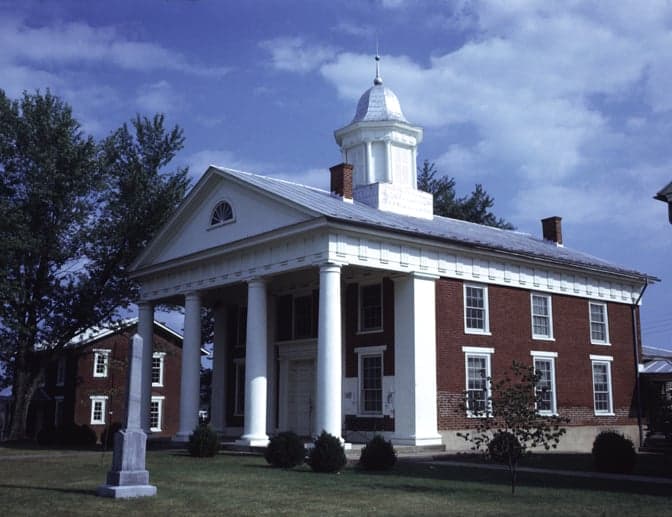
Photo: Wikipedia
Demographics of Greene County
Affluence Level in Greene County
A middle-class area roughly in line with national averages across income, home values, education, and employment.
People of Greene County
Greene County, Virginia, is a predominantly rural and increasingly suburban community of 20,850 residents, characterized by a strong white majority (79.5%) and a growing Hispanic and Black presence. The county’s identity is rooted in its agricultural past and its position as a quieter, more affordable alternative to the bustling Charlottesville metro area just to the south. Distinctive markers include a deep sense of local independence, a landscape of rolling hills and the Blue Ridge Mountains, and a population that is slightly less diverse and less college-educated than the state average, with a notable 28.5% holding a bachelor’s degree or higher.
Settlement & growth (pre-1960)
The land that is now Greene County was originally inhabited by the Siouan-speaking Monacan people, who lived in small villages along the Rivanna River and its tributaries. European contact and encroachment began in the early 1700s, with English and Scots-Irish settlers moving westward from the Tidewater region. The area was officially formed from Orange County in 1838, named after Revolutionary War General Nathanael Greene, and its early economy was almost entirely agricultural, centered on tobacco, corn, and livestock.
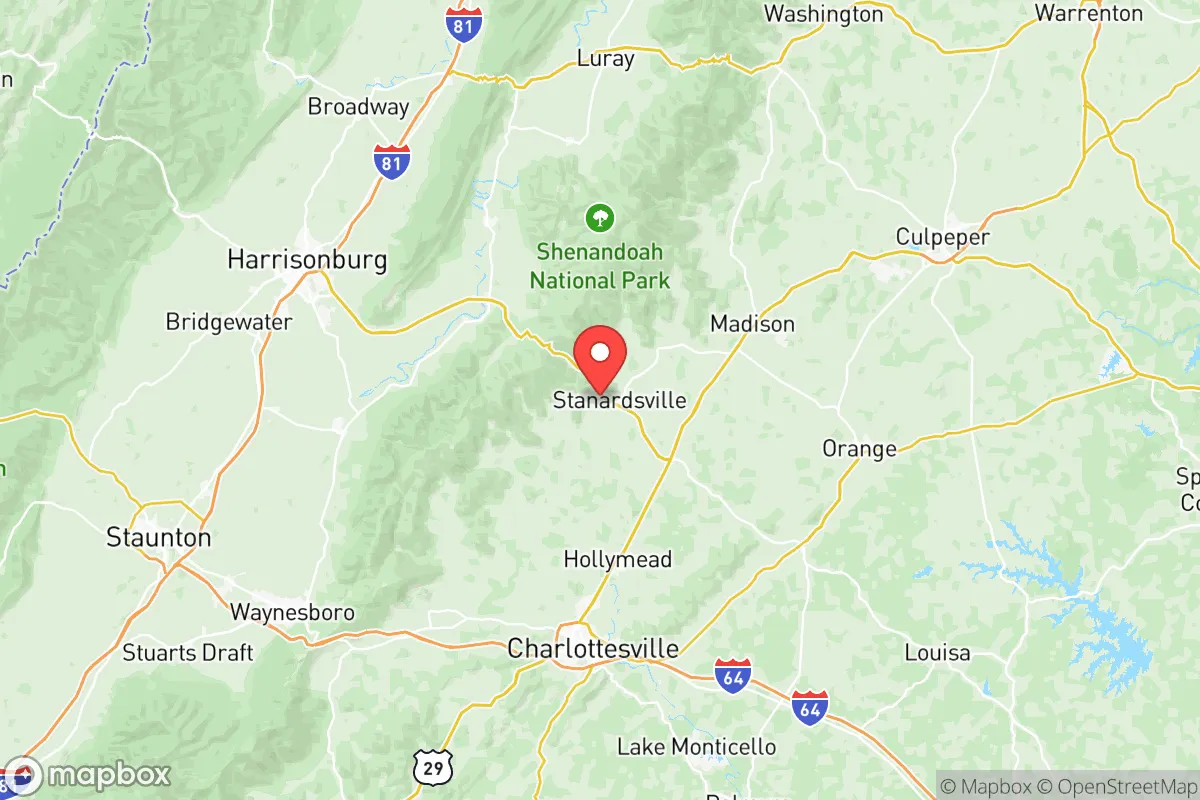
The first major wave of European settlers were predominantly Scots-Irish and English, who arrived in the mid-to-late 1700s, drawn by the promise of cheap, fertile land in the Piedmont foothills. These families established small farms and communities in what are now the villages of Stanardsville (the county seat), Ruckersville, and Dyke. Stanardsville, named after a local landowner, became the commercial and governmental hub, while Ruckersville grew as a crossroads settlement along what is now U.S. Route 29. The population remained overwhelmingly white and rural through the 19th century, with a small number of enslaved Black people working on larger plantations, primarily in the southern part of the county near the Greene-Albemarle line.
After the Civil War and Reconstruction, the county’s Black population, which had been a significant minority, declined as many families left for urban opportunities in the North and in cities like Richmond and Washington, D.C. The period from 1900 to 1960 saw very little population growth. Greene County remained an isolated, agricultural backwater, with its economy based on small-scale farming, apple orchards, and timber. The construction of the Skyline Drive and Shenandoah National Park in the 1930s displaced some families but also brought a trickle of tourism. By 1960, the county’s population was still under 5,000, and its residents were overwhelmingly white, native-born, and tied to the land.
Modern era (post-1965)
The 1965 Hart-Cellar Act had a minimal direct impact on Greene County, as the area did not attract large numbers of new international immigrants. The county’s foreign-born population today stands at just 3.2%, well below the national average. The most significant demographic changes since 1965 have been driven by domestic migration and suburbanization.
The first major shift began in the 1980s and accelerated through the 2000s, as the Charlottesville metropolitan area expanded northward. Families and individuals seeking lower housing costs, larger lots, and a slower pace of life began moving into Greene County, particularly into the Ruckersville area, which is the closest part of the county to Charlottesville (about 15 miles north). This wave was predominantly white and middle-class, drawn by new subdivisions and the convenience of U.S. Route 29. The county’s population more than doubled between 1980 and 2020, from roughly 7,000 to over 20,000.
A second, more recent wave has brought a growing Hispanic population, now 6.9% of the total. This community is largely composed of Mexican and Central American immigrants and their U.S.-born children, who have been drawn by work in the region’s construction, landscaping, and agricultural sectors, particularly in the apple orchards and nurseries around Stanardsville and Dyke. Many families have settled in mobile home parks and rental communities, forming a small but visible enclave. The Black population, now 6.8%, has remained relatively stable, with many families having deep roots in the county, particularly in the Pine Grove and Simmons Gap areas. The East/Southeast Asian population (1.2%) and Indian-subcontinent population (1.4%) are small but growing, often consisting of professionals and academics connected to the University of Virginia in Charlottesville who have chosen to live in Greene for its lower cost of living and rural character.
Suburbanization has been the dominant force reshaping the county. The Ruckersville corridor has seen the most development, with new shopping centers, gas stations, and fast-food restaurants replacing farmland. In contrast, the western part of the county, including the communities of Quinque and Burnt Tree, remains deeply rural, with few services and a population that is almost entirely white and native-born. This geographic split—a more diverse, suburbanizing east versus a homogeneous, rural west—is a defining feature of modern Greene County.
The future
Greene County is projected to continue growing, but at a slower pace than in the 1990s and 2000s. The county’s population is likely to become slightly more diverse, driven by continued Hispanic in-migration and a small but steady influx of professionals from Charlottesville. The white share of the population (currently 79.5%) will likely decline gradually, but the county will remain predominantly white for the foreseeable future. The foreign-born share (3.2%) may rise to 5-6% over the next decade, but Greene will not become a major immigrant destination.
The most significant demographic trend is the continued suburbanization of the Ruckersville area, which is increasingly becoming a bedroom community for Charlottesville. This will bring more families, more retail, and more pressure on schools and infrastructure. The western part of the county, including Stanardsville and Dyke, will likely see slower growth and retain its rural character, though second-home buyers and retirees may increase demand for land. The county’s cultural identity is evolving from a purely agricultural, insular community to a more diverse, commuter-oriented one, though this change is happening unevenly and is concentrated along the Route 29 corridor.
For someone moving in now, Greene County offers a choice: the suburban convenience and growing diversity of Ruckersville, or the quiet, traditional rural life of Stanardsville and the western hills. The county is becoming more connected to the Charlottesville economy and culture, but it retains a distinct, independent character that appeals to those who want to be near a city without living in one. The future is one of moderate growth, gradual diversification, and an ongoing tension between preservation and development.

* Values derived from national, state, county, city and local statistics and may differ in a specific area. Last updated: 2026-09-07T21:40:59.000Z
Narrative content on this page is AI-generated and may contain mistakes. Verify any details that matter before acting on them.
ReloMaps may earn a commission from affiliate links at no extra cost to you.

