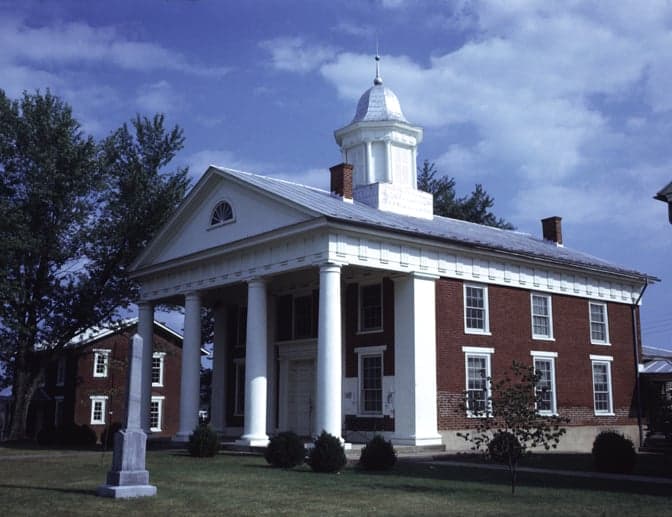
Photo: Wikipedia
Personal Sovereignty in Greene County
Viable for self-reliance. Generally workable, though some barriers may limit total independence.
What does Personal Sovereignty tell us?
Personal Sovereignty measures your capacity for self-reliance and independence with minimal government friction. Higher scores mean fewer barriers between you and the way you want to live... but it assumes you have the space you need and good neighbors.
What does this tell us?
Personal Sovereignty measures your capacity for self-reliance and independence with minimal government friction. Higher scores mean fewer barriers between you and the way you want to live... but it assumes you have the space you need and good neighbors.
State Policy
Energy independence: Importer (20% of energy produced in-state)
Personal Liberty
Homesteading

Personal Liberty Analysis
Greene County, Virginia, offers a notably high degree of personal sovereignty compared to many parts of Northern Virginia and the broader D.C. metro area, with a regulatory environment that leans heavily toward individual autonomy and local control. The county’s rural character, combined with Virginia’s relatively strong preemption laws on firearms and land use, creates a setting where residents can exercise significant freedom in daily life, from self-defense choices to homesteading practices. While not as libertarian as some Western states, Greene County provides a tangible alternative for those seeking to escape the more intrusive governance found in nearby urban centers like Charlottesville or Fairfax County.
Tax burden and regulatory posture in Greene County
Greene County’s tax burden is moderate by Virginia standards, with a real property tax rate of approximately $0.68 per $100 of assessed value as of 2025, which is lower than neighboring Albemarle County ($0.85) but slightly higher than more rural counties like Madison ($0.55). The county does not impose a local income tax, and Virginia’s state income tax is a flat 5.75%, which is competitive for the region. The regulatory posture is generally light-touch, particularly for land use and business operations. The county’s zoning ordinance is less restrictive than in incorporated towns like Stanardsville, the county seat, where historic district guidelines can add layers of review for exterior modifications. Outside of Stanardsville, in areas like Ruckersville and Quinque, property owners face fewer bureaucratic hurdles for building sheds, fences, or home-based businesses. The county’s comprehensive plan emphasizes preserving agricultural and rural character, which translates to minimal interference with traditional land uses. However, Virginia’s state-level building codes still apply, so new construction must meet standard safety requirements, but there are no county-specific energy codes or green building mandates that add cost or complexity.
Self-defense and gun law specifics in Greene County
Virginia is a shall-issue state for concealed carry permits, and Greene County’s circuit court processes applications efficiently, typically within 45 days. The county is home to several gun shops and ranges, including the popular Greene County Gun Club near Ruckersville, which offers a 200-yard rifle range and hosts regular training events. Open carry is legal without a permit for anyone 18 or older who can legally possess a firearm, and the county has no local ordinances restricting where firearms can be carried beyond state law. Stand-your-ground principles apply under Virginia’s self-defense statutes, which do not impose a duty to retreat in any place where a person has a legal right to be. The sheriff’s office, led by Sheriff Steven Smith, has publicly stated support for Second Amendment rights and does not participate in voluntary federal firearm confiscation programs. For residents in the more rural parts of the county, such as the areas around Dyke and Lydia, firearm ownership is nearly universal, and the culture strongly supports personal protection as a norm. Magazine capacity limits and assault weapon bans are not enforced at the county level, as Virginia’s state preemption law prohibits localities from enacting their own gun control measures.
Self-reliance and homesteading viability in Greene County
Greene County is one of the more homestead-friendly areas in Central Virginia, with zoning that permits a wide range of agricultural and self-reliance activities on parcels as small as 2 acres in the Agricultural (A-1) district. In the rural areas around Quinque and Stanardsville, residents commonly keep chickens, goats, and even small livestock without needing a special permit, provided the animals are for personal use. Off-grid living is feasible but requires adherence to state health department regulations for septic systems and well water. Solar panels are allowed without county-level restrictions, and several properties in the Dyke area operate entirely off-grid with solar arrays and rainwater collection. The county does not have a building moratorium or growth cap, unlike some nearby localities, so residents can develop their land as they see fit within basic health and safety codes. The average lot size in the county is 3.5 acres, which provides ample space for gardens, small orchards, and woodlots. For those seeking a more self-sufficient lifestyle, the area around Lydia offers larger parcels (10-20 acres) at prices significantly lower than comparable land in Albemarle County. The county’s extension office offers workshops on canning, livestock management, and soil conservation, supporting the homesteading community without imposing mandates.
Personal liberties in Greene County: parental rights, medical autonomy, speech, and property
Parental rights are strongly protected in Greene County, with the school board maintaining a policy of transparency in curriculum and materials, and a parental opt-out process for any instruction parents find objectionable. The county’s public schools, including Greene County High School and William Monroe Middle School, have not adopted controversial social-emotional learning programs that bypass parental consent. Medical autonomy is generally respected, though Virginia’s state-level vaccine mandates for school attendance apply, and the county does not have a local health department that enforces additional restrictions. Speech and assembly rights are robust, with the county’s board of supervisors meetings regularly featuring public comment periods that are not time-limited, and no local ordinances restrict political signage or leafleting. Property rights are protected by Virginia’s strong right-to-farm laws, which shield agricultural operations from nuisance lawsuits, and the county’s zoning code does not include aesthetic restrictions on building materials or colors outside of the Stanardsville historic district. The county’s approach to short-term rentals is permissive, with no cap on the number of permits issued, unlike nearby Charlottesville. For residents in Ruckersville, the commercial hub, property owners can operate home-based businesses with minimal paperwork, provided they do not generate excessive traffic or noise.
Overall, Greene County offers a level of personal sovereignty that is rare in the D.C. metro orbit, combining low taxes, strong gun rights, and a permissive homesteading environment with a culture that values individual responsibility. While not as deregulated as parts of West Virginia or the rural Midwest, it provides a practical middle ground for those who want to live autonomously without completely disconnecting from modern infrastructure. For families and individuals prioritizing freedom over convenience, Greene County stands out as one of the more liberty-respecting options within a two-hour drive of Washington, D.C.

* Values derived from national, state, county, city and local statistics and may differ in a specific area. Last updated: 2026-09-07T21:40:59.000Z
Narrative content on this page is AI-generated and may contain mistakes. Verify any details that matter before acting on them.
ReloMaps may earn a commission from affiliate links at no extra cost to you.

