
Photo by Damien Santos on Unsplash
Political ClimatePolitical Climate in Fredericksburg City County
Showing state-level results — no local-only data available.
Local Political AnalysisPolitical Analysis of Fredericksburg City County
Fredericksburg City County, Virginia, has shifted from a reliably conservative area to a genuine battleground, now carrying a Cook Partisan Voting Index (PVI) of D+2. That means the city leans slightly Democratic, but it's a full six points more Republican than the state of Virginia as a whole, which sits at D+4. This isn't a deep-blue enclave; it's a place where elections are decided by a few thousand votes, and the trajectory is toward a slow, steady purple, not a hard blue.
How it compares
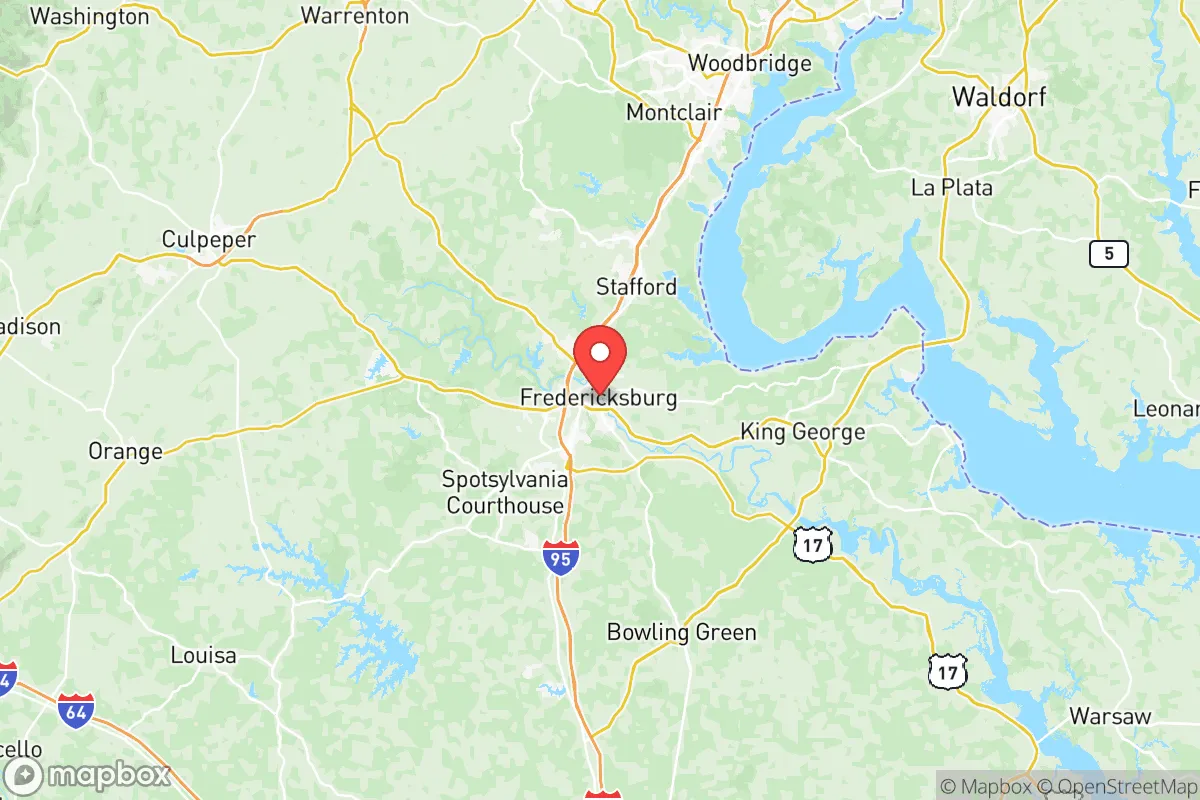
The contrast between Fredericksburg City and the rest of Virginia is stark. While the state has moved decisively leftward in recent cycles—driven by the massive, reliably Democratic suburbs of Northern Virginia and the growing Richmond metro—Fredericksburg City has held a more moderate line. The city's D+2 PVI means it's about as competitive as a district can get, whereas Virginia's D+4 reflects a state that now consistently votes Democratic in presidential races. The real divide isn't between the city and the state, but between the city and its own surrounding county. Spotsylvania County, just south of the city line, is R+12, and Stafford County to the north is R+9. Fredericksburg City is a blue dot in a sea of red, but it's a pale blue dot. The swing precincts are the ones you'd expect: the downtown core and the neighborhoods around the University of Mary Washington (like College Heights) lean solidly Democratic, while the more suburban, family-oriented areas near the city's western edge—think the neighborhoods off Cowan Boulevard and near the Spotsylvania line—tilt Republican. The precincts around the historic district and the newer apartments along the Rappahannock River are the true bellwethers; they flip back and forth depending on turnout.
What this means for residents
For a conservative resident, living in Fredericksburg City means you're in the minority, but you're not isolated. You'll find plenty of like-minded neighbors in the western precincts, and your vote carries real weight in local races—city council and school board elections are often decided by margins of a few hundred votes. You'll see more Trump signs in the yards near the Spotsylvania line than you will downtown. For a liberal resident, the city feels like a safe space within a conservative region. You can reliably expect your city council to support progressive policies on housing, climate, and social equity, but you'll also see those policies get challenged in every election cycle. The practical upshot is that neither side gets everything it wants. The city's budget tends to be moderate—taxes aren't as low as in Spotsylvania, but they're not as high as in Arlington. The school board, for instance, has debated critical race theory and LGBTQ+ policies, but the outcomes have been more compromise than revolution.
Culturally, Fredericksburg City is defined by this tension. The downtown area, with its cobblestone streets, independent bookstores, and craft breweries, feels like a smaller, more affordable version of Charlottesville or Richmond's Fan District. But drive ten minutes west, and you're in a landscape of chain restaurants, megachurches, and gun shops. The city's identity is split between its historic, walkable core and its sprawling, car-dependent edges. One notable policy distinction: Fredericksburg City has its own school system, separate from Spotsylvania and Stafford, which gives it more control over curriculum and funding. That independence is a double-edged sword—it allows for progressive experimentation, but it also means the city bears the full cost of its priorities. In the near future, expect the city to remain a purple battleground, with the national mood and local turnout deciding whether it tips D+3 or slips back to D+1. The long-term trend, driven by younger, more diverse residents moving into the downtown apartments, points toward a slow, steady drift leftward, but don't expect a blue wave anytime soon.

State Political ClimatePolitical Climate in Virginia
State Political AnalysisPolitical Environment in the State
Virginia has shifted from a reliably conservative-leaning swing state to a solidly Democratic-leaning one over the past two decades, with a Cook PVI of D+4. The transformation is driven almost entirely by explosive population growth in the Washington, D.C. suburbs, which now overwhelm the state’s traditionally conservative rural and exurban regions. For a relocator, this means you’re moving into a state where statewide offices and the legislature are controlled by Democrats, but local political reality varies dramatically depending on whether you land in Loudoun County or Lynchburg.
Urban vs. rural divide
The political map of Virginia is a study in stark contrasts. The Democratic stronghold is the dense crescent of Northern Virginia — Arlington, Alexandria, Fairfax County, and Loudoun County — which together cast roughly a third of the state’s votes and deliver margins of 60-70% for Democrats. The other major blue anchor is the Richmond metro area, particularly the city of Richmond itself and Henrico County, along with the Hampton Roads cities of Norfolk, Virginia Beach, and Newport News. On the other side, the rural Southside and Southwest Virginia — places like Roanoke, Danville, and the coal country around Bristol — vote Republican by similar margins. The key battlegrounds have been the fast-growing exurbs and smaller cities: Chesapeake and Fredericksburg have trended blue in recent cycles, while Lynchburg remains a conservative anchor thanks to Liberty University’s influence. The urban-rural split is so pronounced that a resident of Arlington and a resident of Wise County essentially live under different political realities despite sharing a governor.
Policy environment
Virginia’s policy environment reflects its purple-to-blue trajectory. The state income tax is a flat 5.75% on taxable income above $17,000, with a standard deduction of $9,000 for individuals. Sales tax is 5.3% (6.3% in Northern Virginia and Hampton Roads for local transportation funding). Property taxes are set locally and vary widely — Loudoun County levies around $1.20 per $100 of assessed value, while Pittsylvania County is under $0.60. The state has no right-to-work law in its constitution, but it remains a right-to-work state by statute, a legacy of its conservative past. Education policy is largely controlled by the state Board of Education and the General Assembly; Virginia has seen heated battles over school funding, transgender student policies, and critical race theory, with the current Democratic majority pushing for expanded LGBTQ+ protections and increased per-pupil spending. Election laws are moderately accessible: no-excuse absentee voting, same-day registration during early voting, and voter ID required but with a signed affidavit option if you lack one. Gun laws are moderate — a permit is required for concealed carry, but the state does not ban any specific class of rifles, and private sales do not require background checks.
Recent policy direction
The last five years have seen Virginia swing decisively left on several fronts. In 2020, the Democratic-controlled General Assembly passed the Virginia Clean Economy Act, mandating a carbon-free grid by 2050. In 2021, they abolished the death penalty. On gun policy, they passed a red-flag law, a one-handgun-per-month limit, and universal background checks for all firearm sales at gun shows — though private sales between individuals remain unregulated. On education, the state eliminated the Standards of Learning (SOL) graduation requirements for history and social studies in 2022, replacing them with locally developed assessments. Parental rights became a flashpoint: Governor Glenn Youngkin, a Republican elected in 2021, issued a model policy requiring schools to notify parents if a child requests a name or pronoun change, but the current Democratic legislature has blocked its codification. On medical freedom, Virginia did not impose broad COVID-19 vaccine mandates for state employees, but private employers were free to do so. Abortion remains legal up to the second trimester (26 weeks), with a 24-hour waiting period and parental consent for minors — a relatively moderate position compared to Southern neighbors. Recreational marijuana was legalized in 2021, but retail sales have been delayed repeatedly and are not yet operational as of 2026. Property rights are generally strong; Virginia is a “Dillon’s Rule” state, meaning local governments only have powers explicitly granted by the state, which limits local zoning experiments but also prevents radical local land-use shifts.
Civil unrest & political movements
Virginia has been a stage for some of the most visible political flashpoints in the country. The 2017 Unite the Right rally in Charlottesville — and the subsequent violence and national backlash — remains a defining scar, leading to the removal of Confederate statues across the state and ongoing debates over historical memory. In 2020, Richmond saw weeks of protests over racial justice, including confrontations at the Robert E. Lee monument. On the right, the “Virginia is for Lovers” slogan has been co-opted by the “Virginia is for Gun Lovers” movement, and the 2020 Second Amendment Sanctuary movement saw over 100 counties and cities pass resolutions vowing not to enforce new gun laws — though these resolutions are symbolic and unenforceable. Immigration politics are relatively quiet compared to border states; Virginia has no sanctuary state law, but some localities like Fairfax County limit cooperation with ICE. Election integrity controversies flared after 2020, with Republican activists alleging irregularities in mail-in ballot processing, but multiple audits and court cases found no systemic fraud. The most visible ongoing political movement is the parental rights push, which helped elect Youngkin in 2021 and remains a potent organizing force in school board races across the exurbs.
Projection
Over the next 5-10 years, Virginia will likely continue its slow drift leftward, but not as dramatically as some predict. The D.C. suburbs are still growing, but at a decelerating rate, and the remote work shift has slowed in-migration from 2020-2022 peaks. The rural exodus continues, meaning the Democratic base will grow as a share of the electorate. However, the state has a built-in brake: the state Senate is closely divided, and the House of Delegates is competitive, meaning no single party is likely to achieve a supermajority. The 2025 gubernatorial race will be a key test — if a Democrat wins, expect further movement on gun control, abortion access, and climate policy. If a Republican wins, expect a focus on parental rights, tax cuts, and energy deregulation. The wild card is the growing Hispanic population in Northern Virginia and Hampton Roads, which leans Democratic but is not monolithic. For a relocator, the realistic expectation is that Virginia will remain a purple state with a blue tint — not California, not Texas, but a place where your local experience depends heavily on which county you choose.
For a new resident, the bottom line is this: Virginia offers a moderate-to-liberal state government with conservative pockets that still hold real political power. If you’re a conservative, you’ll find welcoming communities in Lynchburg, Roanoke, or the Shenandoah Valley, but you’ll be voting in a state where your presidential vote won’t matter. If you’re a liberal, you’ll feel at home in Arlington or Richmond, but you’ll encounter persistent conservative resistance on school boards and in the legislature. The practical takeaway is to choose your locality carefully — the difference between living in Loudoun County and Campbell County is the difference between two different states entirely.
* Values derived from national, state, county, city and local statistics and may differ in a specific area. Last updated: 2026-06-28T12:31:20.000Z
Narrative content on this page is AI-generated and may contain mistakes. Verify any details that matter before acting on them.
ReloMaps may earn a commission from affiliate links at no extra cost to you.

