
Photo by Damien Santos on Unsplash
Demographics of Fredericksburg City County
Affluence Level in Fredericksburg City County
A middle-class area roughly in line with national averages across income, home values, education, and employment.
People of Fredericksburg City County
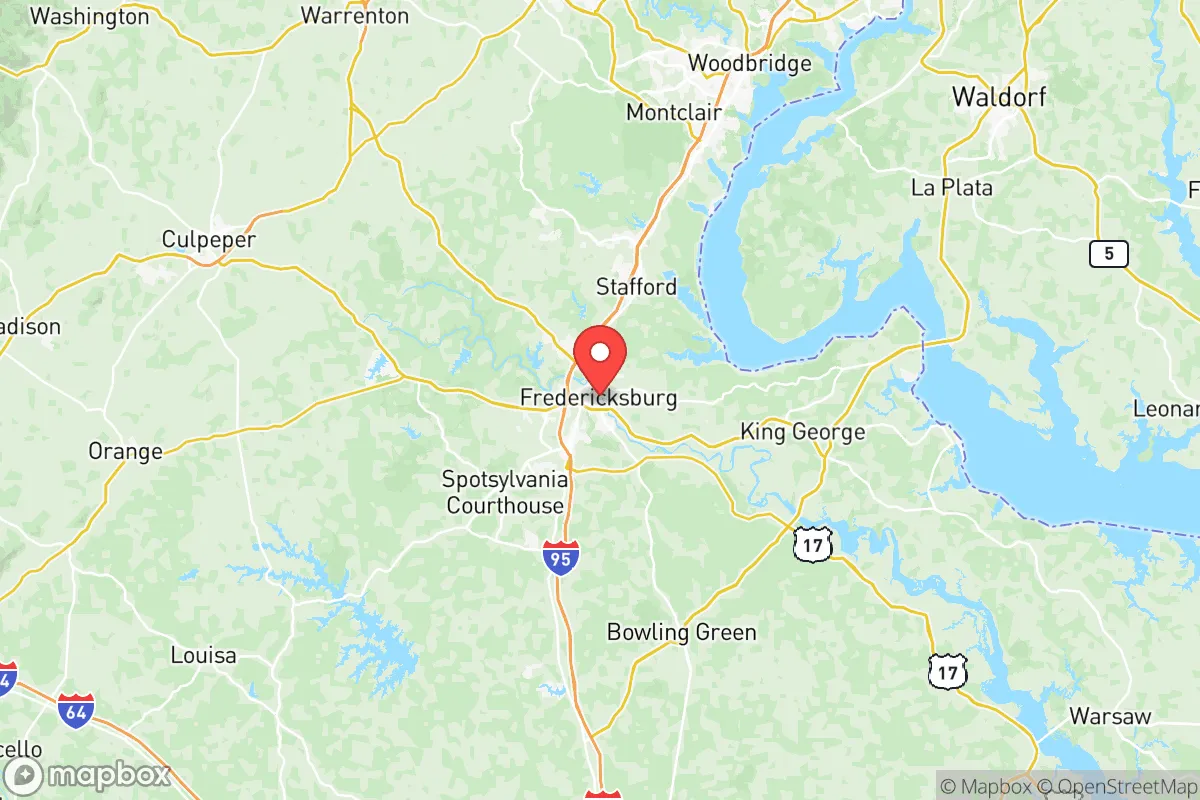
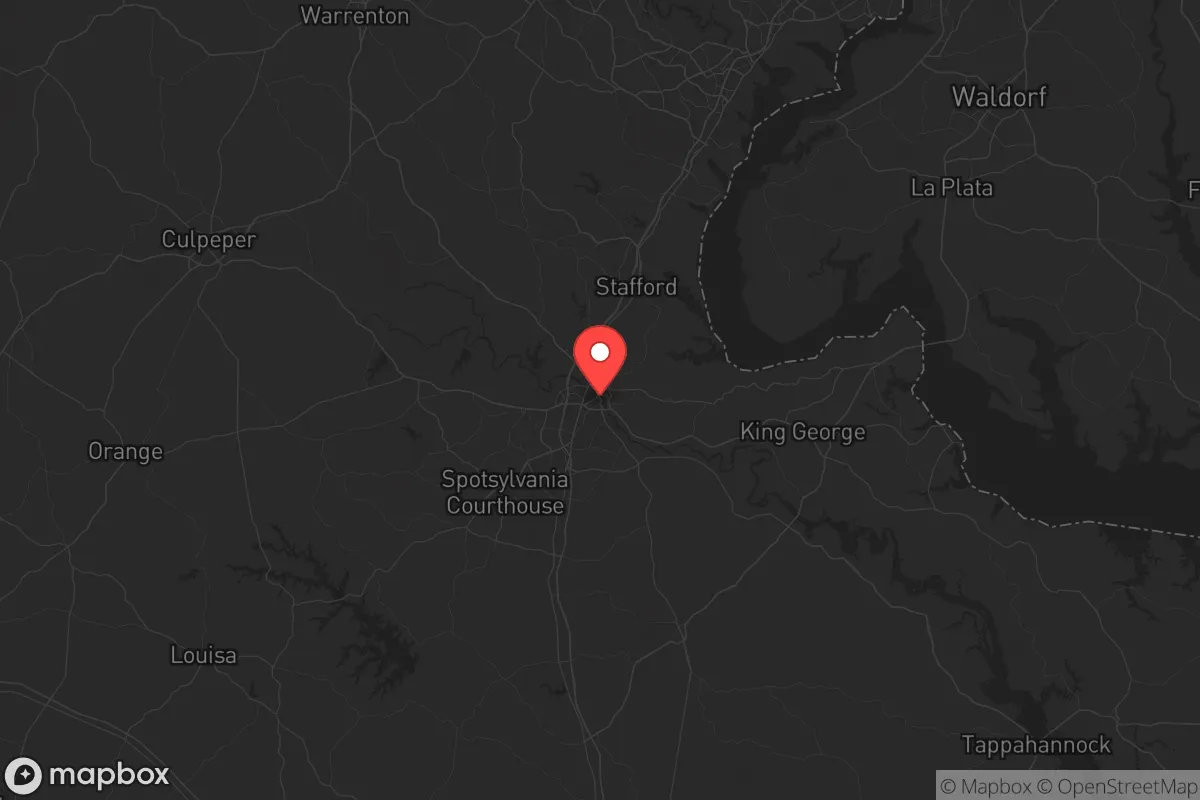
Fredericksburg City County, Virginia, is a small, historically dense independent city of 28,383 residents, where the population is notably more diverse than the surrounding region, with a 55.6% White, 19.8% Black, and 12.4% Hispanic composition. The city’s identity is shaped by its deep colonial roots, its role as a Civil War crossroads, and a modern influx of government contractors and commuters drawn to its position halfway between Washington, D.C., and Richmond. Despite its compact size—just 10.5 square miles—Fredericksburg packs a distinct urban character, with a walkable downtown, a high proportion of college-educated residents at 46.8%, and a foreign-born population of 7.9% that reflects modest but growing international diversity.
Settlement & growth (pre-1960)
Long before European settlement, the area now known as Fredericksburg City County was the territory of the Manahoac and Siouan-speaking tribes, who used the Rappahannock River as a trade and fishing corridor. English colonists began arriving in the 1670s, drawn by the Virginia Company’s land grants and the promise of tobacco wealth. The Virginia General Assembly officially established Fredericksburg as a port town in 1728, naming it after Frederick, Prince of Wales. The town’s location at the fall line of the Rappahannock—the farthest point upstream for oceangoing ships—made it a natural hub for the export of tobacco and the import of enslaved Africans, who by the mid-1700s constituted a significant portion of the labor force.
During the Revolutionary and early national periods, Fredericksburg grew as a mercantile and political center. It was home to prominent figures like George Washington’s mother, Mary Ball Washington, and the founding father himself surveyed land in the region. The city’s population remained overwhelmingly of English and Scots-Irish descent through the 18th and early 19th centuries, with a substantial enslaved Black population that worked the surrounding plantations. By 1860, on the eve of the Civil War, Fredericksburg’s population was roughly 5,000, with about one-third enslaved. The Battle of Fredericksburg in December 1862 devastated the town, leaving much of it in ruins and displacing many residents.
Reconstruction and the post-Civil War era saw the city’s Black population grow as freedmen and women settled in neighborhoods like Mayfield and Bragg Hill, establishing churches, schools, and small businesses. The late 19th and early 20th centuries brought modest industrial growth—railroads, a cement plant, and a shirt factory—which attracted some European immigrants, primarily Germans and Irish, though in smaller numbers than in Northern industrial cities. The Great Migration (1910–1970) saw many Black residents leave Fredericksburg for Northern cities, but the city also received a steady stream of rural Black Virginians from surrounding counties like Spotsylvania and Stafford. By 1950, Fredericksburg’s population had reached about 12,000, still predominantly White and native-born, with a Black population of roughly 25%.
Modern era (post-1965)
The 1965 Hart-Cellar Act had a limited immediate impact on Fredericksburg compared to major metropolitan areas, but its long-term effects are visible today. The city’s foreign-born population of 7.9% is modest but growing, driven primarily by two groups: Hispanic immigrants (largely from Central America, especially El Salvador and Honduras) and East/Southeast Asian communities (including Vietnamese and Korean families). These groups have concentrated in the city’s more affordable neighborhoods, such as the Rappahannock Landing area and along the Jefferson Davis Highway corridor, where small ethnic grocery stores and restaurants have emerged. The Hispanic population, now 12.4%, has grown steadily since the 1990s, fueled by construction and service-sector jobs tied to the region’s suburban expansion.
The most transformative demographic shift in Fredericksburg since 1965 has been domestic migration, not international immigration. The city’s location on Interstate 95, midway between Washington, D.C., and Richmond, made it a prime destination for government contractors, military personnel from nearby Marine Corps Base Quantico, and families fleeing the high cost of Northern Virginia. This influx, accelerating after 2000, has reshaped the city’s character. The White population, which was over 70% in 1980, has declined to 55.6% as the city has become more diverse. The Black population, at 19.8%, includes both long-established families from the pre-1960 era and newer arrivals from the Washington metro area. The Asian population (East/Southeast Asian) stands at 3.1%, with a separate Indian-subcontinent population of 0.6%, reflecting the broader trend of South Asian professionals working in tech and government contracting.
Suburbanization has been a double-edged sword for Fredericksburg. While the city proper has grown from 15,000 in 1970 to 28,383 today, much of the region’s explosive growth has occurred in the surrounding counties of Spotsylvania and Stafford, which have seen their populations quadruple since 1980. This has left Fredericksburg City County as a dense, walkable urban core surrounded by sprawling suburbs—a dynamic that has attracted younger, college-educated residents (46.8% hold a bachelor’s degree or higher) who value the city’s historic downtown, its proximity to the University of Mary Washington, and its relatively affordable housing compared to Arlington or Alexandria.
The future
Fredericksburg City County is likely to become more diverse and more densely populated over the next 10–20 years, though at a slower pace than its suburban neighbors. The city’s land area is fixed at 10.5 square miles, so growth will come through infill development and redevelopment of underutilized industrial sites, such as the Celebrate Virginia mixed-use project along the Rappahannock. The Hispanic and East/Southeast Asian populations are expected to continue growing, driven by both international immigration and second-generation families remaining in the area. The Black population share is likely to remain stable or increase slightly, as the city retains its historic Black neighborhoods and attracts new Black professionals from the D.C. metro area.
The city’s cultural identity is evolving from a sleepy historic town into a small but vibrant urban center with a growing arts scene, craft breweries, and a food culture that increasingly reflects its diversity. The high college-education rate suggests continued in-migration of knowledge workers, many of whom commute to D.C. or work remotely. However, the city faces challenges: housing affordability is declining as demand rises, and the public school system must adapt to a more diverse student body. The next decade will likely see Fredericksburg solidify its role as a diverse, walkable alternative to the car-dependent suburbs, attracting residents who want urban amenities without the cost of the nation’s capital.
For someone moving in now, Fredericksburg City County offers a historically rooted, increasingly diverse community with a strong sense of place. It is not a typical Sun Belt suburb—it is a compact, old city with real density, a mix of incomes and backgrounds, and a pace of change that is noticeable but not overwhelming. The population is becoming more varied in origin and outlook, but the city’s core identity as a Virginia river town with a deep American story remains intact. New residents will find a place where history is visible on every block, and where the future is being built by a population that is younger, more educated, and more diverse than the region around it.

* Values derived from national, state, county, city and local statistics and may differ in a specific area. Last updated: 2026-06-28T12:31:20.000Z
Narrative content on this page is AI-generated and may contain mistakes. Verify any details that matter before acting on them.
ReloMaps may earn a commission from affiliate links at no extra cost to you.

