Photo: Wikipedia
Political ClimatePolitical Climate in Culpeper County
Showing state-level results — no local-only data available.
Local Political AnalysisPolitical Analysis of Culpeper County
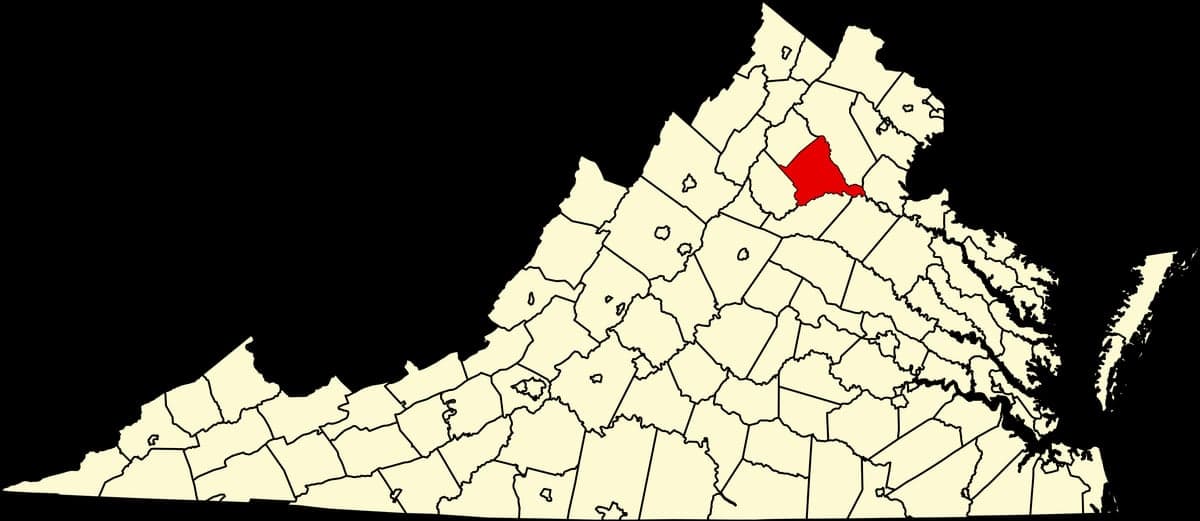
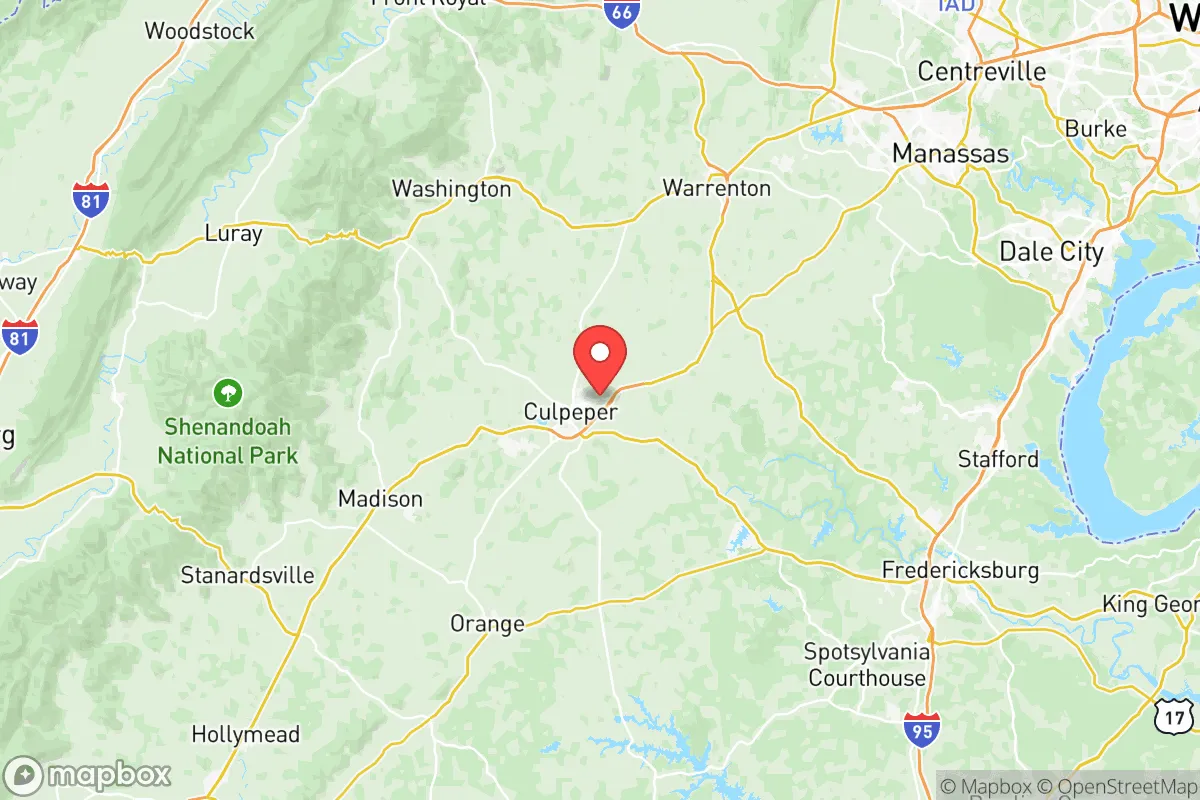
Culpeper County has been trending blue, but it’s still a genuine battleground — it flipped to Biden by a whisper in 2020 and sits at a Cook PVI of D+2, compared to Virginia’s overall D+4. That two-point gap means the county is measurably more competitive than the state as a whole, and the proof is in the precinct-level splits. The town of Culpeper, the county seat, votes reliably Democratic, especially in precincts around East Davis Street and the downtown core, where younger professionals and new arrivals from Northern Virginia have shifted the balance. Drive ten minutes west to the rural precincts around Brandy Station or Lignum, and you’ll find solid Republican majorities — old farm families, horse-country estates, and a deep distrust of Richmond encroachment. The swing precincts that decide elections are the exurban strips along Route 29 and 15, places like the Salem area and the new subdivisions near the Town of Culpeper limits. Those voters are often priced out of Fairfax or Prince William, and they bring moderate-to-left economic views paired with conservative social leanings — the perfect recipe for a purple county.
How it compares
Compared to Virginia’s D+4 average, Culpeper’s D+2 makes it one of the few counties in the state that is actually less Democratic than the state as a whole while still having a Democratic lean. For context, neighboring Fauquier County is R+8, Madison County is R+16, and Orange County is R+5 — so Culpeper is the blue island in a sea of red rural neighbors. But it’s not blue like the urban crescent: Fairfax County, for example, is D+29, and even nearby Albemarle County (Charlottesville) is D+9. Culpeper’s politics are more like a scaled-down version of Loudoun County ten years ago — a mix of historic small-town conservatism and incoming suburban liberalism, without either side fully dominating yet. The state-level comparison that matters most is the governor’s race: in 2021, Glenn Youngkin won Culpeper by 2.5 points, even as he won Virginia by only 1 point. That tells you the county still has a slight Republican lean in off-year, lower-turnout elections, while presidential-year turnout from the growing Democratic-leaning precincts cancels it out.
What this means for residents
For conservatives in Culpeper, the practical reality is that your vote counts more here than it does in most of Virginia. The county commission and school board are still majority-Republican, and local policy — like land-use decisions and school curriculum debates — tends to reflect that. But you can’t take anything for granted. The Town Council in the Town of Culpeper has a Democratic majority as of 2024, and the county board flipped once in recent memory. For liberals, the trajectory is encouraging but slow. You’ll find like-minded neighbors in town and in the new developments off McDevitt Drive, but you will also encounter plenty of “Don’t Tread on Me” flags on trucks at the Sheetz on James Madison Highway. The closest thing to a “safe space” for progressive politics is the Culpeper Democrats’ monthly meeting at the library, but even that crowd is more moderate than what you’d find in Arlington. The real divide isn’t Republican vs. Democrat — it’s old Culpeper vs. new Culpeper, and that tension shows up in every zoning hearing and school bond referendum.
Culturally, the county is distinct from the rest of Virginia because it still has a working agricultural base — you can go to the Culpeper Agricultural Enterprises farm market on a Saturday and see just as many feed trucks as Teslas. The policy difference that most visibly separates Culpeper from the state is land use: Virginia’s state-level push for higher-density housing and transit-oriented development is often met with resistance here, where the Board of Supervisors still leans toward preserving rural character through large-lot zoning. At the same time, the county has embraced data-center development along the Route 29 corridor, which brings in tax revenue but also lines up the classic blue/red fight over “jobs vs. environmental cost.” For the person living here, the bottom line is that Culpeper offers a political reality that feels more like a choice than a destiny — and both sides know the next election could swing either way.

State Political ClimatePolitical Climate in Virginia
State Political AnalysisPolitical Environment in the State
Virginia today is a D+4 state on the Cook Partisan Voting Index, meaning it leans about four points more Democratic than the national average, but that single number masks a deep and volatile split. Over the last 20 years, the state has shifted from a reliably red presidential bellwether (voting Republican in 10 of 11 elections from 1952 to 2004) to a solidly blue bastion in federal races, yet it still elects Republican governors and keeps a closely divided General Assembly. For a relocator, the practical reality is that you will live in a state where your vote genuinely counts, but your day-to-day experience will vary dramatically based on whether you settle in the booming exurbs of Northern Virginia, the fast-growing Richmond suburbs, the rural Shenandoah Valley, or the conservative-leaning cities like Roanoke and Lynchburg.
Urban vs. rural divide
The political map of Virginia is a classic tale of three regions: the densely populated urban crescent stretching from Northern Virginia through Richmond to Hampton Roads, the reliably conservative rural south and southwest, and a handful of competitive suburban and exurban counties that decide statewide elections. The Democratic majority is entirely driven by Fairfax County (population 1.1 million, consistently +30-40 points Democratic) and its neighboring jurisdictions like Arlington, Alexandria, and Loudoun County. Together, Northern Virginia accounts for roughly a third of the state’s total vote and delivers a net Democratic margin that Republicans cannot overcome without making deep inroads elsewhere. The old Democratic strongholds in the rural south and southwest, once known as "the Fighting Ninth" district, have flipped hard to the GOP over the past 15 years, with counties like Carroll, Grayson, and Lee routinely voting +50 to +60 points Republican. The swing territory that decides governors’ races spans the Interstate 81 corridor from Winchester to Roanoke, along with the exurban counties south of Richmond (Chesterfield, Hanover) and the fast-growing Fredericksburg region. Loudoun County is the poster child for this transformation: it went from a Republican-leaning exurb in 2004 to a Democratic +25 point county by 2020, driven by an influx of highly educated tech and federal workers. Meanwhile, Virginia Beach and Chesapeake in Hampton Roads remain competitive swing jurisdictions, often breaking slightly Democratic in presidential years and slightly Republican in off-year state races.
Policy environment
Virginia’s state-level policy environment is a patchwork that reflects the General Assembly's narrow partisan splits. The state income tax is a flat rate of 5.75%, with a standard deduction of $9,300 for married filers — middle-of-the-pack nationally. Sales tax is 5.3% (plus local add-ons, topping 6% in Northern Virginia and Hampton Roads). Property taxes are set locally and vary widely: Loudoun County levies about $1.14 per $100 of assessed value, while Pittsylvania County in the south sits around $0.50. Education policy sees the state ranking 10th nationally in per-pupil spending, but Northern Virginia districts like Fairfax and Loudoun dominate the top of state rankings, while rural divisions in Southside and Southwest Virginia struggle with declining enrollment and funding. Healthcare is a Democratic priority — the state expanded Medicaid under the Affordable Care Act in 2019, covering roughly 400,000 low-income adults. Election laws are moderately accessible: Virginia offers no-excuse absentee voting and early in-person voting starting 45 days before an election, but voter ID is required (photographic ID, accepted widely). The state has no term limits for legislators, and the governor is limited to a single consecutive term, a quirk that guarantees a new chief executive every four years and frequently produces wild policy swings.
Recent policy direction
The last five years have seen Virginia lurch leftward on several fronts, but with notable counterpunches from Republicans. In 2020, the Democratic trifecta passed a sweeping package of gun control measures: universal background checks, a "one handgun a month" purchase limit, a red-flag law allowing temporary seizure of firearms from individuals deemed a threat, and a ban on assault weapons for those under 21. In 2021, Democrats legalized recreational marijuana for adult use, though retail sales have been delayed repeatedly and are now expected in 2025. On education, Governor Glenn Youngkin (Republican, 2022-2026) signed a 2022 executive order that created model policies requiring school districts to inform parents of instructional materials involving "sexually explicit content" and to allow parents to opt their children out — a flashpoint that energized both sides. The 2024 repeal of the "right to work" law failed in the Democratic-controlled Senate, keeping Virginia as one of 26 right-to-work states. Property rights saw a 2023 Supreme Court of Virginia ruling that limited localities' ability to downzone land without compensation, a win for landowners. On voting, the 2020 election saw Democratic-led efforts to expand mail voting and drop boxes, while Republicans in 2024 successfully blocked automatic voter registration at DMVs. The state also ended the death penalty in 2021 and passed a ban on "conversion therapy" for minors. Notably, the 2025 elections will determine control of the House of Delegates and Senate, with redistricting maps that are roughly neutral, meaning the next four years could flip many of these policies.
Civil unrest & political movements
Virginia has been a national flashpoint for political movements on both sides. The 2017 "Unite the Right" rally in Charlottesville, which turned violent and left one counter-protester dead, put the state on the map for white nationalist organizing and led to the removal of Confederate statues (including the Robert E. Lee monument in Richmond, taken down in 2021). Left-leaning activism is robust, particularly in Richmond and Northern Virginia: groups like the Virginia Civic Engagement Table and the New Virginia Majority organize around racial justice, immigrant rights, and criminal justice reform. Immigration politics are heated: while no Virginia county has declared itself a "sanctuary" jurisdiction (a term local officials largely avoid), Fairfax County and Arlington County do not honor Immigration and Customs Enforcement detainers unless accompanied by a judicial warrant. In 2023, the Youngkin administration joined a multi-state lawsuit challenging federal immigration policies, and the governor has deployed the Virginia State Police to assist with border enforcement in Texas. Election integrity controversies flared after 2020, with the state's Department of Elections investigating and clearing numerous voter fraud claims, though no widespread fraud was found. A 2024 audit of the voter rolls removed roughly 3,000 non-citizen registrants, a move Republicans praised and Democrats criticized as potentially overbroad. For a new resident, you will see political bumper stickers and yard signs for both parties, but the most visible activism tends to be on the left, especially in college towns like Charlottesville and Blacksburg, while gun rights activists hold rallies in Richmond (the 2020 "Lobby Day" drew thousands of open-carry supporters).
Projection
Over the next 5-10 years, Virginia is likely to remain a purple state that tilts slightly blue in presidential years and remains fiercely competitive in off-year elections. Demographic trends favor Democrats: Northern Virginia continues to grow, and the state is absorbing many of the same in-migration patterns as North Carolina, with a steady inflow of highly educated, relatively liberal professionals from the Northeast. However, the GOP is not static — the party has consolidated its hold on rural areas and is making inroads in exurban counties like Spotsylvania and Stafford, where rapidly growing families are often more conservative than the inner suburbs. The wild card is the 2030 census and subsequent redistricting: if Republicans can hold the governorship and flip the Senate in 2025, they could lock in more favorable legislative maps for the decade. For a relocator, the realistic expectation is that you will live in a state where one party rarely holds a trifecta for more than two years at a time, meaning policy swings on taxes, guns, abortion, and education will be common. The state will not become a deep blue California or deep red Alabama — it will remain a competitive, moderately governed state where your local county board of supervisors has more direct impact on your daily life than the governor.
For a new resident, the bottom line is this: Virginia offers a truly competitive environment where your vote matters, especially in down-ballot races for the House of Delegates and local offices. If you are a conservative, you can find a comfortable political home in the exurbs of Richmond, the Shenandoah Valley towns like Harrisonburg, or the southwest cities like Bristol — but expect to pay higher taxes and deal with more regulation than in a deep red state like Tennessee. If you are a liberal, the urban corridor from Arlington to Norfolk will feel familiar, but you will encounter plenty of Trump signs and gun stores as you drive through rural counties. The state's political dynamic means your property taxes, school curriculum, and gun laws will shift every few years, so anyone moving here should plan for moderate instability in policy rather than a stable, one-party consensus.
* Values derived from national, state, county, city and local statistics and may differ in a specific area. Last updated: 2026-06-25T08:00:13.000Z
Narrative content on this page is AI-generated and may contain mistakes. Verify any details that matter before acting on them.
ReloMaps may earn a commission from affiliate links at no extra cost to you.

