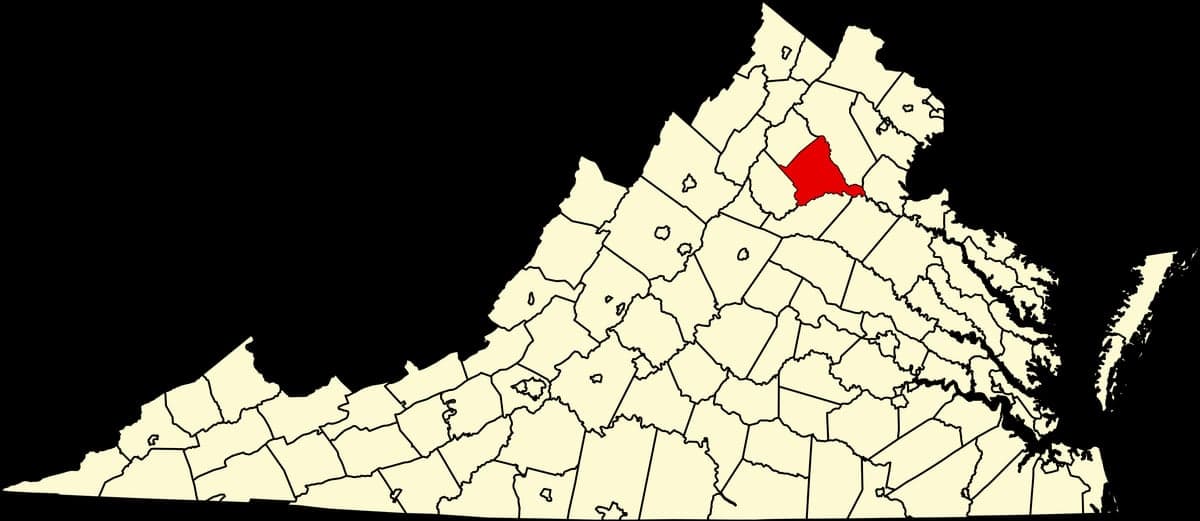
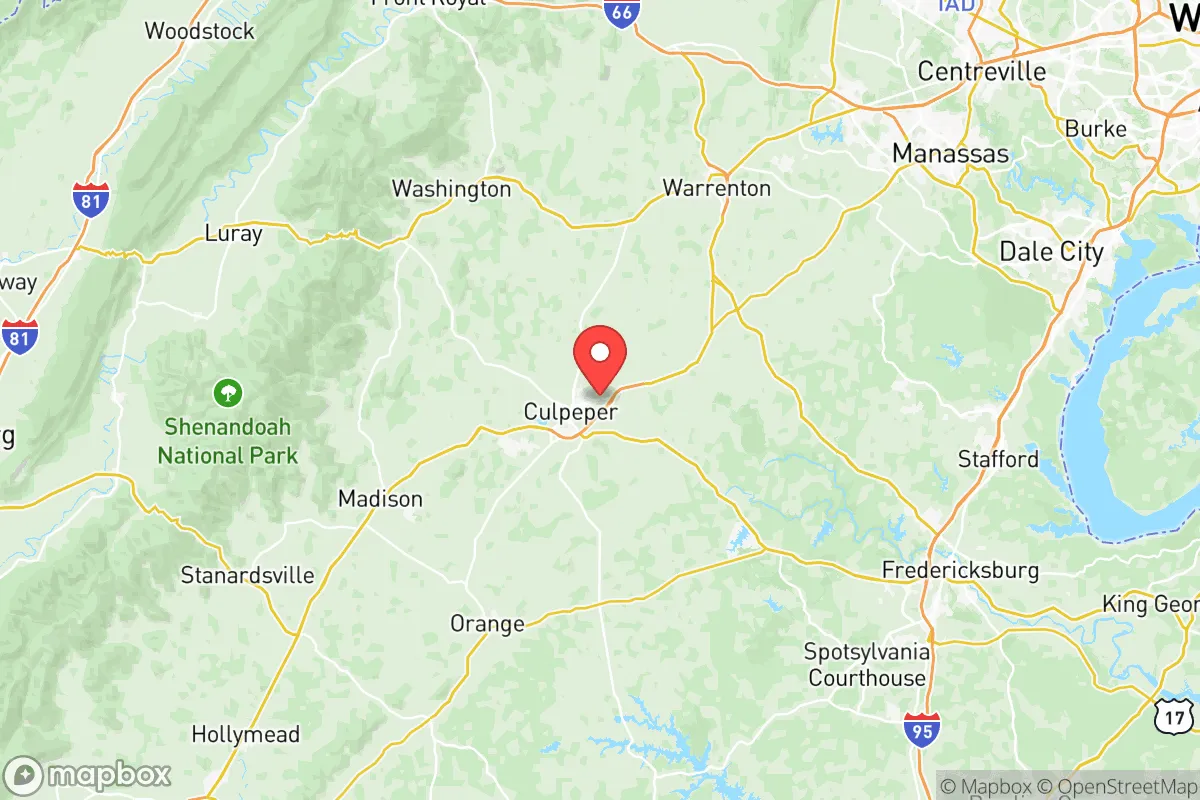
Photo: Wikipedia
Demographics of Culpeper County
Affluence Level in Culpeper County
A middle-class area roughly in line with national averages across income, home values, education, and employment.
People of Culpeper County
Culpeper County is home to roughly 53,500 people, a population that is 65.5% White, 14.8% Hispanic, 12.8% Black, and 1.0% East/Southeast Asian, with a distinct 0.2% Indian-subcontinent community and 5.8% foreign-born residents. The county’s character is rooted in a blend of Old Virginia agricultural tradition and modern exurban growth, with a notably lower college-attainment rate (26.4%) than the state average. Its people are largely concentrated in the historic town of Culpeper, the county seat, with growing suburban nodes in Rixeyville, Brandy Station, and the area around Lake Pelham.
Settlement & growth (pre-1960)
The original inhabitants of the Culpeper area were Siouan-speaking tribes, most notably the Manahoac Confederacy, who controlled the Rappahannock River watershed until pressure from the Iroquois to the north and English settlers from the east displaced them by the early 1700s. European settlement began in earnest around the 1720s, when the Virginia General Assembly opened the Piedmont for tobacco cultivation. The first English and Scots-Irish pioneers trickled down the Germanna Highway from the Tidewater region, establishing farms in what are now the precincts of Little Fork, Big Fork, and the town of Culpeper itself (founded as Fairfax in 1749, renamed in 1859).
The single most consequential migration wave arrived in the 1730s–1750s: a large contingent of German Protestants (often called "Germanna colonists") and Scots-Irish Presbyterians who pushed inland from the port of Fredericksburg. Many German families settled in the northern and eastern parts of the county, notably around the crossroads settlements of Stevensburg and Rappahannock Academy, where their stone foundations and churchyards still dot the landscape. They were drawn by the Spotsylvania Land Office’s promise of 50-acre headrights for tobacco cultivation—a labor-intensive crop that also powered the forced migration of enslaved Africans. By 1790, enslaved Black people constituted roughly 47% of Culpeper’s population, working the large plantations centered near Brandy Station, Lignum, and Cedar Mountain.
The 19th century brought little new foreign immigration to Culpeper; its population remained overwhelmingly native-born White and enslaved Black, with a modest free Black community concentrated in the town of Culpeper. The Civil War devastated the county—the Battle of Brandy Station (1863) and the Battle of Cedar Mountain (1862) left the landscape scarred and farmsteads burned. After emancipation, many formerly enslaved families remained as sharecroppers and tenant farmers, forming distinct rural settlements like the Free State community near Brightwood and the Catalpa neighborhood outside Culpeper town. A small wave of Irish laborers arrived in the 1870s–1880s to build the Orange and Alexandria Railroad (later the Southern Railway), laying track through Culpeper, Jeffersonton, and Winston. These Irish families typically did not remain in large numbers; most moved on to rail hubs in Richmond or Washington. From 1900 through 1960, the county’s population grew slowly, hovering around 13,000–14,000, sustained by tobacco farming, livestock, and the railroad depot in Culpeper town. The Great Migration saw a significant outflow of Black residents to Northern cities, reducing the Black share from roughly 40% in 1910 to 26% by 1960.
Modern era (post-1965)
The 1965 Hart-Cellar Act had a modest direct effect on Culpeper compared to urban Virginia, but it coincided with two domestic shifts that transformed the county’s human map. First, the construction of the Lake Pelham reservoir in the 1960s and the expansion of US-29 into a four-lane highway made Culpeper accessible as a bedroom community for commuters to the Washington, D.C., suburbs (particularly Fairfax and Prince William counties). This triggered a wave of domestic migration from Northern Virginia and the Rust Belt from the 1980s onward—primarily white-collar families and retirees seeking cheaper land. Second, federal immigration policy changes, along with the 1986 Immigration Reform and Control Act, drew a new Hispanic population, largely of Mexican and Central American origin, to work in the county’s poultry-processing plants (notably the Cargill and George’s Foods facilities near the town of Culpeper) and in construction and landscaping for the booming exurbs.
The Hispanic share of the county surged from under 2% in 1990 to 14.8% in the 2020s, with Spanish-speaking enclaves forming predominantly in the census tracts west of downtown Culpeper and in the rural area around Mitchells. The Black population, meanwhile, declined slightly in overall share (to 12.8%) as older Black farming families aged out and younger generations continued a slow outmigration to Richmond and Washington-area job centers. The East/Southeast Asian community (1.0%) is a very recent addition, composed largely of Korean and Filipino professionals affiliated with the Culpeper Regional Hospital system and a small contingent of Vietnamese families who relocated from Northern Virginia for lower home prices; they live mostly in the newer subdivisions off Route 3 east of Culpeper town. The Indian-subcontinent community (0.2%) is tiny but growing, anchored by a handful of doctors and IT workers who commute to the Dominion Energy data centers in nearby Remington and generally live in the Lake Pelham area. The overall foreign-born share (5.8%) is lower than the Virginia state average (about 13%), reflecting the county’s relatively quiet pace of international migration.
The future
Culpeper County’s population trajectory points toward continued, if moderate, diversification—driven more by domestic relocation from the D.C. metro area than by new international arrivals. The county is projected to grow to roughly 58,000–60,000 by 2035, with the Hispanic share likely rising to 18–20% as younger families age into childbearing and new arrivals from the Salvadoran and Guatemalan communities follow existing kin networks. The White population will remain the largest single group but will decline in relative share (to roughly 60% or slightly below), while the Black percentage is likely to hold steady near 12–13%, as outmigration slows and some Black professionals from Prince William County relocate to Culpeper for larger lots and lower taxes. The East/Southeast Asian and Indian populations will grow slowly, probably reaching 1.5–2% combined, as data-center construction and healthcare hiring continue. No large new ethnic enclaves are expected—the county’s built environment is dispersing into cul-de-sac subdivisions rather than dense traditional neighborhoods—so the cultural identity of Culpeper is likely to remain broadly Southern-rural with a growing Hispanic and suburban overlay. The political and social tone, already conservative, may moderate slightly as new arrivals bring D.C.-area sensibilities, but the region’s low density and strong agriculture sector provide a brake on rapid change.
For a family or individual moving to Culpeper County today, the bottom line is that they are joining a place that is still overwhelmingly native-born and rooted in Virginia’s rural traditions, but which is slowly absorbing the demographic currents of the 21st-century exurbs. The population is becoming less White, slightly more Hispanic, and more connected to the Washington region’s economy—while maintaining a slower pace of life and lower cost of living than the northern suburbs. The county rewards those who value open space, local history, and a community where newcomers are noticed but generally welcomed, with the understanding that its future will look more diverse than its past.

* Values derived from national, state, county, city and local statistics and may differ in a specific area. Last updated: 2026-06-25T08:00:13.000Z
Narrative content on this page is AI-generated and may contain mistakes. Verify any details that matter before acting on them.
ReloMaps may earn a commission from affiliate links at no extra cost to you.

