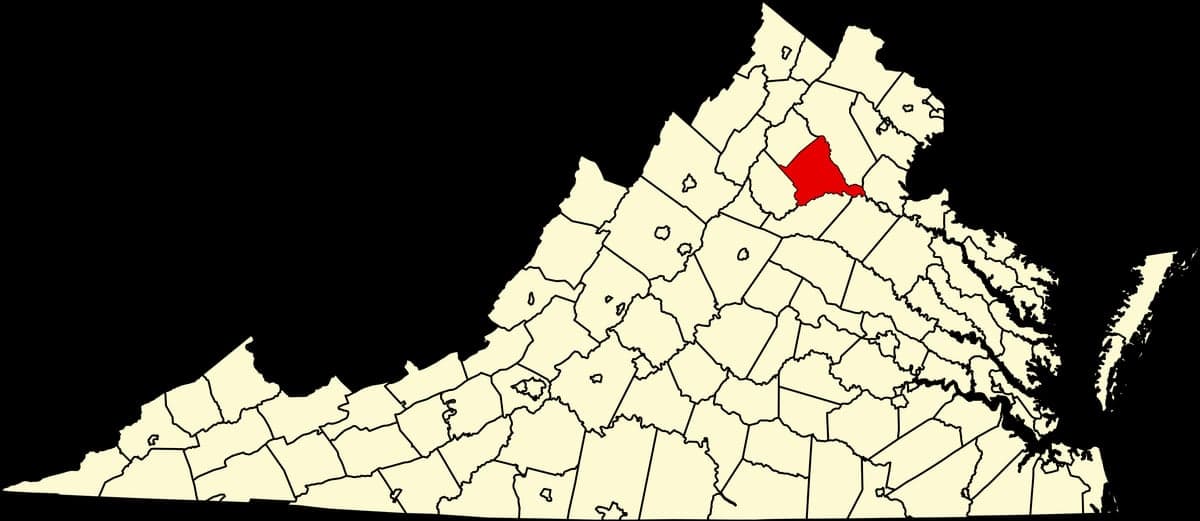
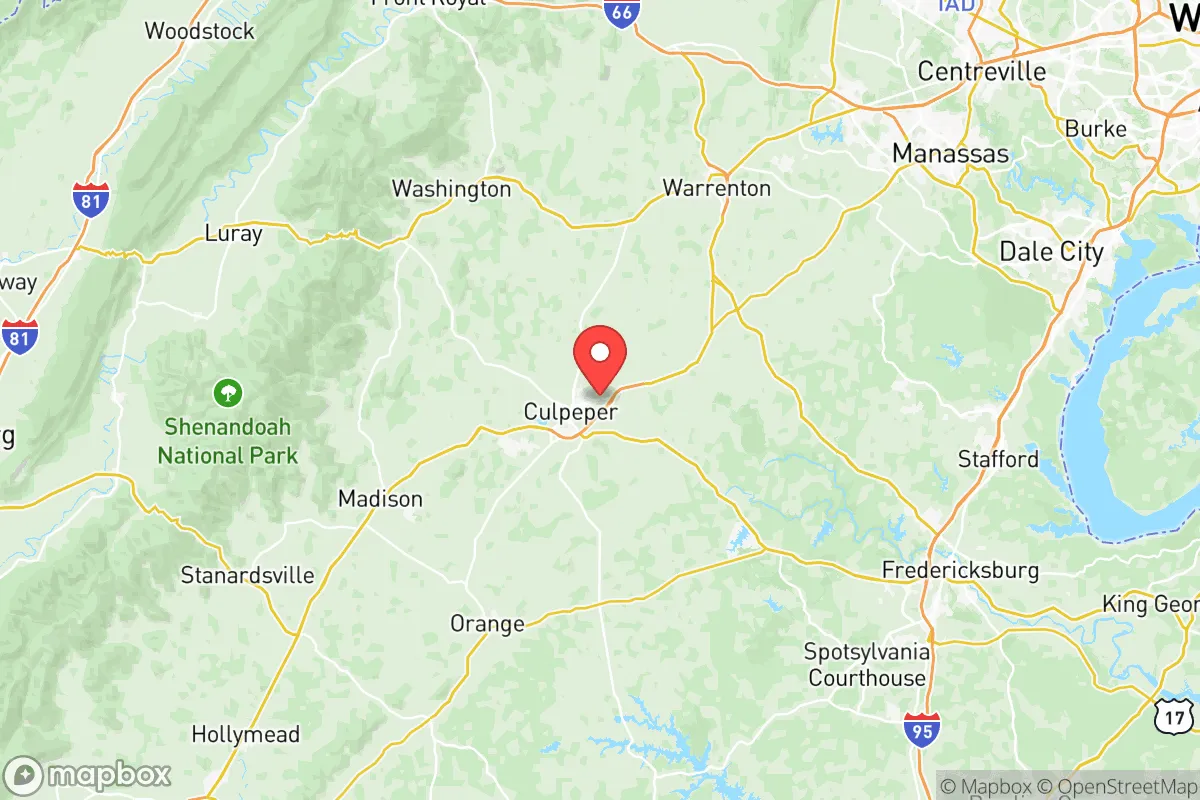
Photo: Wikipedia
Personal Sovereignty in Culpeper County
Viable for self-reliance. Generally workable, though some barriers may limit total independence.
What does Personal Sovereignty tell us?
Personal Sovereignty measures your capacity for self-reliance and independence with minimal government friction. Higher scores mean fewer barriers between you and the way you want to live... but it assumes you have the space you need and good neighbors.
What does this tell us?
Personal Sovereignty measures your capacity for self-reliance and independence with minimal government friction. Higher scores mean fewer barriers between you and the way you want to live... but it assumes you have the space you need and good neighbors.
State Policy
Energy independence: Importer (20% of energy produced in-state)
Personal Liberty
Homesteading

Personal Liberty Analysis
Culpeper County, Virginia, offers a noticeably stronger personal sovereignty environment than the heavily regulated suburbs of Northern Virginia or the more restrictive jurisdictions of the Commonwealth, largely due to its rural character and local governance that leans toward limited government. While Virginia as a state imposes a top-down regulatory framework in areas like firearms and land use, Culpeper County exercises local discretion that preserves significant room for individual autonomy. For families and single individuals prioritizing personal freedom, the county represents a meaningful middle ground — unencumbered by urban-style ordinances but still subject to state-level constraints that shape self-reliance and daily life.
Tax burden and regulatory posture: how county policy compares to the state
Culpeper County’s overall tax burden sits roughly in the middle of Virginia’s 95 counties, offering a tangible advantage over the high-tax environment of neighboring Fairfax or Loudoun counties. The county’s real property tax rate is approximately $0.53 per $100 of assessed value as of 2025, which is below the state median and substantially lower than the $1.00+ rates seen in many Northern Virginia localities. Businesses and residents benefit from Virginia’s right-to-work status and a state-level regulatory climate ranked as moderately business-friendly, but Culpeper County further lightens the load through minimal local business licensing requirements and a planning department that processes most permits within 30 days for standard residential projects. The county has not adopted the more aggressive stormwater management or energy codes found in localities like Charlottesville or Arlington, meaning homesteaders and small builders face fewer compliance hurdles. However, Virginia’s personal property tax on vehicles and boats remains in effect — expect to pay roughly 4-5% of assessed value annually — a feature that feels heavy to newcomers from states like Texas or Florida.
Self-defense and gun law specifics: what the Second Amendment looks like on the ground
Culpeper County is a solidly pro-Second Amendment jurisdiction within a state that has moved in a restrictive direction since 2020. Virginia is a shall-issue state for concealed handgun permits, and Culpeper’s circuit court processes applications with typical wait times of 30-45 days, significantly faster than the 90+ days reported in more populous counties. The county sheriff’s office has publicly stated that it will not enforce unconstitutional federal firearms restrictions — a policy alignment common in rural Virginia but absent in urban centers like Richmond or Alexandria. Open carry is legal in Virginia without a permit for anyone 18 or older who may lawfully possess a firearm, and Culpeper sees regular open carry in everyday settings including grocery stores and gas stations. The town of Culpeper itself is the county seat and most populated area, where gun-friendly culture is visible in the presence of multiple firearms retailers and a local chapter of the Virginia Citizens Defense League. In more rural pockets like Rixeyville and Lignum, most residents view firearm ownership as a baseline expectation rather than a political statement, and private land owners frequently conduct informal target practice without local ordinance interference. One important state-level limitation: Virginia’s 2020 “one handgun a month” law restricts purchases, and the ban on certain firearms features (often called the “assault weapon” restrictions) remains in effect despite local opposition — a binding constraint that no county ordinance can override.
Self-reliance and homesteading viability: lot sizes, zoning, and off-grid feasibility
For those seeking to live off-grid or pursue serious homesteading, Culpeper County offers substantial opportunities outside the town limits, though with some important constraints tied to state health codes. Residential zoning in the county’s Agricultural (A-1) district permits parcels as small as 3 acres for a single-family dwelling, but most active homesteaders target lots of 10-20 acres in areas like Stevensburg and Brandy Station, where well and septic approvals are routine and neighbors are unlikely to object to chickens, goats, or even a small beef herd. Virginia’s statewide building code requires a minimum 200-square-foot septic drainfield per bedroom, which sets a practical floor on how small a homestead can be for full-time occupancy, but the county does not impose the extra 100-foot setbacks or riparian buffers that complicate development in counties like Fauquier. Jeffersonton and Rixeyville have become informal hubs for solar-powered homes and rainwater catchment systems, though the county does require an electrical permit for grid-interactive solar setups. Off-grid power without utility connection is permitted, provided the dwelling meets Virginia’s Uniform Statewide Building Code for structural safety — a moderate hurdle that typically costs $500-$1,000 for plan review. The county does not ban composting toilets or greywater systems explicitly, but the health department requires a conventional septic system for any occupied dwelling with plumbing. For the truly self-reliant, the Kelly’s Ford area along the Rappahannock River offers parcels with limited road access that effectively guarantee privacy, though buyers should verify that recorded easements exist to avoid landlocked property issues.
Personal liberties: parental rights, medical autonomy, speech, and property
Parental rights in Culpeper County are protected by strong local school board policy that aligns with Virginia’s 2023 changes requiring parental notification for any curriculum involving human sexuality and parental opt-out rights for all library materials deemed sexually explicit — a contrast to the more permissive stances in counties like Fairfax or Loudoun. Medical autonomy is generally respected in the county’s healthcare environment, with UVA Health Culpeper Medical Center offering standard care without the vaccine mandates or masking requirements still found in urban hospitals, and most local physicians operate independent practices that accept direct-pay patients. Free speech and assembly rights are exercised robustly in public spaces — the county courthouse lawn in downtown Culpeper hosts regular political rallies and community demonstrations without permit delays or permit fees, a practice that differs sharply from the permit-required and fee-bearing systems in Richmond or Virginia Beach. Property rights remain a strong point: the county does not have a rental inspection program or inclusionary zoning overlay, and there are no local short-term rental restrictions beyond the state’s 2023 registration requirement. However, Virginia’s statewide prohibition on local firearm preemption means that any future county board could not create its own gun regulations — that power rests solely with the General Assembly — which is a structural limitation that some freedom-minded residents find frustrating but also ensures consistency.
Overall, Culpeper County delivers a personal sovereignty profile that ranks among the more favorable in Virginia for those who value self-reliance, limited local government, and traditional liberties. It lacks the unregulated frontier character of deeply rural western counties like Highland or Bath, but it compensates with better access to jobs, schools, and medical care while still preserving a governance culture that leaves residents largely alone. For a family or individual moving from a high-regulation state like California or New York, the adjustment will feel liberating; for someone coming from a freer state like Wyoming or Montana, the state-level constraints on firearms and building codes will be noticeable. The county’s balance between autonomy and infrastructure makes it a pragmatic choice for the conservative-leaning relocator who wants freedom without total isolation.

* Values derived from national, state, county, city and local statistics and may differ in a specific area. Last updated: 2026-06-25T08:00:13.000Z
Narrative content on this page is AI-generated and may contain mistakes. Verify any details that matter before acting on them.
ReloMaps may earn a commission from affiliate links at no extra cost to you.

