Political ClimatePolitical Climate in Chesapeake City County
Showing district-level results — no local-only data available.
Local Political AnalysisPolitical Analysis of Chesapeake City County
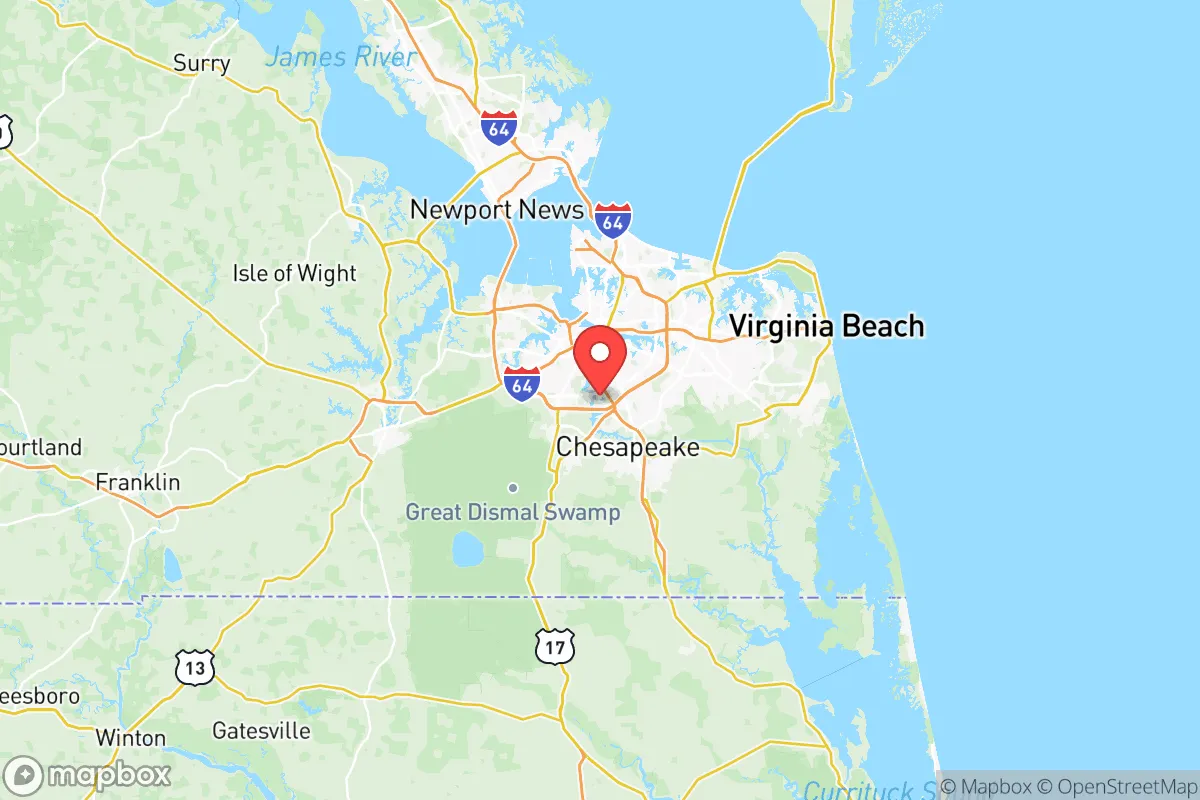
Chesapeake City County is a deep blue stronghold in Virginia, carrying a Cook PVI of D+18, which means it votes about 18 points more Democratic than the nation as a whole. That's a far cry from the state's overall D+4 rating, and it's been trending this way for a while—Chesapeake hasn't gone Republican in a presidential race since 2004, and the margin has only widened since then. The county's political identity is shaped by its mix of suburban sprawl, military families, and a growing African American population, but it's not a monolith; you'll find real pockets of red, especially in the more rural, southern stretches near the North Carolina line.
How it compares
Compared to Virginia as a whole, Chesapeake is significantly more Democratic. The state's D+4 PVI reflects a purple-to-blue tilt, driven by the populous, liberal-leaning suburbs of Northern Virginia and Richmond, but balanced by conservative rural areas in the Shenandoah Valley and Southside. Chesapeake, by contrast, is part of the Hampton Roads region, which leans blue overall, but the county itself is the most Democratic in the area outside of Norfolk. The political variation within Chesapeake is noticeable: neighborhoods like Great Bridge and Hickory tend to lean more Republican, with precincts often voting 55-60% for GOP candidates in local races. Meanwhile, areas like Deep Creek and South Norfolk are reliably Democratic, often hitting 70% or more for Democrats. The swing precincts are in the central part of the county, around Greenbrier and Western Branch, where the vote can split 50-50 in close elections, making them the battlegrounds for city council and school board races.
What this means for residents
For liberal residents, the D+18 lean means their values are broadly reflected in local governance—Chesapeake's city council has a Democratic majority, and the county consistently supports Democratic candidates for state and federal office. You'll find progressive policies on issues like affordable housing and environmental protections, though the pace can be slower than in more urban areas like Norfolk. For conservative residents, it's a different story: they're a clear minority in countywide elections, but they hold real influence in their own precincts. In Great Bridge and Hickory, you'll find active Republican committees, conservative churches, and a strong sense of community around issues like gun rights and lower taxes. The practical effect is that while Democrats control the levers of power, they can't ignore the conservative base—especially in close city council races, where a few hundred votes in those swing precincts can decide the outcome.
Culturally, Chesapeake feels more suburban and family-oriented than the rest of Hampton Roads, with a strong military presence from nearby Naval Support Activity Hampton Roads and Joint Base Langley-Eustis. This gives the county a pragmatic, service-oriented vibe that cuts across party lines. Policy-wise, you'll see a focus on schools and infrastructure—both parties agree on that—but the divide shows up in debates over land use and taxes. The county's trajectory is clear: it's getting bluer, driven by in-migration from Norfolk and Virginia Beach, and younger families moving into new developments. But the conservative pockets are dug in, and they're not going anywhere. If you're moving here, expect a place where your vote matters locally, even if the national outcome is a foregone conclusion.

State Political ClimatePolitical Climate in Virginia
State Political AnalysisPolitical Environment in the State
Virginia has shifted from a reliably purple swing state to a solidly Democratic-leaning one over the past two decades, carrying a Cook PVI of D+4. The transformation is driven primarily by explosive growth in the Washington, D.C. suburbs, which now dominate statewide elections and have pulled the state leftward even as rural and exurban areas have become more Republican. For a conservative relocator, the reality is nuanced: you can find deeply red communities within an hour of a deep blue city, but state-level policy increasingly reflects the priorities of the urban crescent.
Urban vs. rural divide
The political map of Virginia is essentially a story of two Virginias. The "urban crescent" — Northern Virginia (Arlington, Fairfax, Loudoun, Prince William counties), Richmond, and the Hampton Roads area (Virginia Beach, Norfolk, Chesapeake) — generates the vast majority of the state's population and votes reliably Democratic. Loudoun County, once a conservative stronghold, flipped from +20 R in 2004 to +25 D in 2020, emblematic of the broader shift. Meanwhile, Southside Virginia, the Shenandoah Valley, and Southwest Virginia (places like Roanoke, Lynchburg, and the coal country around Wise County) vote heavily Republican. The divide is stark: in 2024, Fairfax County gave Democrats a 300,000-vote margin, while the entire western half of the state combined couldn't offset it. The I-95 corridor is the spine of Democratic power, and the rural counties along the Blue Ridge and the North Carolina border are the GOP's base.
Policy environment
Virginia's tax structure is moderate compared to its neighbors. The state income tax is a flat 5.75% (reduced from 6% in 2023), and the sales tax is 5.3% (higher in Northern Virginia and Hampton Roads due to local add-ons). Property taxes are set locally and vary widely — Loudoun County's rate is about $1.20 per $100 of assessed value, while rural Pittsylvania County is around $0.50. There is no state-level property tax. The regulatory posture is business-friendly in some respects (right-to-work state, low corporate income tax at 6%), but increasingly progressive on social and environmental issues. Education policy is a flashpoint: the state has adopted the "Virginia Literacy Act" emphasizing phonics, but also mandates LGBTQ-inclusive curricula in some districts. Election laws are among the most accessible in the South — no-excuse absentee voting, 45 days of early voting, and same-day voter registration. Gun laws are moderate: a one-handgun-per-month limit, universal background checks, and a red flag law passed in 2020, but no assault weapons ban or magazine capacity limit.
Recent policy direction
The last five years have seen Virginia lurch leftward on several fronts, then partially stabilize under Governor Glenn Youngkin (R). In 2020, Democrats passed the Virginia Clean Economy Act, mandating 100% carbon-free electricity by 2050, and abolished the death penalty. The 2021 election of Youngkin halted further progressive momentum, but the Democratic-controlled Senate has blocked most of his agenda. Key recent laws include: the 2023 "Right to Contraception Act" codifying birth control access; the 2024 "Cell Phone-Free Education" executive order banning phones in K-12 classrooms; and the 2023 "Consumer Data Protection Act" giving residents control over how companies use their personal data. On gun rights, Youngkin signed a bill allowing permitless concealed carry for military members, but a broader constitutional carry bill failed. On parental rights, Youngkin's model policies on transgender students (requiring parental notification and limiting bathroom access) were adopted by about 40% of school districts, but blocked by others. Property rights remain strong — Virginia is a "Dillon Rule" state, meaning localities only have powers explicitly granted by the state, which limits local zoning overreach but also local autonomy.
Civil unrest & political movements
Virginia has been a stage for some of the most visible political flashpoints in the country. The 2017 "Unite the Right" rally in Charlottesville and the subsequent violence left a lasting mark, leading to the removal of Confederate statues statewide and ongoing debates about public memory. The 2020 protests following George Floyd's murder were particularly intense in Richmond, where protesters toppled a statue of Jefferson Davis. On the right, the 2021 "Parents Matter" movement in Loudoun County — sparked by a sexual assault incident and disputes over transgender policies — became a national template for conservative school board activism. Immigration politics are relatively quiet compared to border states, but Northern Virginia has sanctuary-like policies in some localities (Fairfax County limits cooperation with ICE). Election integrity controversies flared in 2020-2021, with some rural counties passing resolutions questioning the 2020 results, but no widespread fraud was found. The state's voter ID law is moderate — a photo ID is required, but expired IDs are accepted.
Projection
Over the next 5-10 years, Virginia's Democratic lean is likely to deepen, but not uniformly. Northern Virginia continues to grow at 1-2% annually, adding tens of thousands of new, mostly Democratic voters each cycle. The Hampton Roads area is more competitive, with Virginia Beach trending left but Chesapeake and Suffolk staying purple. Rural Virginia is shrinking — Southwest Virginia lost population in the 2020 census — which will further concentrate Democratic power in the urban crescent. However, the GOP has a foothold in the exurbs: places like Spotsylvania, Stafford, and Culpeper counties are growing fast and leaning red. The wild card is the 2030 redistricting cycle, which could shift the balance of the state legislature. For a conservative moving in now, expect state-level policy to remain center-left on social issues and climate, but with a strong counterweight in the governor's office and a resilient rural GOP base. The practical reality is that your local government and school board will reflect the politics of your chosen county far more than the state as a whole.
Bottom line for a new resident: Virginia offers a genuine choice of political environments within a single state. If you want a conservative community with low taxes and strong gun rights, move to the Shenandoah Valley or Southside. If you want a progressive, high-amenity urban area, Northern Virginia delivers. The state government will lean left on most issues, but your daily life will be shaped by your locality. The key is to pick your county carefully — and understand that the state's overall trajectory is toward the Democratic side of the ledger, even if your neighborhood feels like a different country.
* Values derived from national, state, county, city and local statistics and may differ in a specific area. Last updated: 2026-07-16T05:54:36.000Z
Narrative content on this page is AI-generated and may contain mistakes. Verify any details that matter before acting on them.
ReloMaps may earn a commission from affiliate links at no extra cost to you.

