Strategic Assessment of Chesapeake City County
Multiple tactical vulnerabilities. Population density, target proximity, or disaster risk are likely compounding. A retreat property and exit planning is required.
What does the Strategic Assessment tell us?
Our Strategic Assessment grades tactical survivability of an area. Major population centers, military targets, fallout zones, natural disasters, and border exposure all drive risk — lower exposure means a more defensible position in a crisis.
This is heavily inspired by Joel Skousen's Strategic Relocation book. Highly recommended you checkout the book ($)What does this tell us?
Our Strategic Assessment grades tactical survivability of an area. Major population centers, military targets, fallout zones, natural disasters, and border exposure all drive risk — lower exposure means a more defensible position in a crisis.
This is heavily inspired by Joel Skousen's Strategic Relocation book. Highly recommended you checkout the book ($)Strategic Pillars

Key Distances
Strategic Assessment Analysis
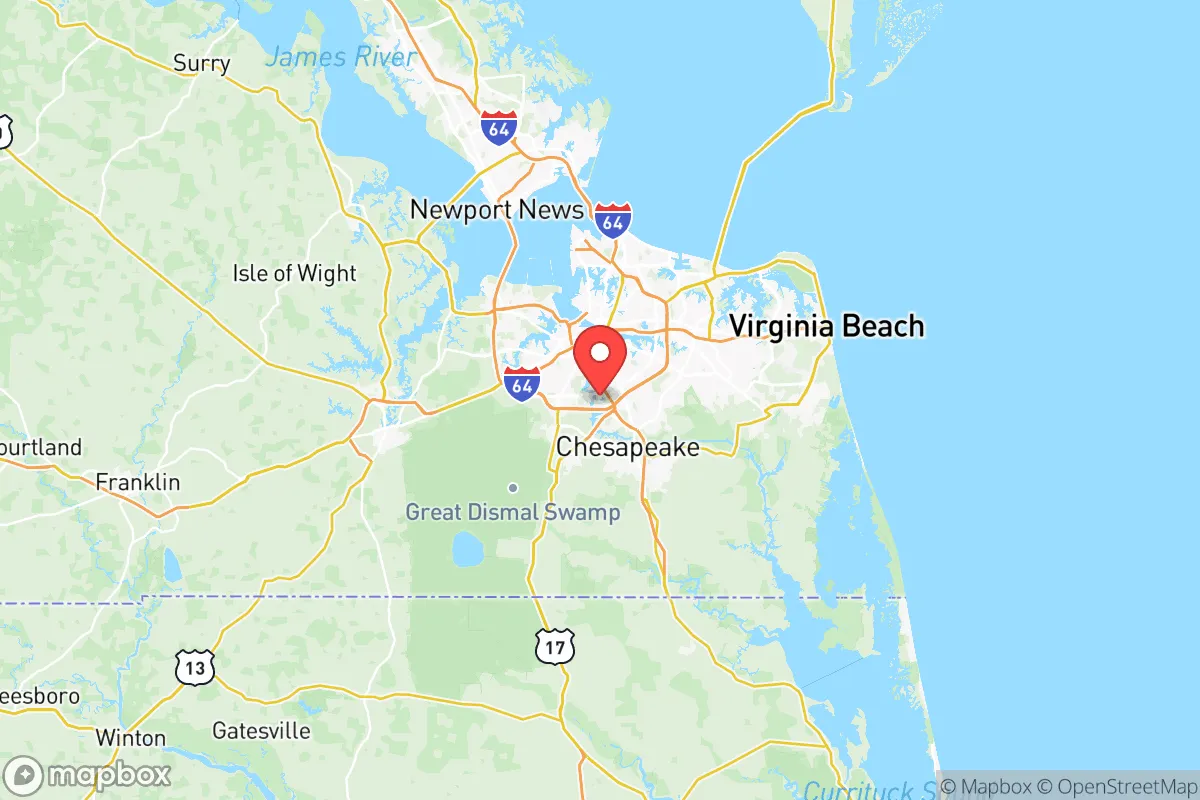
Chesapeake City County, Virginia, occupies a unique strategic position at the confluence of the Intracoastal Waterway, the Elizabeth River, and the Atlantic Ocean, offering a blend of natural resilience and significant exposure to man-made risks. For a relocator prioritizing disaster readiness and self-sufficiency, Chesapeake provides a mixed picture: its geographic advantages—ample freshwater, fertile soil, and a relatively low population density for a major metro area—are counterbalanced by its proximity to high-value military and industrial targets. The city’s location, roughly 10 miles south of Norfolk and 20 miles west of Virginia Beach, places it within the Hampton Roads metropolitan area, a region that is both a logistical hub and a potential fallout-relevant zone.
Geographic position and natural advantages for self-sufficiency
Chesapeake’s geography is defined by its position on the Southern Virginia Coastal Plain, bordered by the Great Dismal Swamp to the south and the Atlantic Ocean to the east. This location offers several natural advantages for a self-sufficient lifestyle. The city sits atop the Potomac Aquifer, one of the most productive groundwater sources on the East Coast, providing reliable access to freshwater for wells and small-scale agriculture. The region’s temperate climate supports a growing season of roughly 210 days, allowing for year-round food production. The Great Dismal Swamp, a 112,000-acre national wildlife refuge, acts as a natural buffer against storm surges and provides a vast, undeveloped area for hunting, foraging, and timber. The Intracoastal Waterway, which runs through the city’s eastern edge, offers a navigable route for trade or evacuation by boat, bypassing congested highways. For a relocator, the combination of abundant water, arable land, and low-density rural pockets—such as the Deep Creek and Hickory areas—makes Chesapeake one of the more viable locations in Hampton Roads for establishing a resilient homestead.
Risks, exposures, and proximity to fallout-relevant landmarks
The same geography that provides natural advantages also exposes Chesapeake to significant risks. The city lies within the Norfolk Naval Station’s operational footprint, the world’s largest naval base, located just 12 miles north. This base, along with Joint Expeditionary Base Little Creek (10 miles east) and Naval Air Station Oceana (15 miles east), makes the region a high-priority target in any conflict scenario. Additionally, the Port of Virginia in nearby Norfolk and Newport News handles over 3 million containers annually, including military cargo and fuel shipments, further concentrating strategic value. Chesapeake itself hosts the U.S. Coast Guard Base Portsmouth and several industrial facilities along the Elizabeth River, including chemical storage and ship repair yards. Natural risks are equally pronounced: the city is vulnerable to hurricanes and nor’easters, with storm surge from the Chesapeake Bay capable of flooding low-lying areas like the Southern Branch of the Elizabeth River. Flood insurance is mandatory in many zones, and the city’s flat terrain offers little natural defensibility against a ground-level threat. For a relocator, the proximity to these targets means that any major conflict or terrorist event could render Chesapeake a secondary fallout zone, with evacuation routes (primarily I-64 and US-17) quickly becoming impassable.
Practical resilience for a relocator: food, water, energy, and defensibility
For a relocator serious about self-sufficiency, Chesapeake offers a mixed bag of practical resilience factors. Water access is excellent: the Potomac Aquifer supports private wells at depths of 100-300 feet, and the city’s numerous creeks and rivers—including the Northwest River and the Elizabeth River—provide surface water for filtration. However, well permits are regulated by the Virginia Department of Health, and new construction in floodplains faces restrictions. Food production is viable: the city’s agricultural zoning in the southern and western reaches allows for livestock, orchards, and row crops, with the Virginia Cooperative Extension offering resources for small-scale farming. Local farmers’ markets, such as the one at Chesapeake City Park, provide a network for seed and supply trading. Energy resilience is moderate: Dominion Energy’s grid is reliable but vulnerable to storm outages; solar panel installations are growing, with net metering available, but battery storage is not yet widespread. The city’s building codes, updated in 2023, require wind-resistant construction in coastal zones, adding to structural resilience. Defensibility is a weakness: the flat, open terrain and dense suburban development in areas like Greenbrier and Great Bridge make it difficult to secure a property against a determined threat. Rural parcels in the Deep Creek area offer more seclusion, but the lack of natural chokepoints—no mountains, no dense forests—means that a relocator would need to invest in perimeter security, such as fencing, cameras, and reinforced doors. Community resilience is bolstered by a strong local emergency management system, with the Chesapeake Fire Department operating 18 stations and the city maintaining a 72-hour emergency supply cache. For a family, the trade-off is clear: Chesapeake provides the resources for long-term self-sufficiency but demands proactive investment in security and evacuation planning.
Overall, Chesapeake City County presents a strategic picture of calculated risk. Its natural advantages—abundant water, fertile land, and a temperate climate—make it one of the more viable locations in coastal Virginia for a self-sufficient lifestyle. However, its proximity to the Norfolk Naval Station, the Port of Virginia, and multiple military installations means that any major conflict or terrorist event would likely have direct consequences for the area. For a relocator with a conservative leaning, the city offers a balance: the ability to build a resilient homestead in a relatively low-density setting, while remaining within a two-hour drive of the Blue Ridge Mountains for a secondary retreat. The key is to choose a property in the southern or western rural zones, away from the industrial corridors and floodplains, and to invest in off-grid water and energy systems. Chesapeake is not a fallout-proof location, but for a prepared individual or family, it provides the resources to weather most natural disasters and a reasonable chance of surviving a man-made one—provided the evacuation plan is solid and the pantry is stocked.

* Values derived from national, state, county, city and local statistics and may differ in a specific area. Last updated: 2026-07-16T05:54:36.000Z
Narrative content on this page is AI-generated and may contain mistakes. Verify any details that matter before acting on them.
ReloMaps may earn a commission from affiliate links at no extra cost to you.

