
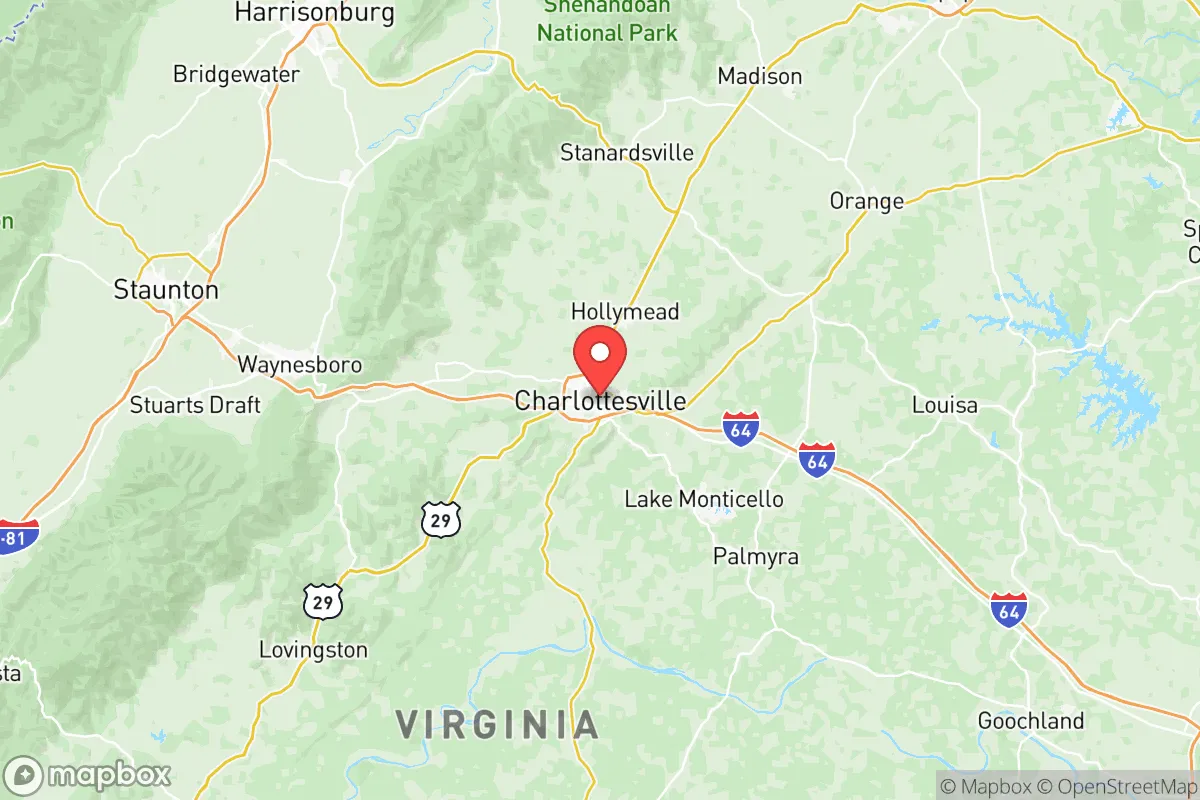
Quality of Life in Charlottesville City County
A livable area that tracks near national norms for affordability, walkability, and neighborhood health.
What does Quality of Life tell us?
Quality of Life measures an area by evaluating factors like cost of living, nearby amenities, country club access, airport proximity, socioeconomic signals and neighborhood character. For large states, this is a general average — quality of life can vary dramatically between metro areas, suburbs, and rural communities within the same state.
What does this tell us?
Quality of Life measures an area by evaluating factors like cost of living, nearby amenities, country club access, airport proximity, socioeconomic signals and neighborhood character. For large states, this is a general average — quality of life can vary dramatically between metro areas, suburbs, and rural communities within the same state.
Cost of Living
39% above national average
55%
The Real Cost of Living in Charlottesville City County for 2026
| Tier | Individual | Family (4) |
|---|---|---|
| Survival | $23k | $44k |
| Comfortable | $87k | $128k |
| Luxury | $126k+ | $196k+ |
| Elite (Top 5%) | $197k+ | $306k+ |
Quality-of-Life Analysis
Charlottesville City County, Virginia, is a geographically small independent city that functions as a unified urban and suburban county, offering a quality-of-life spectrum that ranges from a vibrant, walkable university town to quiet residential neighborhoods and semi-rural pockets on its fringes. The county draws a diverse mix of University of Virginia faculty and students, young professionals, families seeking top-tier schools, and retirees who value cultural amenities, with each group gravitating toward different parts of the city based on lifestyle preferences and budget.
Largest town(s) & population centers
The entirety of Charlottesville City County is the city of Charlottesville itself, which serves as the sole population center and the urban core of the broader Charlottesville metropolitan area. Daily life in the central city, particularly around the Downtown Mall and the University of Virginia (UVA) grounds, is defined by walkability, a dense concentration of restaurants and independent shops, and a calendar of cultural events like the Virginia Film Festival and Fridays After Five concerts. The UVA Corner area buzzes with students and faculty, while the historic Belmont and Fifeville neighborhoods offer a mix of older homes and newer infill development, attracting professionals and families who want proximity to jobs and entertainment. The city's compact size—roughly 10 square miles—means most residents can walk or bike to work, with the average commute time of just under 17 minutes reflecting the ease of getting around.
Smaller towns & rural pockets
Because Charlottesville City County is an independent city, it does not contain separate incorporated towns or unincorporated rural communities within its boundaries. However, the county's character shifts noticeably as one moves away from the downtown core. The northern and western edges of the city, near the Albemarle County line, feel more suburban, with tree-lined streets and larger lots in areas like the Greenbrier and Fry's Spring neighborhoods. The southern end, along the Rivanna River and near the city's industrial corridor, includes pockets of older, more modest housing and light industrial uses. While no distinct "rural pockets" exist within the city limits, the adjacent Albemarle County communities of Crozet, Ivy, and Earlysville provide the rural and small-town lifestyle that many Charlottesville residents access for weekend recreation or longer commutes.
Cost & lifestyle range
The cost of living in Charlottesville City County is significantly above the national average, with a cost-of-living index of 139 (100 = US average), driven largely by housing. The median home value is $448,400, and the median rent is $1,453, placing the city among the more expensive housing markets in Virginia outside of Northern Virginia. Lifestyle options vary by neighborhood and budget. At the higher end, the North Downtown and Venable neighborhoods near UVA feature historic homes and condos often priced above $600,000, attracting faculty and affluent professionals who value walkability to the university and downtown. In the middle range, Belmont and Woolen Mills offer a mix of bungalows and townhomes in the $350,000–$450,000 range, popular with families and young professionals. At the more affordable end, the 10th and Page and Rose Hill neighborhoods have older, smaller homes and apartments with rents closer to the city median, though these areas are also experiencing gentrification pressure. The city's overall high cost means that renters and first-time buyers often look to neighboring Albemarle County for lower prices, but the trade-off is a longer commute and less access to urban amenities.
Who thrives in Charlottesville City County? The county is best suited for those who prioritize a compact, walkable urban environment with strong cultural and educational institutions, and who can afford the premium housing costs. University affiliates, professionals in healthcare and tech, and empty-nesters drawn to the vibrant downtown scene find the city's density and amenities appealing. Families with children benefit from the highly rated Charlottesville City Schools, though the limited housing stock and high prices can be a barrier. Those seeking a quieter, more rural lifestyle or lower housing costs will likely find a better fit in the surrounding Albemarle County communities, making Charlottesville City County a distinct urban island within a larger, more suburban and rural region.

Crime in Charlottesville City County
Generally safer than 60% of comparable U.S. locations.
Violent CrimeViolent Crime Analysis
Property CrimeProperty Crime Analysis
Crime Analysis
Charlottesville City County, Virginia, reports a violent crime rate of 209 incidents per 100,000 residents and a property crime rate of 1,389.4 per 100,000, placing it in a middle tier for safety compared to other independent cities in the Commonwealth. While the violent crime figure sits slightly below the national average, the property crime rate exceeds both the state and national benchmarks, making property theft and vehicle break-ins the most common public safety concerns. The city’s compact, urbanized footprint—combined with its role as a regional hub for the University of Virginia and downtown commerce—creates a concentrated crime environment that differs markedly from the surrounding Albemarle County suburbs.
Crime in context
Charlottesville’s violent crime rate of 209 per 100K is roughly 20% lower than the national average of 260 per 100K, but it is significantly higher than the rates in nearby suburban jurisdictions such as Crozet (part of Albemarle County, with a violent crime rate near 80 per 100K) and Scottsville (roughly 100 per 100K). Property crime in Charlottesville, at 1,389.4 per 100K, is about 15% above the Virginia state average of 1,200 per 100K and notably higher than in Ruckersville (Greene County) or Gordonsville (Orange County), where rates hover near 900 per 100K. The city’s crime profile is typical of a small urban center with a transient student population, a downtown entertainment district, and a significant low-income corridor along the Route 29 North commercial strip. The Charlottesville Police Department has struggled with staffing shortages in recent years, which has slowed response times in some precincts.
What residents experience
For most residents, the daily safety experience is shaped by property crime rather than violent encounters. Vehicle break-ins and package thefts are the most frequently reported offenses, particularly in neighborhoods near the University of Virginia campus, such as Venable and Lewis Mountain, and in the densely populated apartment complexes along Hydraulic Road. The downtown pedestrian mall, while generally safe during the day, sees a spike in thefts and disorderly conduct after 10 p.m., especially on weekends. Violent crime is concentrated in a few specific corridors: the Fry’s Spring and 10th & Page neighborhoods have historically reported higher rates of aggravated assault and robbery, though these remain relatively rare events. The city’s progressive elected officials and the Charlottesville Commonwealth’s Attorney’s Office have adopted a restorative justice and diversion-focused approach for non-violent offenders, which has reduced incarceration rates but has also led to criticism that repeat property offenders cycle through the system without meaningful consequences. This ideological leaning in the local justice system—prioritizing rehabilitation over detention—has contributed to a perception among some residents that the city is soft on crime, particularly for theft and drug-related offenses.
Neighborhood-level variation is significant. Belmont and Woolen Mills report violent crime rates roughly half the city average, while Rose Hill and Fifeville see rates closer to 300 per 100K. The University of Virginia maintains its own police force with a separate jurisdiction, and crime on campus is generally lower than in the surrounding city. For families and professionals, the safest residential options are typically in the western neighborhoods near Ivy Road or in the Greenbrier area, where property crime rates are comparable to suburban Albemarle County. Prospective residents should review block-level crime maps and consider that the city’s compact size means that high-crime and low-crime areas are often just a few blocks apart.
* Values derived from national, state, county, city and local statistics and may differ in a specific area. Last updated: 2026-07-10T02:08:41.000Z
Narrative content on this page is AI-generated and may contain mistakes. Verify any details that matter before acting on them.
ReloMaps may earn a commission from affiliate links at no extra cost to you.

