
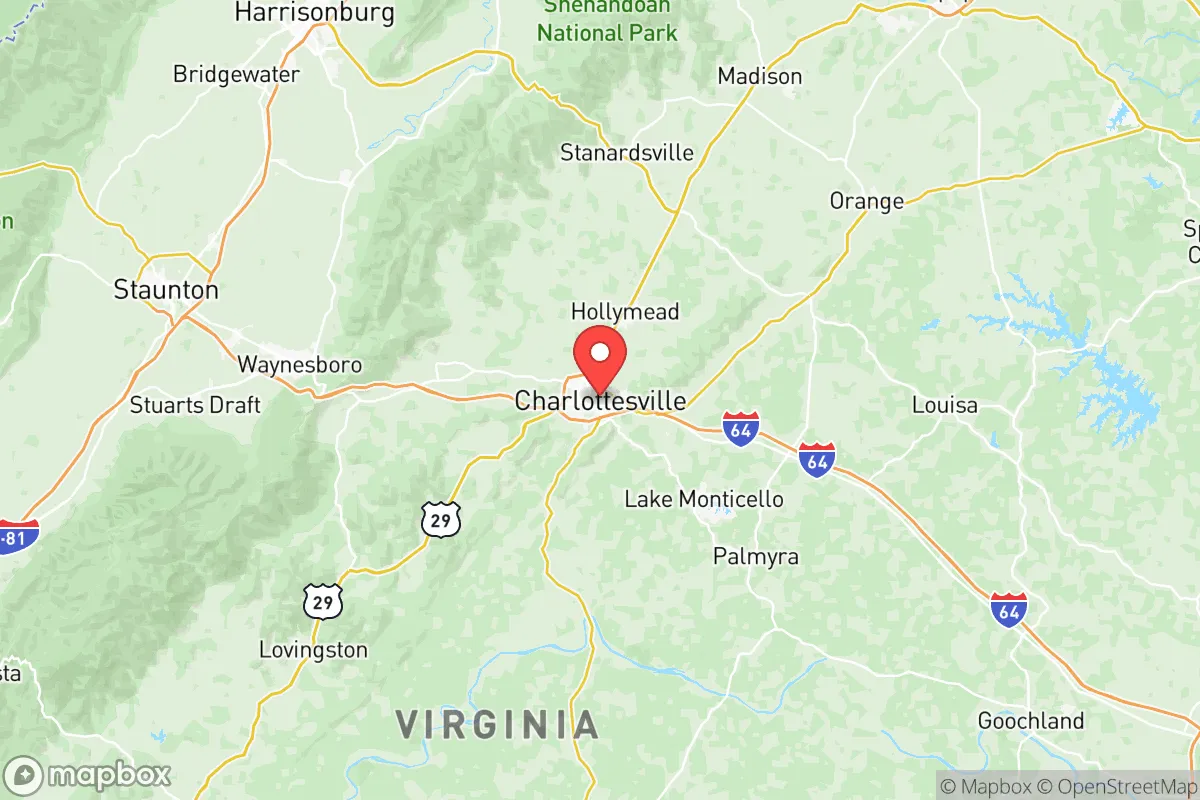
Political ClimatePolitical Climate in Charlottesville City County
Showing district-level results — no local-only data available.
Local Political AnalysisPolitical Analysis of Charlottesville City County
Charlottesville City County is a deep blue island in a sea of red, but the numbers tell a more complex story than the simple labels suggest. While the city itself votes overwhelmingly Democratic—often by margins of 70% or more in presidential elections—the surrounding Albemarle County is more of a purple patchwork, and the broader region leans right. The Cook PVI for the county is R+6, which reflects the fact that the city is a small, dense urban core surrounded by a much larger, more conservative rural and suburban area. The state of Virginia as a whole has shifted to D+4, meaning Charlottesville City County is roughly 10 points more Republican than the state average, but that's entirely because of the county's rural precincts, not the city itself.
How it compares
To understand the political landscape, you have to look at the precincts. Inside the city limits, places like the Jefferson Park Avenue area and the University of Virginia precincts are reliably blue, often hitting 80-85% Democratic. The Fry's Spring and Belmont neighborhoods are also solidly liberal. But drive just a few miles out of town, and the picture flips. In Crozet, a popular bedroom community in western Albemarle, you'll find a mix of moderate Democrats and Republicans, with precincts often splitting 50-50 or leaning slightly red. Head further south to Scottsville, and you're in deep red territory, where Republican candidates routinely win by 20 points or more. The swing precincts are in the Rio Road and Hydraulic Road areas of Albemarle County, where newer subdivisions and a mix of commuters and retirees create a genuine toss-up environment. Compared to the state, Charlottesville City County is a microcosm of the urban-rural divide that defines Virginia politics: the city votes like Arlington or Alexandria, while the county's rural parts vote like the Shenandoah Valley.
What this means for residents
For a liberal resident, living in the city means your vote is part of a comfortable majority, and local policies reflect that—things like a $15 minimum wage for city employees, strong tenant protections, and a city council that has declared support for sanctuary city policies. You'll find plenty of like-minded neighbors at the IX Art Park or on the Downtown Mall. For a conservative resident, the city can feel like a foreign country, but the county offers a different reality. In Crozet or Earlysville, you'll find active Republican committees, gun-friendly attitudes, and a school board that has pushed back on some progressive curriculum changes. The practical effect is that your experience depends heavily on where you live. If you're a conservative who works at UVA, you might feel politically isolated at work but comfortable at home in North Garden. If you're a liberal who bought a house in Ivy for the schools, you might be the only one on your street with a Harris sign.
The cultural and policy distinctions are sharp. The city has a strong "Blue Ridge progressive" vibe—think environmentalism, local food, and historic preservation mixed with social justice activism. The county is more libertarian-leaning, with a "live and let live" attitude that sometimes clashes with city ordinances. The biggest flashpoint in recent years has been the debate over Confederate monuments and the city's response to the 2017 Unite the Right rally, which deepened the political divide. Looking ahead, the city will likely stay blue as UVA expands and attracts more young, educated residents, while the county's rural precincts will remain red. The swing areas around Hollymead and Pantops will decide whether the county as a whole trends purple or stays red. For now, the area is a textbook example of how a single county can contain two completely different political worlds.

State Political ClimatePolitical Climate in Virginia
State Political AnalysisPolitical Environment in the State
Virginia has shifted from a reliably swing state to a solidly Democratic-leaning one over the past two decades, with a Cook PVI of D+4. The transformation is driven by explosive growth in the Washington, D.C. suburbs, particularly in Northern Virginia, which now supplies a massive Democratic vote margin that overwhelms the rest of the state. While the state still elects a Republican governor (Glenn Youngkin won in 2021) and has a competitive House of Delegates, the long-term trajectory is clearly blue, with Democrats controlling the governorship for 12 of the last 16 years and holding both U.S. Senate seats.
Urban vs. rural divide
The political map of Virginia is a textbook case of the urban-rural split. The Democratic stronghold is Northern Virginia, anchored by Arlington, Alexandria, and Fairfax County, which together cast over 1.5 million votes and deliver margins of 60-70% for Democrats. Richmond and Norfolk (Hampton Roads) are also reliably blue, while Charlottesville and Blacksburg (home to UVA and Virginia Tech) add academic liberal votes. The rural south and southwest—places like Lynchburg, Danville, and the coal country around Bristol—vote heavily Republican, often by 70% or more. The key battlegrounds are the exurban counties like Loudoun and Prince William, which flipped from red to blue in the 2010s and now decide statewide races. A conservative relocating to Virginia will find a very different political reality depending on whether they settle in Virginia Beach (a purple military town) versus Roanoke (a conservative-leaning mid-sized city).
Policy environment
Virginia’s tax structure is moderately competitive: a flat 5.75% income tax rate (one of the highest flat rates in the South) and a statewide property tax that averages about 0.8% of assessed value, though local rates vary widely. The state has no sales tax on groceries and a 5.3% general sales tax. Education policy is a major flashpoint: Governor Youngkin pushed through a 2022 executive order banning "inherently divisive concepts" in public schools, but the Democratic-controlled Senate has blocked most of his K-12 agenda. Virginia has a right-to-work law (no mandatory union membership) and is a "shall-issue" state for concealed carry permits, but it banned assault weapons and high-capacity magazines in 2020 under Democratic control. Election laws are moderately restrictive: voter ID is required, but same-day registration is not allowed, and early voting is available for 45 days. Healthcare is a mixed bag: Virginia expanded Medicaid under the ACA in 2019, but the state has some of the strictest abortion laws in the South after a 15-week ban was passed in 2023 with Youngkin’s support.
Recent policy direction
The last five years have seen Virginia swing hard in both directions, creating a whiplash effect for residents. In 2020, Democrats passed a sweeping gun control package (SB 35, HB 2) that included universal background checks, a "one handgun per month" limit, and a red flag law. In 2021, they legalized recreational marijuana (effective 2024), abolished the death penalty, and expanded voting access with no-excuse absentee voting. Then in 2022, Youngkin’s election brought a conservative turn: he signed a 15-week abortion ban (HB 1387), rolled back COVID-19 mandates, and pushed for parental rights in education (the "Parents Matter" campaign). On property rights, Virginia has a strong "right to farm" law protecting agricultural operations from nuisance lawsuits, but local zoning battles in Northern Virginia are intense over missing-middle housing. On privacy, the state passed a comprehensive data privacy law (VCDPA) in 2021, but it lacks a private right of action. For conservatives, the recent direction on guns and abortion is concerning; for liberals, the 2020-21 Democratic trifecta was a high-water mark that has since receded.
Civil unrest & political movements
Virginia has been a flashpoint for political violence and protest. The 2017 "Unite the Right" rally in Charlottesville (which turned deadly) remains a national symbol of far-right extremism. In 2020, Richmond saw massive Black Lives Matter protests, including the toppling of a Confederate statue on Monument Avenue. The state’s gun rights movement is highly organized: the 2020 "Lobby Day" in Richmond drew over 20,000 armed protesters, leading to a temporary state of emergency. Immigration politics are less heated than in border states, but Prince William County has a history of sanctuary city debates, and the state generally avoids aggressive enforcement. Election integrity controversies flared in 2020-2021, with Youngkin’s campaign focusing on "election security" and the state conducting a post-election audit that found no widespread fraud. A new resident will notice the Confederate monument debates still simmering in smaller towns, and the presence of "Don't Tread on Me" flags in rural areas versus "Black Lives Matter" signs in the suburbs.
Projection
Over the next 5-10 years, Virginia will continue its slow but steady drift leftward, driven by demographic trends. Northern Virginia is adding population at twice the state average, and the new arrivals are overwhelmingly young, diverse, and college-educated—a reliably Democratic voting bloc. The rural areas are losing population and aging, which will further reduce their political weight. The state’s electoral map is already drawn to favor Democrats in the U.S. House (8 of 11 seats are Democratic), and the state Senate is likely to remain under Democratic control after 2023. However, the governor’s mansion remains competitive: Youngkin’s 2021 win shows that a moderate Republican can still win by focusing on education and the economy. A conservative moving to Virginia now should expect that the state will likely pass a state-level Equal Rights Amendment, expand voting access further, and possibly codify abortion rights if Democrats regain full control. A liberal should expect continued fights over school curriculum and gun rights, but the long-term trend is favorable to their side.
For a new resident, the bottom line is that Virginia offers a genuinely mixed political environment. If you’re a conservative, you’ll find a strong community in the Shenandoah Valley, Southside, or Southwest Virginia, but you’ll be living under a state government that is increasingly hostile to your views on guns, taxes, and social policy. If you’re a liberal, you’ll feel at home in Northern Virginia, Richmond, or the college towns, but you’ll face a governor who can veto your priorities and a legislature that is evenly split. The state’s political identity is still being fought over, and your vote will matter more here than in a deep-red or deep-blue state. Just know that the direction of travel is blue, and the pace is accelerating.
* Values derived from national, state, county, city and local statistics and may differ in a specific area. Last updated: 2026-07-10T02:08:41.000Z
Narrative content on this page is AI-generated and may contain mistakes. Verify any details that matter before acting on them.
ReloMaps may earn a commission from affiliate links at no extra cost to you.

