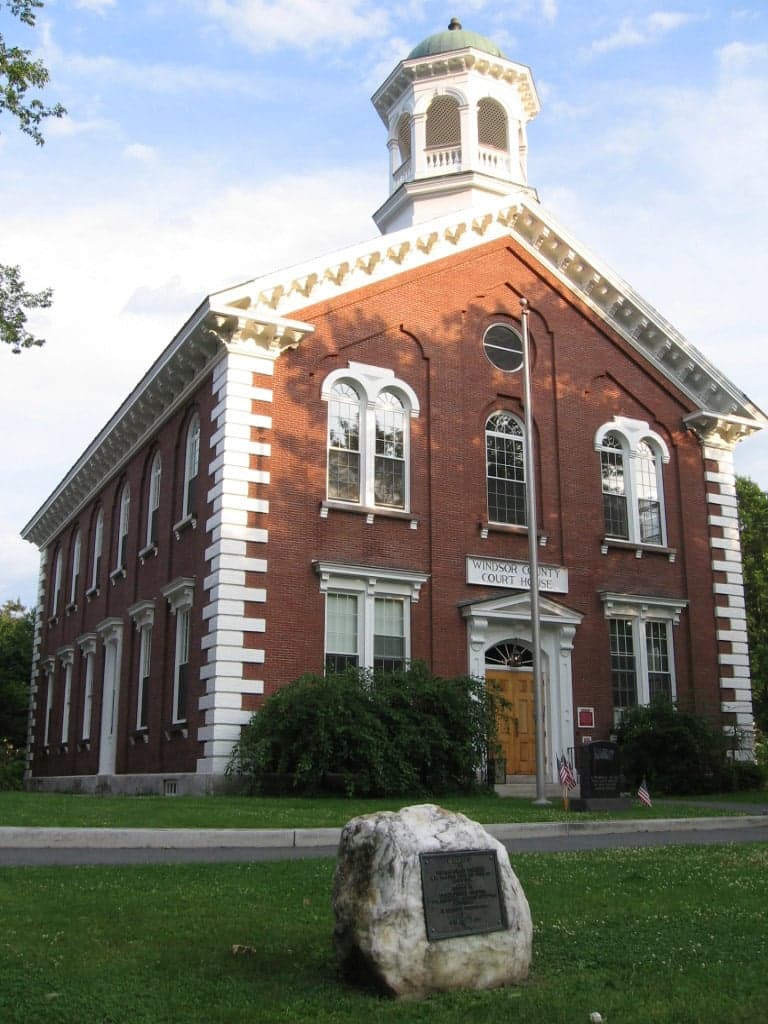
Photo: Wikipedia
Personal Sovereignty in Windsor County
Moderate friction. Expect trade-offs in some aspect of personal liberty and independence.
What does Personal Sovereignty tell us?
Personal Sovereignty measures your capacity for self-reliance and independence with minimal government friction. Higher scores mean fewer barriers between you and the way you want to live... but it assumes you have the space you need and good neighbors.
What does this tell us?
Personal Sovereignty measures your capacity for self-reliance and independence with minimal government friction. Higher scores mean fewer barriers between you and the way you want to live... but it assumes you have the space you need and good neighbors.
State Policy
Energy independence: Importer (15% of energy produced in-state)
Personal Liberty
Homesteading

Personal Liberty Analysis
Windsor County, Vermont, offers a distinctive balance of personal sovereignty that appeals to those prioritizing autonomy, but the reality is more nuanced than a simple "live free or die" narrative. The county's regulatory environment is shaped by Vermont's state-level progressive policies, yet local enforcement and community norms in towns like Hartford, Woodstock, and Springfield create a patchwork of freedom that varies significantly by municipality. For a conservative-leaning individual or family, the key is understanding where the state's heavy hand ends and where local self-reliance begins — and Windsor County's rural character provides more breathing room than Vermont's Chittenden County (Burlington) corridor.
Tax burden and regulatory posture in Windsor County
Vermont's tax burden is among the highest in the nation, and Windsor County residents feel it directly. The state's income tax is progressive, topping out at 8.75% for individuals earning over $213,150 (2025), and property taxes are notably high — the statewide average effective rate is roughly 1.8%, with Windsor County towns like Woodstock and Norwich often exceeding that due to local school spending. However, the regulatory posture is lighter in unincorporated areas and smaller towns like Reading or Plymouth, where zoning ordinances are minimal and building permits are less stringently enforced compared to Hartford (home to the county seat and more developed infrastructure). Vermont has no statewide building code for single-family homes in towns under 5,000 population, which covers many Windsor County communities — a significant advantage for those seeking to build or renovate without bureaucratic delays. The state's Act 250 land-use law applies to larger developments, but most individual homesteads and small-scale projects in towns like Bethel or Royalton can proceed without triggering its review, provided they stay under 10 acres of disturbance.
Self-defense and gun law specifics in Vermont
Vermont is a constitutional carry state — no permit is required to carry a concealed firearm for anyone 21 or older who can legally possess a gun. This is a strong point for personal sovereignty, and it applies uniformly across Windsor County, from the more liberal enclave of Woodstock to the rural stretches of Springfield and Windsor. However, Vermont enacted a 2018 package of gun laws that includes universal background checks for private sales, a 24-hour waiting period for handgun purchases, and a ban on magazines over 15 rounds (rifles) or 10 rounds (handguns). These restrictions are enforced statewide, so even in gun-friendly Windsor County towns, residents must comply. The county has a strong hunting culture, and shooting ranges are available in Hartford (Hartford Fish & Game Club) and Springfield (Springfield Rifle & Pistol Club). Stand-your-ground laws do not exist in Vermont; the state follows a duty-to-retreat standard, which is a notable limitation for those accustomed to Texas or Florida self-defense statutes. For a conservative-leaning reader, Windsor County offers a permissive carry environment but with state-level restrictions that may feel intrusive.
Self-reliance and homesteading viability in Windsor County
Homesteading is genuinely viable here, especially in the county's more rural towns. Minimum lot sizes vary: Reading and Plymouth require 2-acre minimums for residential development, while Springfield and Hartford allow 1-acre lots in some zones. Off-grid living is feasible — Vermont has no state law prohibiting rainwater collection, and solar panels are common, though net metering rules have become less favorable in recent years. Composting toilets are permitted under state wastewater rules for systems serving fewer than 6 bedrooms, which covers most homesteads. Towns like Bethel and Royalton have active agricultural communities, and the county's soil quality in the Connecticut River Valley supports small-scale farming. However, Act 250 can still apply if you plan to subdivide land or build multiple structures, so consulting with a local land-use attorney in Woodstock or Norwich is advisable. The county's zoning is generally permissive for accessory dwelling units, home-based businesses, and livestock — chickens, goats, and even small cattle operations are common in unincorporated areas. For a family seeking to reduce reliance on external systems, Windsor County's rural towns offer a realistic path, though the state's property tax burden remains a long-term cost.
Personal liberties in Windsor County: parental rights, medical autonomy, speech, and property
Parental rights are relatively strong in Vermont, though the state mandates vaccination for school attendance (medical and religious exemptions are available, but philosophical exemptions were removed in 2019). Windsor County school districts like Windsor Southeast Supervisory Union and Two Rivers Supervisory Union generally accommodate homeschooling, which is legal with a simple enrollment notice — no curriculum approval or testing requirements. Medical autonomy is more constrained: Vermont has a universal healthcare system (Green Mountain Care) that mandates insurance coverage, and the state's vaccine mandates extend to healthcare workers and childcare providers. However, alternative medicine practitioners are available in Woodstock and Hartford, and the state does not restrict the sale of raw milk or home-canned goods at farmers' markets. Free speech is protected under the First Amendment, and Windsor County's public forums — town meetings, local newspapers like the Valley News — are active. Property rights are generally respected, but Vermont's "common law" approach to land use means that towns can impose aesthetic or historical district restrictions, particularly in Woodstock (a designated National Historic Landmark district). In contrast, Springfield and Windsor have fewer such constraints, making them more attractive for those who want to modify their property without local review.
Overall, Windsor County offers a moderate-to-high level of personal sovereignty compared to other New England counties, but it falls short of the libertarian-leaning environments found in parts of New Hampshire or the rural West. The county's strength lies in its homesteading viability, constitutional carry, and local autonomy in towns like Reading and Bethel, while its weaknesses are the state-level tax burden, gun magazine restrictions, and vaccine mandates. For a conservative-leaning individual or family, the best fit is likely a rural town with minimal zoning — Plymouth or Royalton — where the regulatory footprint is lightest and self-reliance is most practical. The trade-off is accepting Vermont's progressive state policies while leveraging the county's permissive local culture to carve out a genuinely independent lifestyle.

* Values derived from national, state, county, city and local statistics and may differ in a specific area. Last updated: 2026-07-01T21:13:53.000Z
Narrative content on this page is AI-generated and may contain mistakes. Verify any details that matter before acting on them.
ReloMaps may earn a commission from affiliate links at no extra cost to you.

