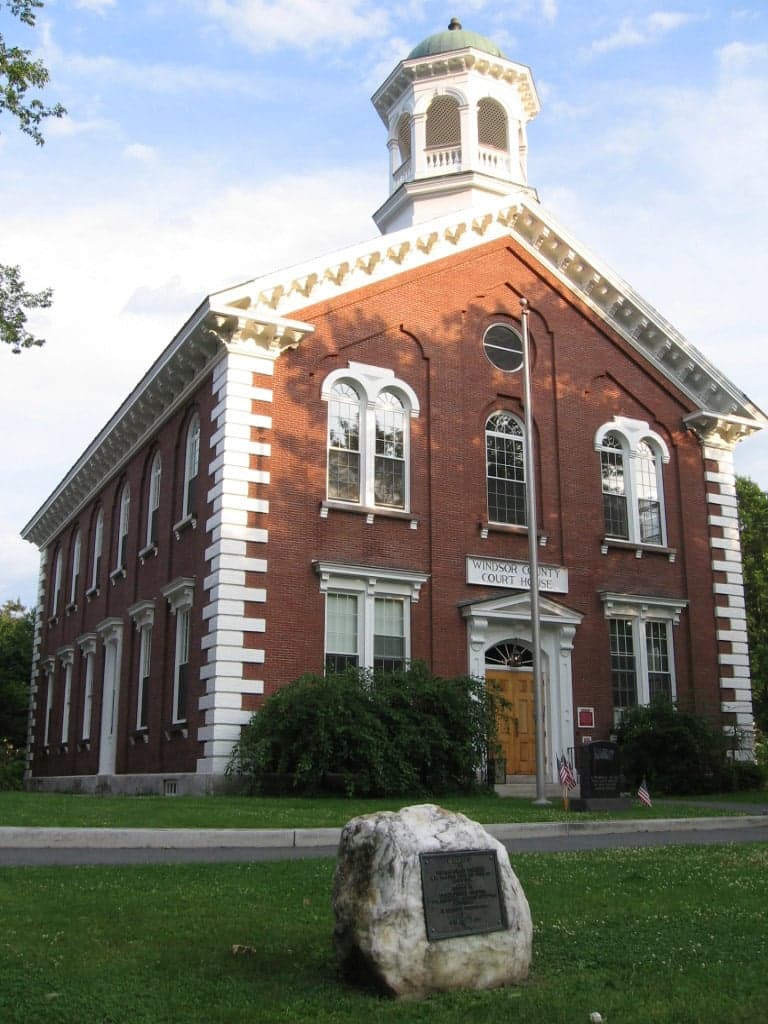
Photo: Wikipedia
Demographics of Windsor County
Affluence Level in Windsor County
A middle-class area roughly in line with national averages across income, home values, education, and employment.
People of Windsor County
Windsor County, Vermont, is home to roughly 57,968 residents, making it one of the state's more populous counties, yet it retains a distinctly rural and small-town character. The population is predominantly white (92.7%) and older than the national median, with a notable concentration of college-educated individuals (41.9%) drawn to the region's scenic beauty and historic villages. The county's identity is shaped by a deep Yankee heritage, a strong tradition of local governance, and a landscape dotted with former mill towns and classic New England villages like Woodstock, Windsor, and Springfield. For a relocation audience, this is a place where community roots run deep, and newcomers are often those seeking a quieter, more traditional lifestyle.
Settlement & growth (pre-1960)
The original inhabitants of the area now known as Windsor County were the Abenaki people, particularly the Sokoki band, who used the Connecticut River as a major travel and trade corridor. European settlement began in earnest after the French and Indian War, with the first permanent English settlers arriving in the 1760s. The New Hampshire Grants, which created towns like Windsor (chartered in 1761) and Woodstock (1761), drew settlers primarily from southern New England—Connecticut, Massachusetts, and Rhode Island. These were largely English-descended farmers and craftsmen, often of Puritan stock, who sought affordable land and religious freedom.
Through the late 18th and early 19th centuries, the population grew steadily as the county's rivers—the Connecticut, Ottauquechee, and White—powered gristmills, sawmills, and later textile mills. Windsor became a manufacturing hub, earning the nickname "The Birthplace of Vermont" for hosting the 1777 signing of the state's constitution. The town of Springfield emerged as a center for precision toolmaking, with firms like Jones & Lamson Machine Company drawing skilled machinists from across New England and, by the late 1800s, from Canada and Europe. The railroad, arriving in the 1840s, connected Windsor County to Boston and New York, enabling the export of machine tools, paper, and woolen goods.
Immigration to Windsor County was modest compared to urban centers, but it was significant for a rural area. French Canadians were the largest immigrant group, arriving in waves from the 1850s through the early 1900s to work in the mills of Springfield, Windsor, and Ludlow. They settled in distinct neighborhoods, often near the factories, and maintained their language and Catholic faith for generations. Smaller numbers of Irish immigrants came to build railroads and canals, and a few German and Italian families arrived as skilled craftsmen. The county's population peaked around 1900 at roughly 50,000, then declined as mills mechanized and young people left for cities. By 1960, the population had stabilized around 45,000, with a character that was still overwhelmingly Yankee and French-Canadian, with little diversity beyond those groups.
Modern era (post-1965)
The 1965 Hart-Cellar Act, which opened immigration to non-European countries, had a minimal direct impact on Windsor County. The county's foreign-born population today is just 1.4%, far below the national average. Instead, the most significant demographic shift since the 1960s has been domestic: an influx of out-of-state residents, particularly from the Northeast and Mid-Atlantic, seeking second homes, retirement, or a rural lifestyle. Woodstock, with its iconic village green and upscale inns, became a magnet for affluent newcomers, driving up property values and reshaping the local economy toward tourism and services. Towns like Quechee and Norwich (though Norwich is in neighboring Orange County, Quechee is in Windsor County) saw similar trends, with vacation homes and condominiums dotting the landscape.
This domestic migration has made Windsor County slightly more diverse, though it remains overwhelmingly white. The Hispanic population (2.2%) and Black population (0.5%) are small but growing, often concentrated in the more affordable towns like Springfield and Claremont (just across the river in New Hampshire), where service-sector jobs are available. East and Southeast Asian residents (0.6%) and Indian-subcontinent residents (0.4%) are present in very small numbers, often associated with the region's colleges and hospitals, such as the Dartmouth-Hitchcock Medical Center in nearby Lebanon, NH, which draws medical professionals from around the world. The county has not seen the formation of distinct ethnic enclaves; rather, new residents tend to disperse across the small towns and rural areas, integrating into existing communities.
Suburbanization has been limited by Vermont's strong land-use laws (Act 250, passed in 1970) and the county's mountainous terrain. Development has clustered along the Interstate 91 and Route 4 corridors, with the largest growth in the towns of Hartford (which includes the village of White River Junction) and Hartland. White River Junction, once a declining railroad town, has seen a revival as a creative and arts hub, attracting younger residents and small businesses. Meanwhile, the more remote towns like Plymouth and Reading have seen population decline as farming and forestry have waned.
The future
The population of Windsor County is projected to remain stable or decline slightly over the next decade, as it has since the 1970s. The county's age structure is older than the state average, with a median age around 50, and the number of deaths has exceeded births in recent years. Growth will depend entirely on in-migration, which is likely to continue at a modest pace, driven by remote workers, retirees, and second-home buyers attracted to the region's natural beauty and low crime rates. The county is not becoming more diverse in any rapid sense; the white share of the population is expected to remain above 90% for the foreseeable future.
New residents are likely to continue concentrating in the more accessible towns along the interstate and major highways—Hartford, Windsor, Springfield, and Woodstock—while the more remote hill towns will see further population loss. The cultural identity of the county is evolving from a Yankee-and-French-Canadian manufacturing base toward a more amenity-driven, tourism-oriented economy. This shift brings tensions between longtime residents and newcomers over development, property taxes, and the character of village life. For a newcomer, Windsor County offers a stable, safe, and scenic environment, but one where fitting in requires respect for local traditions and a willingness to embrace a slower pace of life.
Windsor County is becoming a place defined less by its industrial past and more by its role as a refuge for those seeking a quieter, more rooted existence. For someone moving in now, the county offers a community where neighbors still know each other, where the landscape is protected, and where the pace of change is deliberately slow. The trade-off is limited job opportunities, a high cost of living relative to local wages, and a population that is both older and less diverse than the national average. It is a place for those who value stability and tradition over dynamism and diversity.

* Values derived from national, state, county, city and local statistics and may differ in a specific area. Last updated: 2026-07-01T21:13:53.000Z
Narrative content on this page is AI-generated and may contain mistakes. Verify any details that matter before acting on them.
ReloMaps may earn a commission from affiliate links at no extra cost to you.

