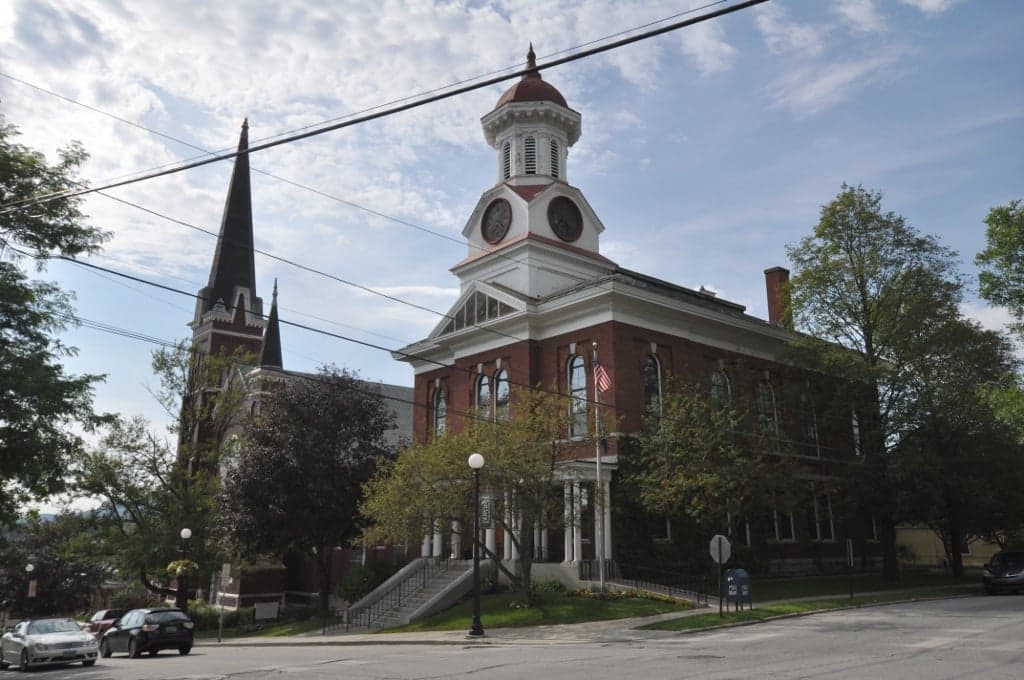
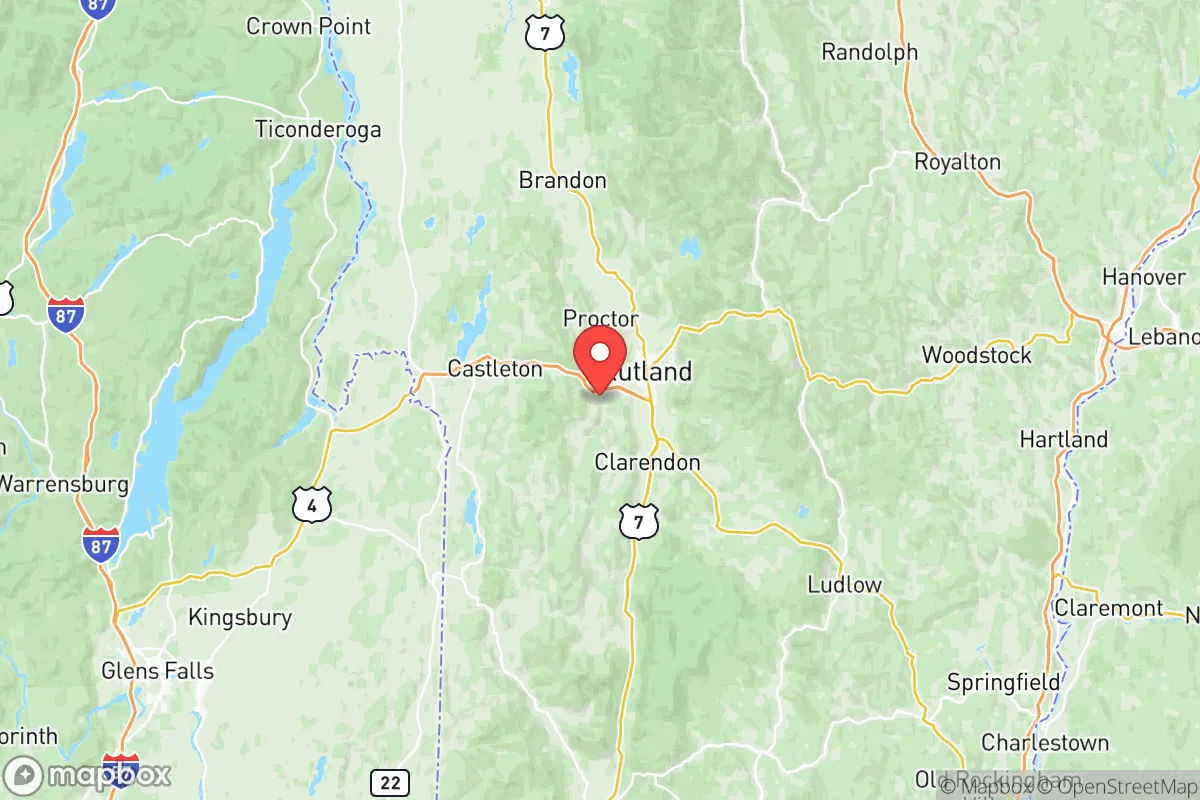
Photo: Wikipedia
Political ClimatePolitical Climate in Rutland County
Showing state-level results — no local-only data available.
Local Political AnalysisPolitical Analysis of Rutland County
Rutland County, Vermont, carries a Cook PVI of D+17, making it a solidly Democratic area that aligns exactly with the statewide Vermont average. But if you’ve spent any time here, you know that number doesn’t tell the whole story. The county has been drifting leftward over the last decade, but it’s a slower, more grudging shift than what you’d see in Chittenden County. The real action is in the towns: Rutland City and the southern villages like Wallingford and Clarendon lean reliably blue, while the rural northern towns—Brandon, Pittsford, and especially Castleton—still have a noticeable Republican streak. The swing precincts are in the suburban ring around Rutland City, places like Mendon and Killington, where independent voters can tip a local race by a few hundred ballots.
How it compares
On paper, Rutland County and Vermont share the same D+17 PVI, but the lived experience is different. Vermont’s Democratic lean is driven heavily by Burlington and the surrounding Chittenden County corridor, where progressive politics are the norm. Rutland County, by contrast, is more of a mixed bag. The county’s Democratic edge comes from Rutland City’s working-class base and the college-adjacent precincts in Castleton, but the rural towns still elect Republicans to local offices and the state legislature. For example, the Rutland-2 district (covering parts of Rutland Town and Proctor) has flipped between parties in recent cycles, while the Rutland-5-4 district (Rutland City) has been reliably Democratic for years. Compared to the rest of Vermont, Rutland County is less uniformly liberal—it’s more like a blue county with red pockets, whereas the state as a whole is a blue state with a few deep-red rural outliers like Newport and Derby.
What this means for residents
For conservative residents, the county’s Democratic lean means state-level policies—like Vermont’s paid family leave law, carbon pricing initiatives, and gun safety measures—are here to stay. But locally, there’s still room for influence. Town meetings in places like Brandon and Pittsford often see lively debates on school budgets and land use, and Republican selectboard members are common. For liberal residents, the county’s trajectory is encouraging but not a foregone conclusion. The 2020 and 2022 cycles saw increased turnout in Rutland City, driven by younger voters and new arrivals from out of state, but the county’s older, more established population still holds sway in local primaries. The practical upshot: if you’re a conservative, you’ll find your voice in town government and local races, but you’ll be swimming against the current at the state level. If you’re a liberal, you’ll feel at home in the city and the college towns, but don’t expect the rural precincts to flip anytime soon.
Culturally, Rutland County is distinct from the rest of Vermont in a few key ways. The county has a stronger working-class identity, rooted in its history as a quarrying and manufacturing hub, and that shows in the local politics—less emphasis on environmental activism, more on economic development and property taxes. The policy debates here tend to be more pragmatic than ideological. For instance, the county’s approach to housing and zoning has been more permissive than in Chittenden County, reflecting a broader willingness to balance growth with conservation. If you’re moving here, expect a political climate that’s blue on the surface but with enough local variation to keep things interesting. The county is not a monolith, and that’s what makes it feel more like a real community than a political label.

State Political ClimatePolitical Climate in Vermont
State Political AnalysisPolitical Environment in the State
Vermont is one of the most reliably Democratic states in the country, with a Cook Partisan Voting Index of D+17, meaning it votes about 17 points more Democratic than the nation as a whole. The state hasn't voted for a Republican presidential candidate since George H.W. Bush in 1988, and both U.S. Senate seats and the single House seat have been held by Democrats or independents who caucus with them for decades. Over the last 10-20 years, the shift has been subtle but real: the rural, more independent-minded Yankee Republican tradition has faded, replaced by a coalition of Burlington-area progressives, college-town liberals, and second-home owners from the Northeast Corridor, while the remaining conservative pockets have become more concentrated and vocal.
Urban vs. rural divide
The political map of Vermont is a textbook case of urban-rural polarization, but with a twist — the "urban" areas are small by national standards. Burlington and its surrounding Chittenden County are the Democratic engine, delivering margins of 70-80% in statewide races. The city itself is home to the University of Vermont, a thriving progressive activist scene, and Bernie Sanders's political base. Just south, Montpelier and Middlesex are similarly deep blue, driven by state government workers and environmental nonprofits. The rural northeast — the Northeast Kingdom counties of Essex, Orleans, and Caledonia — is the most conservative part of the state, often voting 55-60% Republican in statewide races. Rutland and Bennington counties are swingier, with working-class towns that have drifted rightward in the Trump era, though they still vote Democratic in most state-level contests. The divide is stark: drive 20 minutes outside Burlington and you're in Trump country, but those rural areas don't have the population to offset Chittenden County's turnout.
Policy environment
Vermont's policy environment is among the most progressive in the nation, with a tax structure to match. The state has a progressive income tax with top rates over 8%, property taxes that are among the highest in the country (funding a generous education system), and a sales tax of 6% that exempts food and clothing. There is no right-to-work law, and union density is high, especially in public-sector and education jobs. Healthcare is a perennial battleground: Vermont attempted a single-payer system in 2014 under Governor Peter Shumlin but abandoned it over cost, instead passing Act 48 in 2011, which established the Green Mountain Care Board to regulate hospital budgets and insurance rates. Education policy is centralized — the state effectively abolished local school boards in 2010 with Act 46, consolidating districts to equalize funding, a move that remains deeply controversial in rural towns. Election laws are among the most accessible in the country: universal mail-in voting was made permanent after 2020, same-day registration is available, and voter turnout regularly leads the nation.
Recent policy direction
The last five years have seen Vermont accelerate in a progressive direction across multiple fronts. On gun policy, the state passed Act 69 in 2018 after a near-miss school shooting plot in Fair Haven, enacting universal background checks, a 24-hour waiting period, a ban on magazines over 10 rounds, and raising the purchase age to 21. A 2023 law added a ban on "ghost guns" and strengthened the state's red flag law. On education and parental rights, Vermont has moved in the opposite direction of many red states: Act 1 (2022) codified abortion rights and removed parental consent requirements for minors seeking abortions, while Act 76 (2023) expanded gender-affirming care protections and banned conversion therapy. Act 173 (2024) created a statewide "right to read" framework that some conservatives argue reduces local control over curriculum. On property rights, the state passed Act 250 reforms in 2024 that tightened environmental review for large developments, angering landowners and builders. Taxation has seen incremental increases: a 2023 surcharge on high-income earners to fund child care, and a 2024 carbon pricing study that has businesses worried. On voting and ballot access, Vermont made universal mail voting permanent in 2021 and added automatic voter registration at the DMV. For a conservative relocator, the bottom line is that the state's policy direction is clearly toward expanded government services, tighter regulation, and social liberalism — with no sign of reversal.
Civil unrest & political movements
Vermont's political activism is intense but generally non-violent. The Yellow Vests movement, a loose coalition of gun-rights advocates and anti-tax activists, held large rallies at the Statehouse in 2019-2020, drawing hundreds to protest the gun laws. On the left, the Rights and Democracy coalition and the Vermont Progressive Party are well-organized, pushing for rent control, single-payer healthcare, and climate action. The secessionist movement is small but real — the "Second Vermont Republic" group advocates for peaceful independence, though it has no serious political traction. Immigration politics are relatively quiet: Vermont has no sanctuary city ordinances per se, but Burlington's Welcoming City policy (2017) limits cooperation with ICE, and the state offers in-state tuition to undocumented students. Election integrity controversies have been minimal; Vermont's universal mail voting system enjoys broad bipartisan trust, and there were no significant disputes after 2020 or 2022. The most visible flashpoint for a new resident would be the Statehouse protests during legislative sessions, where both sides set up competing demonstrations on the Montpelier lawn — generally civil, but passionate.
Projection
Over the next 5-10 years, Vermont's political trajectory is likely to continue leftward, but with growing friction. In-migration from out of state — driven by remote work and second-home buyers — is bringing more people from blue states like New York and Massachusetts, reinforcing the Democratic majority. However, the cost of living crisis, driven by high housing prices and property taxes, is pushing working-class families out of the state, accelerating the demographic shift toward wealthier, more liberal newcomers. The rural conservative vote will likely become more concentrated and more frustrated, but it won't gain power without a major national realignment. The Vermont Republican Party is increasingly a rural, Trump-aligned party, but it has not won a statewide office since 2016 (Phil Scott, a moderate Republican governor who often vetoes his own party's bills). Expect continued battles over education funding (Act 46 consolidation remains unpopular in small towns), housing deregulation (a potential bipartisan issue), and carbon pricing (which could become a defining 2026-2028 fight). A conservative moving in now should expect to live in a state where their political views are a minority, but where local town-level politics — especially in the Northeast Kingdom and southern Rutland County — still offer some refuge.
For a new resident, the practical takeaway is that Vermont is a state where your vote for president or Senate will almost certainly not affect the national outcome, but your voice in local town meeting — where school budgets, zoning, and road maintenance are decided — matters enormously. Conservatives will find the state's tax burden and regulatory culture frustrating, but will also find a tradition of neighborly independence, low crime, and beautiful landscape that transcends politics. Liberals will find a policy environment that largely matches their values, but should be prepared for high costs and a slow-moving, consensus-driven political culture that can frustrate ambitious reform. Either way, Vermont is a place where politics is personal, not abstract — and that cuts both ways.
* Values derived from national, state, county, city and local statistics and may differ in a specific area. Last updated: 2026-07-12T03:42:43.000Z
Narrative content on this page is AI-generated and may contain mistakes. Verify any details that matter before acting on them.
ReloMaps may earn a commission from affiliate links at no extra cost to you.

