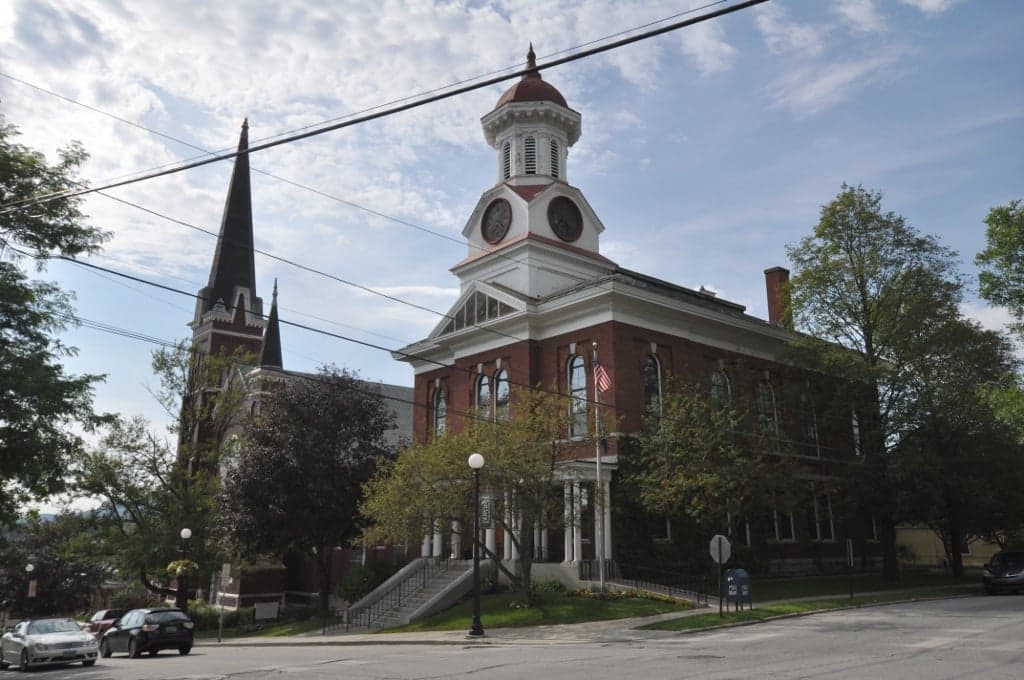
Photo: Wikipedia
Demographics of Rutland County
Affluence Level in Rutland County
A middle-class area roughly in line with national averages across income, home values, education, and employment.
People of Rutland County
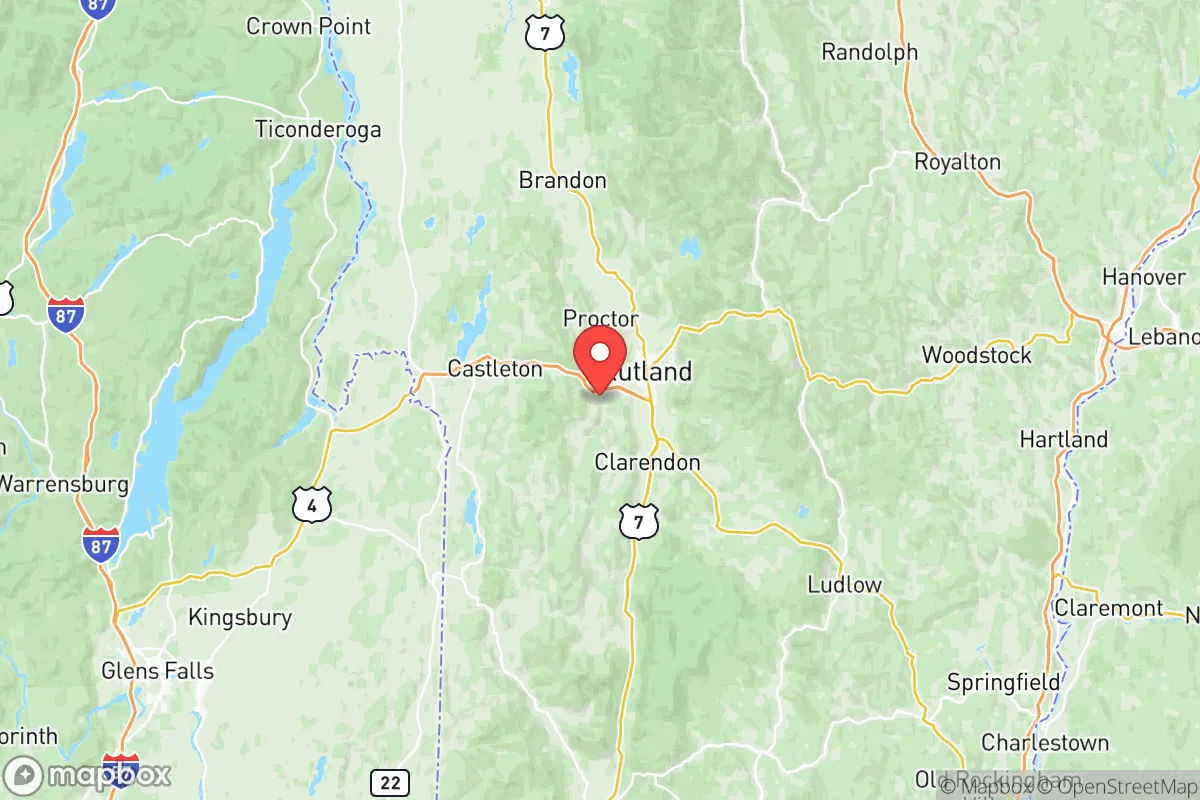
The people of Rutland County, Vermont, today number roughly 60,500, forming a predominantly white, rural population with a distinct Yankee and Franco-American character. The county is notably less diverse than the national average, with a foreign-born population of just 0.7% and a 93.3% white demographic, concentrated in the city of Rutland and the surrounding towns of Fair Haven, Castleton, and Poultney. This is a region shaped by successive waves of European settlement, a long industrial history, and a recent trend of slow decline, making it a place where deep-rooted local identity and a quiet, self-reliant culture still define daily life.
Settlement & growth (pre-1960)
Before European contact, the area now known as Rutland County was part of the traditional territory of the Western Abenaki people, particularly the Sokoki band, who used the Otter Creek and Poultney River valleys for seasonal fishing and hunting. French explorers and Jesuit missionaries passed through in the 17th and early 18th centuries, but no permanent European settlement occurred until after the French and Indian War. The region was formally chartered as part of the New Hampshire Grants in the 1760s, with the town of Rutland chartered in 1761 and first settled in 1770 by families from Connecticut and Massachusetts.
The first major wave of settlers were Yankee farmers of English descent, who cleared the dense forests for agriculture and established the county's early villages: Castleton (chartered 1761), Poultney (1775), and Fair Haven (1779). These were largely subsistence farmers, but the region's abundant water power soon attracted industry. By the early 1800s, the falls on the Castleton River and Poultney River powered gristmills, sawmills, and iron forges, with Fair Haven becoming a major slate-quarrying center by the 1840s, drawing skilled Welsh and Irish quarrymen.
A second, larger wave arrived with the Irish in the 1840s and 1850s, fleeing the Great Famine. They found work building the Rutland & Burlington Railroad and later the marble quarries that made the county famous. The Vermont Marble Company, headquartered in Proctor (a town literally built by the company), employed hundreds of Irish and, later, Italian immigrants. The Irish settled heavily in the city of Rutland's "Frog Hollow" neighborhood and in the mill villages of West Rutland and Proctor.
The French Canadians were the third and largest immigrant group, arriving steadily from Quebec between 1850 and 1920. They came for work in the marble sheds, slate quarries, and railroad yards, settling in dense, insular neighborhoods in Rutland City (especially the "French Hill" area), West Rutland, and Poultney. By 1900, French Canadians made up roughly a third of the county's population, and their cultural imprint—Catholic parishes, French-language newspapers, and a strong work ethic—remains visible today.
Smaller groups included Italians (arriving 1890-1910, concentrated in Proctor and Rutland City's marble sheds), Polish and Lithuanian immigrants (settling in Rutland City and Fair Haven), and a tiny number of African Americans, mostly railroad workers and servants, who never formed a significant community. The county's population peaked at around 49,000 in 1950, supported by a robust manufacturing economy of marble, slate, machine tools, and dairy processing.
Modern era (post-1965)
The post-1965 era in Rutland County has been defined not by new immigration but by domestic out-migration and demographic aging. The 1965 Hart-Cellar Act, which reshaped U.S. immigration nationally, had almost no effect here: the county's foreign-born share remains at 0.7%, far below the national average of roughly 14%. No significant new immigrant enclaves formed. The small Hispanic population (2.1%) is largely of Puerto Rican and Mexican descent, scattered across Rutland City and Castleton, often working in service industries or agriculture. The tiny East/Southeast Asian population (0.5%) includes a few Hmong and Vietnamese families, mostly in Rutland City, and the Indian-subcontinent population (0.1%) is negligible, consisting of a handful of medical professionals at Rutland Regional Medical Center.
The dominant demographic story since 1970 has been population decline and white aging. The county's population fell from 49,000 in 1950 to 60,484 in 2020 (a modest decline after a mid-century dip), but the real shift has been internal: young adults leave for college and careers in Burlington, Boston, or New York, while the remaining population grows older. The median age is now 45.6, well above the national median of 38.8. The Black population (0.6%) has barely grown since the Great Migration era, and no significant domestic migration from other states has reversed the trend. Suburbanization has been minimal; new housing developments are sparse, concentrated in Rutland Town and Clarendon, and the county's rural character remains intact.
The future
Rutland County's demographic future points toward continued slow decline and further aging, with little prospect of significant diversification. The county's birth rate is below replacement level, and net domestic migration is slightly negative, as the region struggles to attract new residents despite relatively low housing costs. The city of Rutland has made modest efforts to attract refugee resettlement—a small Bhutanese-Nepali community of about 50 families arrived between 2010 and 2015—but these numbers are too small to shift the overall demographics. The Hispanic share may grow slowly through natural increase and some agricultural labor, but it is unlikely to exceed 5% by 2040.
The most likely scenario is that Rutland County becomes whiter, older, and more economically fragile, with population concentrated in the Rutland City-Proctor corridor and the remaining towns (Poultney, Castleton, Fair Haven) continuing to lose young families. The county's cultural identity—rooted in Yankee self-reliance, Franco-American Catholicism, and a working-class marble-and-slate heritage—will persist but may become more insular as the population shrinks. For someone moving in now, this is a place where you can buy a historic home for under $200,000 and enjoy quiet, low-crime rural living, but where you will find little ethnic diversity and a community that is slowly graying.
In short, Rutland County is becoming a quieter, more homogeneous version of its past—a region where the human history is deep and visible in every town's marble sidewalks and slate roofs, but where the next chapter will likely be written by fewer, older hands. For a conservative-leaning family seeking affordable land, strong community ties, and a slower pace, it offers a genuine, if shrinking, slice of traditional New England life.

* Values derived from national, state, county, city and local statistics and may differ in a specific area. Last updated: 2026-07-12T03:42:43.000Z
Narrative content on this page is AI-generated and may contain mistakes. Verify any details that matter before acting on them.
ReloMaps may earn a commission from affiliate links at no extra cost to you.

