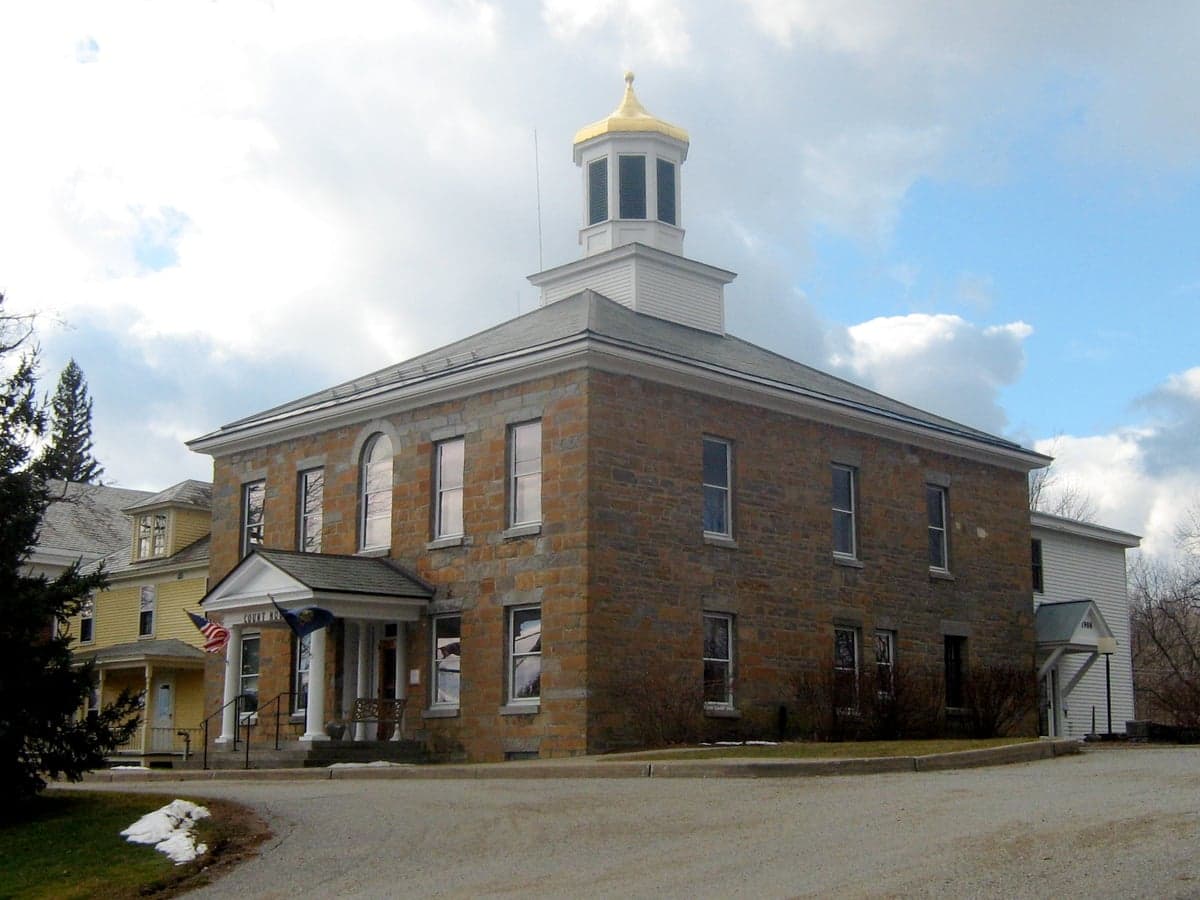
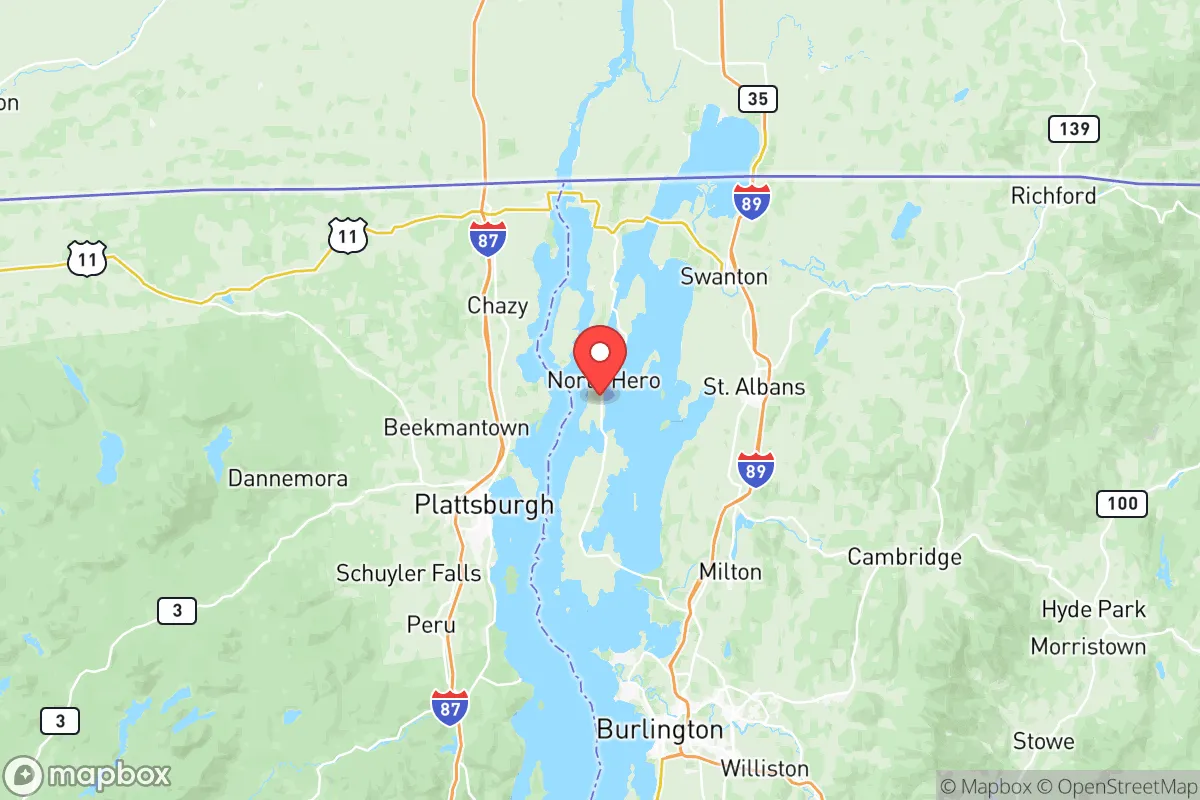
Photo: Wikipedia
Political ClimatePolitical Climate in Grand Isle County
Showing state-level results — no local-only data available.
Local Political AnalysisPolitical Analysis of Grand Isle County
Grand Isle County, Vermont, is reliably blue, with a Cook PVI of D+17, matching the statewide figure exactly. This means the county votes about 17 points more Democratic than the national average, a pattern it has held consistently for the last two presidential cycles, with no signs of a shift to the right. While the whole county leans Democratic, the political center of gravity is in the larger towns like South Hero and Grand Isle, where Democratic margins are widest, though even the smaller, more rural communities like North Hero and Isle La Motte rarely break for Republicans in a way that threatens the overall outcome.
How it compares
At first glance, Grand Isle County is a perfect mirror of Vermont's statewide politics—same D+17 PVI, same overwhelming preference for Democrats in federal races. But look closer and you'll see the county's character is subtly different. Vermont's political strength is concentrated in Chittenden County (Burlington), while Grand Isle is more of a rural, lake-centric county. The Democratic margins here are less about college-town activism and more about the county's deep-seated independence and libertarian streak, which often aligns with the Vermont Progressive Party's environmental priorities. In practice, a Republican running for local office in South Hero has a harder time than one in, say, Alburgh (a village in the county with a stronger independent voting record), but even there, the county's overall blue hue washes out any local flips. The 2024 presidential results showed Trump improving in some rural, northern Vermont counties, but Grand Isle's margins for Biden held steady, indicating its Democratic lean is more structural than transient.
What this means for residents
For liberal residents, living in Grand Isle County means your values are represented at the state and federal level without much tension. You can expect your representative in Montpelier to champion climate action and social welfare programs, and your federal taxes will flow to Democratic policy priorities. Conservative residents, however, are in a clear minority. While you won't face overt hostility—Vermont's version of blue is famously polite—you will have little influence on legislative outcomes. Local town meetings in North Hero or Isle La Motte might give you a louder voice on school budgets or road repairs, but in statehouse races, your vote is effectively symbolic. The practical upshot: if you're conservative, you're voting to signal your preferences rather than to change the law. If you're liberal, you can relax and assume your side will win most elections, but you'll also need to contend with the county's independent-mindedness—no one here likes being told what to do, even if they vote for the party that does the telling.
Culturally, this political climate fosters a kind of quiet, rural progressivism. You'll see more "Bernie" signs than "Biden" ones, and environmental stewardship—caring for Lake Champlain and preserving open land—is a bipartisan concern, even if the policy solutions differ. The county's two biggest policy distinctions from the rest of Vermont are its intense focus on lake conservation (which drives development restrictions) and its small-school funding dynamics (which can spark heated local debates). Bottom line: Grand Isle County is a pocket of comfortable, established blue in a blue state, where the political temperature is cool and the lake is always the real center of attention.

State Political ClimatePolitical Climate in Vermont
State Political AnalysisPolitical Environment in the State
Vermont is reliably Democratic, with a Cook PVI of D+17, making it one of the bluest states in the nation. Over the past 10-20 years, the state has shifted leftward more slowly than other parts of New England, but the dominant coalition remains a mix of progressive Burlington activists, moderate Democratic professionals in places like Montpelier and Brattleboro, and a shrinking but stubbornly independent Republican minority rooted in rural areas. The trajectory shows a gradual deepening of Democratic control at the state level—both legislative chambers and the governor’s office have been held by Democrats or Progressives for most of the last decade—while local town-level politics retain a pragmatic, town-meeting flavor that sometimes surprises newcomers.
Urban vs. rural divide
The political map of Vermont is starkly split between the urbanized Chittenden County corridor and the rest of the state. Burlington, the state’s largest city, leans heavily Democratic and hosts the University of Vermont, a progressive anchor. South Burlington and Winooski are similarly blue, often voting by margins of 70% or more for Democratic candidates. In contrast, rural counties like Orleans, Essex, and Franklin in the Northeast Kingdom reliably vote Republican or independent. For example, in 2024, Orleans County voted +22 for Donald Trump, while Chittenden County went +45 for Joe Biden. The suburbs of South Burlington and Colchester are politically distinct—more moderate than Burlington but still solidly Democratic—while tiny towns like St. Johnsbury and Randolph show a patchwork of independent and Republican leanings. The divide isn’t just partisan; it’s cultural, with rural residents often feeling overlooked by Burlington-centric state policy.
Policy environment
Vermont’s policy environment reflects its dominant Democratic lean, with a high-tax, high-service model. The state has a progressive income tax with top rates at 8.75%, plus a statewide property tax that funds education, averaging about 1.8% of home value. The regulatory posture is business-friendly for small farms and craft industries but strict on development and environmental issues. Education policy is centralized: the state-run Agency of Education sets curriculum standards, and there’s no statewide school choice program, though some towns allow voucher-like programs for special needs. Healthcare is a single-payer-style system through Vermont’s health care exchange, with strong subsidies. Election laws are notably permissive: same-day voter registration, universal mail-in ballots for all elections (enacted in 2020), and no voter ID requirement at the polls. For a conservative relocator, the biggest practical concerns are the tax burden and the regulatory environment for building or expanding a business, but the state’s low crime and strong community ties are draws.
Recent policy direction
In the last five years, Vermont has doubled down on its progressive model. On gun and self-defense law, the state passed Act 81 (2023) requiring a permit to carry a concealed firearm, universal background checks, and a 72-hour waiting period for handgun purchases, with no permitless carry option. On parental and education rights, Act 166 (2020) expanded child care subsidies and mandated universal pre-K, while recent debates over critical race theory and LGBTQ+ curriculum in schools have been less heated than in other states, with the state Department of Education generally supporting inclusive materials. Speech is broadly protected under the state constitution, but a 2024 law (Act 201) made it illegal to intentionally misgender someone in public accommodations, which is enforced by the Attorney General’s office. Privacy and surveillance saw Act 7 (2023), which limits police use of facial recognition except for serious crimes. Medical and bodily autonomy is expansive: Vermont was one of the first states to expand telehealth access for abortion (2022), and in 2023 it passed a shield law protecting providers from out-of-state civil suits. Property rights are constrained by Act 250, a 1970s-era land-use law that heavily regulates development; recent reforms in 2024 eased some rules for affordable housing projects. Voting and ballot access remain wide open, with automatic voter registration and mail-in ballots for all. For a conservative relocator, the gun laws and property regulations are the biggest potential friction points, while the healthcare protections and lack of surveillance are neutral or positive.
Civil unrest & political movements
Vermont has a history of civil unrest that’s more about environmental activism than partisan street fights. In 2020, the Black Lives Matter protests in Burlington were large but peaceful, leading to the city council’s renaming of Columbus Day to Indigenous Peoples’ Day. The state has a small but vocal secessionist movement, the Vermont Republic, which pushes for independence from the U.S., though it’s more of a libertarian fringe than a serious political force. Immigration politics are relatively quiet: Vermont has no sanctuary state law, but Burlington has a “Welcoming City” ordinance that limits local police cooperation with ICE. The state’s Republican party is fragmented between moderates and a more populist wing aligned with Trump, but they make up only about 20-25% of registered voters. Election integrity is not a major controversy here—Vermont’s mail-in voting system has broad bipartisan support, and there have been few disputes. For newcomers, the flashpoints to expect are debates over housing development (Act 250 is a constant source of local conflict) and school spending, with rural towns often voting down budget increases.
Projection
Looking five to ten years ahead, Vermont’s politics are likely to remain firmly Democratic, but the pace of change may slow. In-migration from other parts of the Northeast, particularly during the pandemic, has been a wild card—remote workers from New York and Boston have moved to places like Montpelier, Woodstock, and Middlebury, and they tend to be even more progressive than native Vermonters, reinforcing the blue trend. However, the state’s population is stagnant or declining slightly in rural areas (Orleans County lost 3% of its residents between 2010 and 2024), which could make the urban-rural divide even sharper. A conservative relocator moving into a Northeast Kingdom town now will find a community that’s still independent-minded but is likely to see more progressive influence as new arrivals settle in. The tax burden won’t decrease—if anything, the state is likely to move toward a wealth tax or higher inheritance taxes to fund an aging population. Property rights will remain a battleground, with developers pushing for looser regulations and environmentalists fighting to keep Act 250 intact. What won’t change is the community-centric feel: even in blue towns, town meeting day decisions still get made over potluck dinners.
For a new resident, the bottom line is that Vermont offers a stable, predictable political environment where you know what you’re getting: high taxes, strong social services, and a hands-on local government. Conservative residents can find community in rural towns like St. Johnsbury or Newport, but they’ll need to accept that state-level policy will tilt left on guns, education, and regulation. Progressive residents will feel at home in Burlington or Brattleboro but should brace for the property tax bill. Best to tour a few towns first—stop by a diner in Randolph and a café in Montpelier—to gauge the local political temperature before pulling the trigger. It’s a small state, and the politics are personal.
* Values derived from national, state, county, city and local statistics and may differ in a specific area. Last updated: 2026-06-22T06:09:59.000Z
Narrative content on this page is AI-generated and may contain mistakes. Verify any details that matter before acting on them.
ReloMaps may earn a commission from affiliate links at no extra cost to you.

