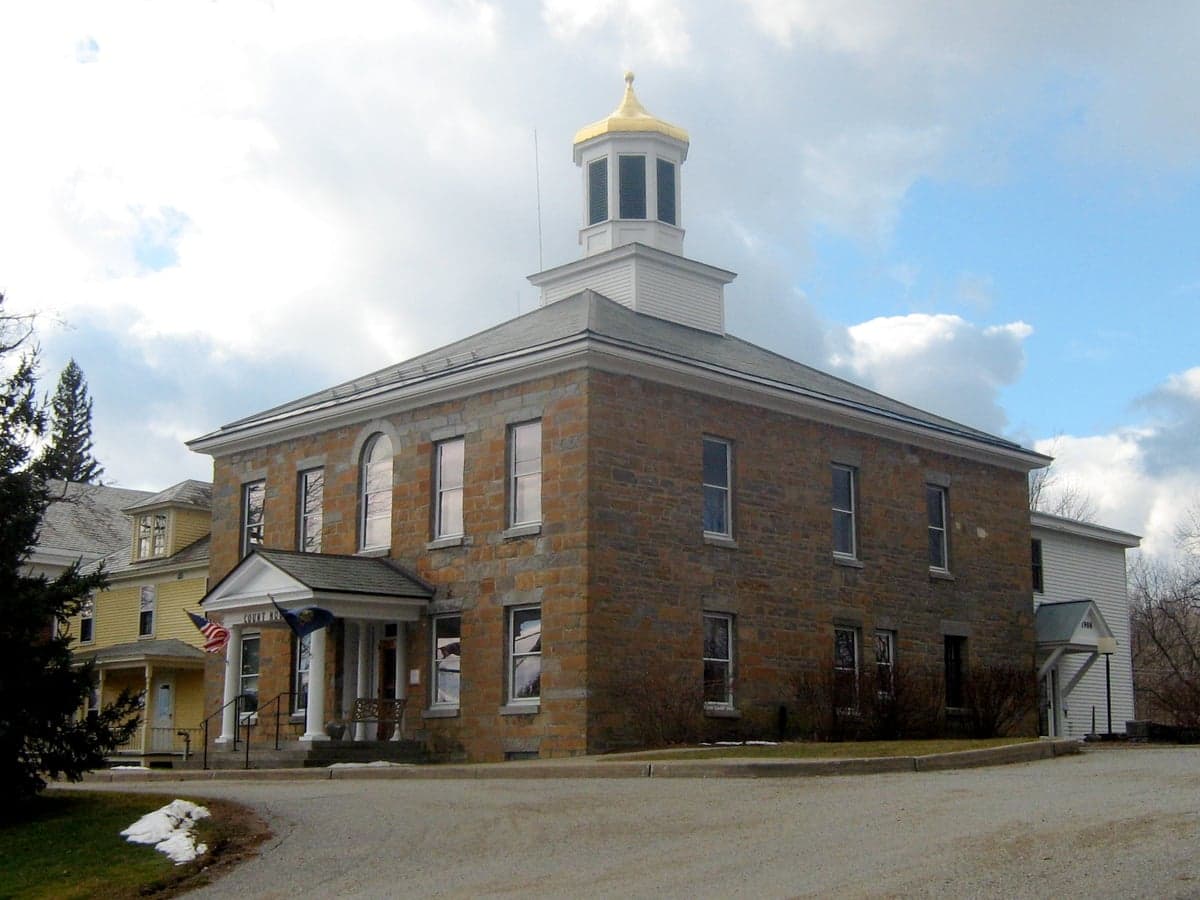
Photo: Wikipedia
Demographics of Grand Isle County
Affluence Level in Grand Isle County
A middle-class area roughly in line with national averages across income, home values, education, and employment.
People of Grand Isle County
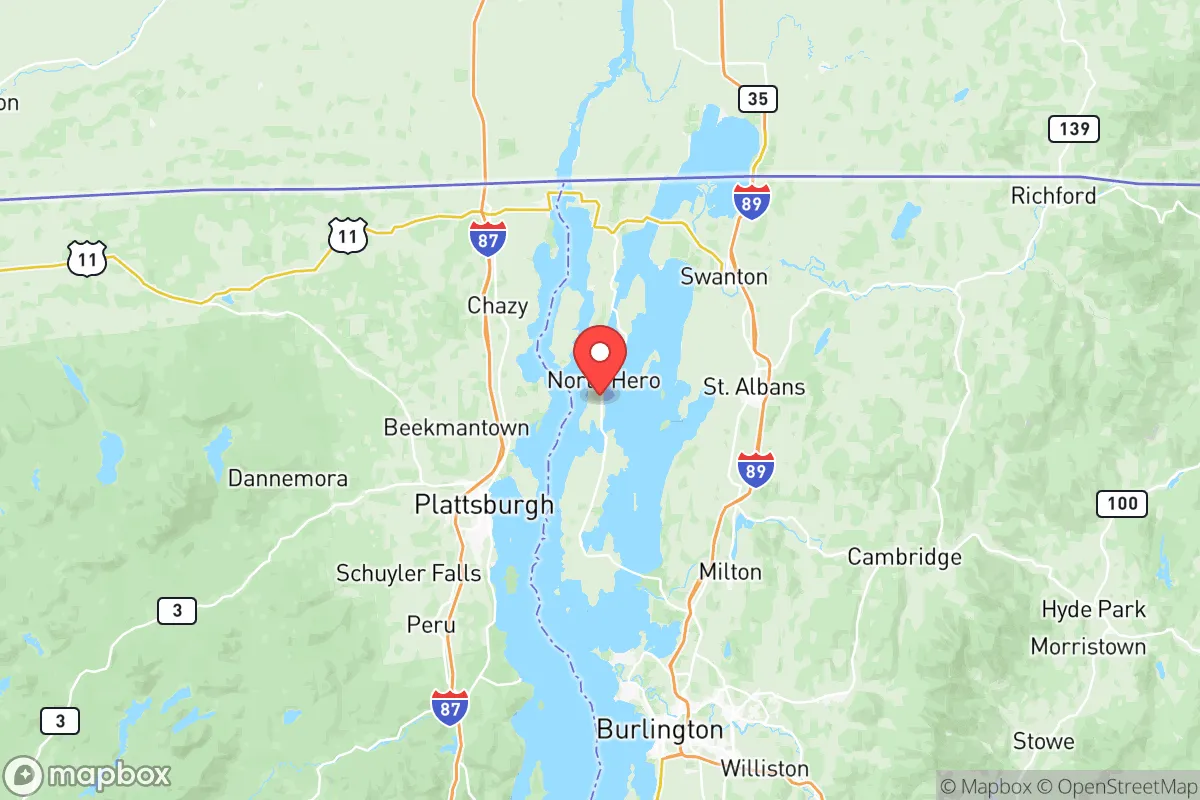
Grand Isle County, Vermont, is the state’s smallest and most rural county by population, with just 7,393 residents spread across the Lake Champlain islands. The people here are overwhelmingly white (90.6%) and native-born, with only 2.0% foreign-born, and the county’s identity is shaped by deep Yankee roots, a working lake economy, and a quiet, family-oriented character. Distinct from the rest of Vermont, the islanders—those living on the mainland peninsulas of Alburgh and the islands of Grand Isle, South Hero, and North Hero—maintain a strong sense of place tied to lake access, agriculture, and summer tourism. The population is highly educated (43.2% hold a college degree), politically mixed compared to the rest of the state, and increasingly older as young adults leave for career opportunities off-island.
Settlement & growth (pre-1960)
The human history of Grand Isle County begins with the Western Abenaki, who for centuries used the Lake Champlain islands as summer fishing and hunting grounds. The Missisquoi Abenaki, centered near the present-day Swanton area, traveled to the islands seasonally, particularly to the sheltered coves of what is now Isle La Motte and North Hero. There is no evidence of permanent year-round Abenaki villages on the islands before European contact, but the lake corridor was a vital trade and travel route. French explorers and Jesuit missionaries arrived in the 1600s, claiming the region as part of New France. By 1666, the French built Fort Sainte Anne on Isle La Motte—one of the earliest European forts in Vermont—as a defensive post against Iroquois raids. French settlers never established farms on the islands, however, and the area remained sparsely populated until after the French and Indian War.
American settlement began in earnest after the Revolutionary War, when the newly formed Republic of Vermont granted land on the islands to veterans. The first wave of English-descended Yankees—mostly from southern New England, New Hampshire, and eastern New York—arrived between 1783 and the 1820s. They settled the three main townships: South Hero (chartered 1779), Grand Isle (formerly Middle Hero), and North Hero (chartered 1779). The land grants were intended for agricultural use, and these early settlers cleared the forests to establish dairy farms and apple orchards. A smaller group of Scottish-descended families, some coming directly from Scotland and others via Nova Scotia, settled on the northern end of Alburgh—the only part of the county connected to mainland Vermont—in the 1790s. Ferry service across the lake to Plattsburgh, New York, began as early as the 1820s, but the islands remained isolated for much of the 19th century, connected to the mainland primarily by ice in winter and boat in summer.
Throughout the 1800s, the county’s population grew slowly but steadily, peaking at about 3,700 by the 1840s. The 1849 completion of the Rutland & Burlington Railroad on the mainland—which did not reach the islands—actually slowed growth, as young people left for industrial jobs in Burlington or the mills of Massachusetts. The 1850s saw a small influx of Irish immigrants, who worked as laborers on farms and in the region’s emerging limestone quarries on Isle La Motte and the western shore of Grand Isle. These quarries, which produced black marble and limestone for buildings and monuments, employed several dozen men through the late 19th century. A handful of French-Canadian families crossed the lake from Quebec in the 1880s and 1890s, settling primarily in the East Alburgh area and working as dairy hands. By 1900, the county’s population had dropped to just over 2,800—a decline of nearly 25% from its mid-century peak—as agriculture consolidated and the isolated island economy could not sustain a large workforce.
The 1920s brought the first summer cottagers—wealthy families from Burlington, Montreal, and as far as New York City—who built seasonal homes on the lakefront of South Hero and North Hero. This tourism economy, modest but steady, provided the first non-agricultural jobs in the county. The completion of the first Lake Champlain Bridge connecting Alburgh to New York in 1935—and the subsequent paving of Vermont Route 2 through the islands—began to end the county’s isolation. During the Great Depression and World War II, the population stabilized at around 2,500, supported by subsistence farming, lake fishing, and small-scale tourism. The region saw virtually no immigration from outside the Northeast and Canada during this period; well into the 1950s, the county remained nearly 100% white and native-born, with the majority of families tracing their roots to the original Yankee settlers of the 1780s–1820s.
Modern era (post-1965)
The demographic shift in Grand Isle County after 1965 was not driven by the Hart-Cellar Act immigration reforms, which primarily changed cities and suburbs. Instead, the county’s modern identity was shaped by two forces: second-home development and counter-cultural back-to-the-land migration. Beginning in the late 1960s and accelerating through the 1980s, middle-class families from Burlington, southern New England, and New York’s Hudson Valley bought lakefront property on Grand Isle and Isle La Motte as weekend and summer homes. By the 1990 census, about 30% of the county’s housing stock was classified as seasonal use—the highest share of any Vermont county at the time. This internal domestic migration—mostly white, college-educated, and professional—brought new money and new political attitudes but did not change the county’s racial composition.
The back-to-the-land movement of the 1970s brought a smaller but culturally significant wave of young people—many from out of state—who established homesteads and organic farms on South Hero and North Hero. These newcomers were predominantly white, and they intermarried with the older Yankee families, preserving the county’s overwhelming ethnic homogeneity. As of the most recent data, the foreign-born population is just 2.0%—one of the lowest rates in the country—and the county’s non-white population consists of a small number of Hispanic (2.1%), Black (0.5%), and East/Southeast Asian (0.4%) residents, most of whom work in seasonal tourism, healthcare, or the education system. There is no significant Indian-subcontinent community (0.0%).
Suburbanization has been minimal compared to Vermont’s Chittenden County (Burlington area). However, the 1990s and 2000s saw a gradual conversion of seasonal homes into permanent residences, particularly on Grand Isle and South Hero, as remote work became more feasible. Grand Isle County’s population grew from 3,400 in 1970 to 6,200 in 1990, and then to 7,393 by the 2020 census—a rate of growth slower than the state as a whole. The county remains one of the least racially diverse in the United States, with a white population share that has barely budged from 99% in 1980 to 90.6% today. The modest increase in Hispanic residents is driven primarily by agricultural workers on a few large apple and dairy operations on Grand Isle and South Hero, but their numbers remain small and families tend to leave after a few seasons.
The future
Grand Isle County’s population is aging and slowly declining. The median age is now above 50—significantly higher than the Vermont average—as young adults continue to leave for educational and job opportunities in Burlington, Boston, or beyond. The school-age population has shrunk by roughly 20% over the past decade, forcing the consolidation of the elementary school on South Hero and the middle school on North Hero. New in-migration is almost entirely composed of retirees from outside Vermont, who are white, over 55, and purchasing lakefront homes for primary or seasonal use. There is no evidence of emerging immigrant or minority communities; the county lacks the industrial or service-sector jobs that drive diversity in other parts of Vermont, such as Rutland or the Upper Valley.
Demographically, the county is likely to become smaller and slightly less diverse over the next 10–20 years. The small number of Hispanic families now resident may not be replaced if agricultural labor shifts toward automation. The county’s extreme homogeneity and geographic isolation make it an unlikely destination for the international migration that is reshaping Vermont’s cities. At the same time, remote work may draw some younger families—almost entirely white and college-educated—to the islands, particularly if high-speed internet continues to improve. But any such influx will not significantly alter the county’s racial or ethnic composition. The character of Grand Isle County—strongly family-oriented, lake-centered, and deeply rooted—will remain intact, but it will be a quieter and older place than it was even a generation ago.
For someone moving in now, Grand Isle County offers a tight-knit community of largely native-born, white, college-educated families and retirees who value privacy, natural beauty, and a slow pace of life. The county is becoming an enclave for those who can afford lakefront living and who seek to escape the racial and economic diversity of larger regions. The trade-off is clear: a stable, safe, and scenic environment with a population that is unlikely to change much in the coming decades. If you value homogeneity and solitude, the islands offer that in abundance. The future is not about new communities but about the careful preservation of an older, whiter, and quiet way of life.

* Values derived from national, state, county, city and local statistics and may differ in a specific area. Last updated: 2026-06-22T06:09:59.000Z
Narrative content on this page is AI-generated and may contain mistakes. Verify any details that matter before acting on them.
ReloMaps may earn a commission from affiliate links at no extra cost to you.

