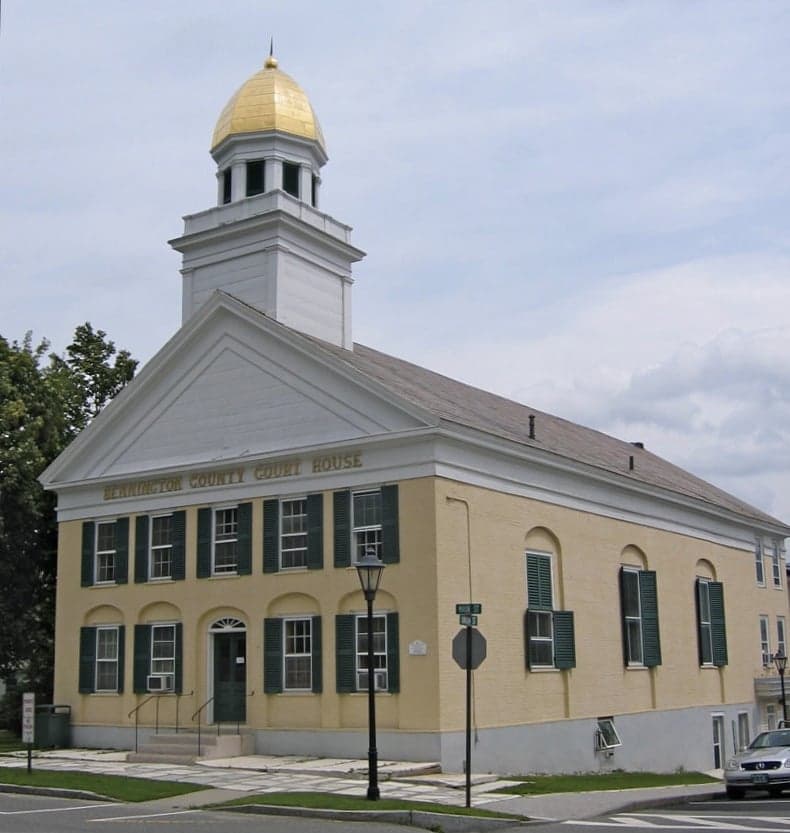
Photo: Wikipedia
Political ClimatePolitical Climate in Bennington County
Showing state-level results — no local-only data available.
Local Political AnalysisPolitical Analysis of Bennington County
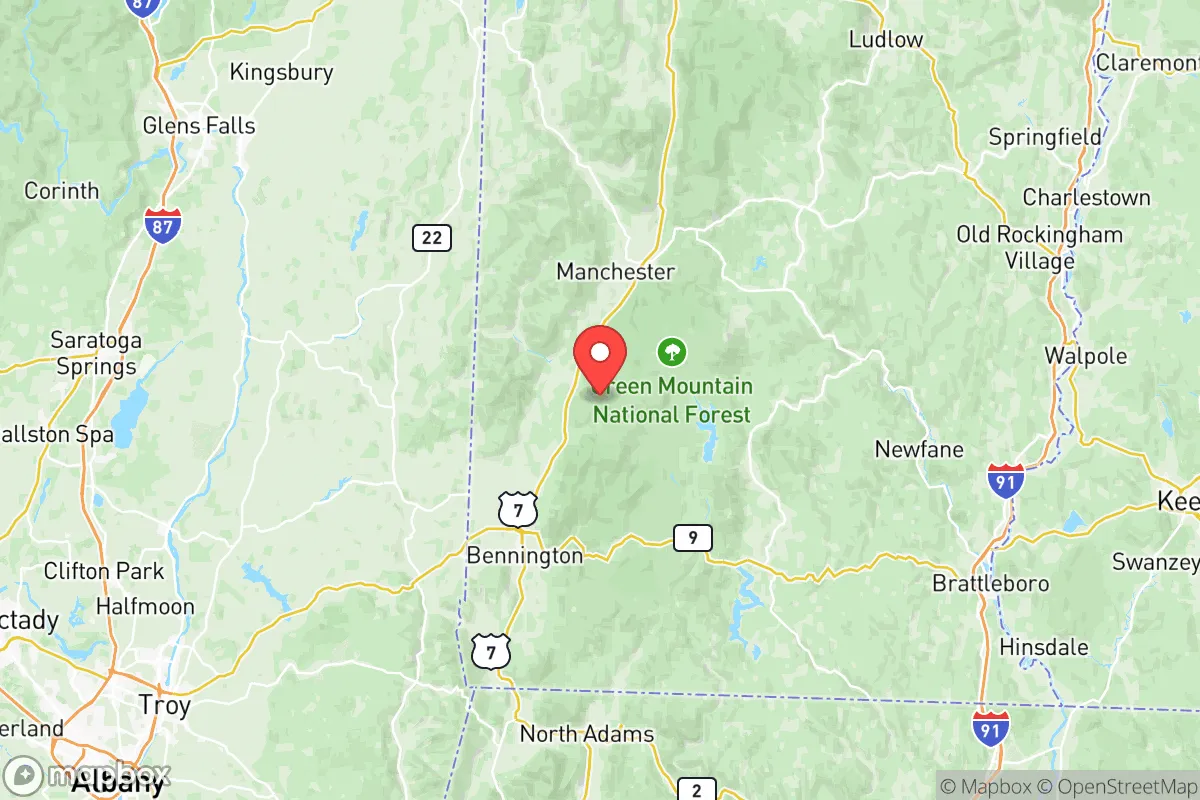
Bennington County, Vermont, holds a Cook Partisan Voting Index of D+17, making it as reliably Democratic as the state itself — but that stat masks a more layered reality on the ground. For decades the county has been a bedrock of Democratic voting, yet the actual political landscape inside its borders is far from monolithic, with conservative strongholds in the southern and eastern hill towns that can surprise newcomers expecting a uniformly blue Vermont.
How it compares
When you look at the Cook PVI number — D+17 — Bennington County and Vermont are identical. But spend any time in the county's towns and you see the difference. The village of Bennington itself, along with Manchester and Dorset, consistently turn in Democratic margins well above the county average, often pushing 70% or higher in presidential races. Drive south or east, though, and the story flips. Pownal, Woodford, and Stamford have precincts where Republican candidates can win by double digits — Pownal, for instance, went for Trump by about 15 points in 2020. Shaftsbury and Arlington are genuine swing territory, often landing within a few points of the statewide margin. So while the county's overall PVI mirrors Vermont's, the internal swing precincts make it one of the most politically diverse counties in the state. The trajectory has been a slow drift leftward in the higher-tax-base tourism towns, while the working-class mill towns have stayed relatively stable or shifted slightly right over the past decade.
What this means for residents
For a conservative resident in Pownal or Stamford, life is not a political isolation chamber. You'll find neighbors who share your views, and local town offices in those communities lean more moderate-to-conservative, especially on land use and school budgets. The county's Republican Committee remains active, and that means local races — select board, school board — are often genuinely contested, not coronations. For a liberal resident in Bennington or Manchester, the county's policies track closely with the state's progressive bent, such as mandatory paid family leave, strict renewable energy goals, and strong tenant protections. But you'll also encounter genuine debates over property taxes and growth management, especially in the booming Manchester real estate market. The practical effect is that both sides have to work together at the town level because the county government itself is relatively weak — most real power sits in each town's annual meeting, where voices from both ends of the spectrum show up. That keeps the political temperature lower than in many parts of the country; people here value knowing their select board member as a person, not just a party label.
One cultural distinction that sets Bennington County apart from some other parts of Vermont is the persistent influence of its Southern Vermont roots. The county shares a long border with Massachusetts and New York, and many residents commute across state lines for work or healthcare, exposing the area to a mix of regional political sensibilities. That cross-border dynamic keeps the county's politics grounded in practical, local concerns — road maintenance, school funding, housing availability — rather than national culture-war flashpoints. You'll hear more talk about whether to fix the Arlington bridge than about whatever cable-news controversy is dominating the national conversation. It's a place where the D+17 label is real, but the way it plays out in daily life is far more textured than any PVI number can capture.

State Political ClimatePolitical Climate in Vermont
State Political AnalysisPolitical Environment in the State
Vermont is one of the most reliably Democratic states in the country, with a Cook Partisan Voting Index of D+17, meaning it votes about 17 points more Democratic than the national average in presidential elections. The state hasn't voted for a Republican presidential candidate since George H.W. Bush in 1988, and the Democratic lean has only deepened since the 2000s, when it was still considered a swing state in local races. That said, the political reality is far more nuanced than the statewide numbers suggest — Vermont's brand of liberalism is distinctly rural, libertarian-leaning on personal freedoms, and tempered by a strong independent streak that can surprise newcomers.
Urban vs. rural divide
The political map of Vermont is a textbook case of the urban-rural split, but with a twist. The Democratic stronghold is Chittenden County, anchored by Burlington, the state's largest city and home to the University of Vermont. Burlington and its suburbs — South Burlington, Winooski, and Essex Junction — consistently deliver margins of 70-80% for Democratic candidates. This metro area, with about 160,000 residents, drives the statewide blue lean. In contrast, the rural Northeast Kingdom — counties like Essex, Orleans, and Caledonia — votes reliably Republican in local races, though many of these voters are registered as independents. Newport and St. Johnsbury are the conservative anchors there. The southern counties, particularly Rutland and Bennington, are more mixed: Rutland City itself leans Democratic, but the surrounding towns vote red. A notable exception is Montpelier, the state capital, which is even more progressive than Burlington, with a strong activist culture around environmental and social justice issues. The divide isn't just about party — it's about lifestyle: rural towns prioritize property rights and local control, while the urban core pushes for statewide mandates on climate, housing, and education.
Policy environment
Vermont's policy environment is shaped by a progressive majority in the legislature and a Republican governor, Phil Scott, who has been in office since 2017. This creates a dynamic where the legislature passes ambitious bills and Scott frequently vetoes them, often sustaining the vetoes with bipartisan support. The tax structure is high by national standards: Vermont has a progressive income tax with a top rate of 8.75%, a statewide property tax that funds education (averaging about $1.50 per $100 of assessed value), and a 6% sales tax. There is no county-level government, so all services are delivered by the state or municipalities. Education policy is centralized: the state sets curriculum standards and funds schools through the property tax, which has led to frequent debates about equity and cost. Healthcare is a major issue — Vermont attempted a single-payer system in 2014 but abandoned it due to cost, and now operates a public option (Green Mountain Care) alongside private insurance. Election laws are among the most accessible in the country: same-day voter registration, automatic voter registration via the DMV, no-excuse absentee voting, and universal mail-in ballots for all elections since 2020. Gun laws are relatively strict: a 2018 law (Act 94) banned magazines over 10 rounds, raised the purchase age to 21, and expanded background checks to private sales. There is no permit requirement for concealed carry, but the state does not recognize permits from most other states.
Recent policy direction
Over the past five years, Vermont has moved decisively left on several fronts, but with notable exceptions. In 2023, the legislature passed Act 47, which codified abortion rights into state law and removed most restrictions, including parental notification for minors — a move that drew sharp criticism from conservative towns. On education, Act 1 (2024) created a statewide universal school meal program and expanded funding for early childhood education, but also centralized control over school district budgets, reducing local authority. On housing, Act 250, the state's landmark land-use law, was reformed in 2024 to allow more density in designated growth centers, but rural towns fought to preserve local zoning control. On gun rights, the 2018 law has held, but a 2024 attempt to ban "assault weapons" failed in the legislature after Governor Scott signaled a veto. On parental rights, a 2023 law (Act 14) requires schools to affirm a student's gender identity without notifying parents if the student requests confidentiality — a flashpoint that has energized conservative opposition. On privacy, Vermont passed one of the strongest data privacy laws in the country (Act 162 of 2024), giving residents the right to opt out of data collection and sue companies for violations. On voting, the state expanded automatic voter registration to include 16- and 17-year-olds (they can pre-register) and made mail-in ballots permanent. On property rights, the state's "opt-in" system for broadband expansion has been slow, leaving many rural areas without reliable internet — a practical liberty issue for remote workers.
Civil unrest & political movements
Vermont is not known for large-scale civil unrest, but there are active and organized movements on both sides. The left is dominated by the Vermont Progressive Party, which holds seats in the legislature and pushes for rent control, a state bank, and a Green New Deal-style energy transition. The Burlington area has seen periodic protests over police reform, housing affordability, and climate change — the 2020 Black Lives Matter protests in Burlington were large for the city, drawing thousands. On the right, the Vermont Republican Party is small but vocal, with a strong libertarian wing that opposes vaccine mandates and gun control. The "Take Back Vermont" movement, which emerged in the early 2000s over civil unions, has evolved into a network of local groups focused on school board elections and parental rights. In 2023, a controversy over a school district's policy on transgender students led to a recall effort against school board members in Essex Junction. Immigration politics are relatively quiet — Vermont has no sanctuary city policies, but Burlington has a "welcoming city" ordinance that limits cooperation with ICE. There is no serious secession movement, though some rural towns have floated the idea of joining New Hampshire over tax and gun policy. Election integrity has not been a major controversy; Vermont's mail-in voting system has been in place since 2020 with bipartisan oversight and no significant fraud allegations.
Projection
Over the next 5-10 years, Vermont's political trajectory is likely to continue leftward on social and environmental issues, but with increasing friction from rural towns. In-migration is a wild card: the state has seen a modest influx of remote workers from New York and Boston since 2020, many of whom are progressive and settle in Chittenden County or the Upper Valley (around White River Junction). This demographic shift will deepen the urban-rural divide, as new arrivals tend to support higher taxes and stricter land-use regulations. However, the state's population is aging and declining in rural areas, which could reduce the political power of conservative towns. The Republican Party may become more libertarian and less socially conservative to appeal to independent voters, but it's unlikely to win statewide office without a moderate like Phil Scott. Expect continued battles over school funding, gun laws, and housing policy, with the legislature pushing further left and the governor's veto providing a check. For a conservative relocator, the practical reality is that Vermont will remain a place where you can own property, hunt, and live quietly, but you'll pay high taxes and have limited influence on state-level policy. For a liberal relocator, the state offers a supportive environment for progressive values, but with the trade-off of high costs and a slow-moving bureaucracy.
For someone moving to Vermont, the bottom line is this: you'll be living in a state where the government is active in your daily life — from your property taxes to your children's education to your healthcare choices. If you're conservative, you'll find like-minded communities in the Northeast Kingdom and southern towns, but you'll be swimming against the current in statewide elections. If you're liberal, you'll find a welcoming policy environment, but be prepared for the high cost of living and the frustration of a system that can be slow to change. The state's independent streak means that local relationships and town meeting democracy still matter — your voice can be heard at the local level, even if the statehouse is dominated by the other side. Vermont is not a place for people who want to be left alone by government; it's a place for people who want to be part of a community that governs itself, for better or worse.
* Values derived from national, state, county, city and local statistics and may differ in a specific area. Last updated: 2026-07-09T01:42:30.000Z
Narrative content on this page is AI-generated and may contain mistakes. Verify any details that matter before acting on them.
ReloMaps may earn a commission from affiliate links at no extra cost to you.

