
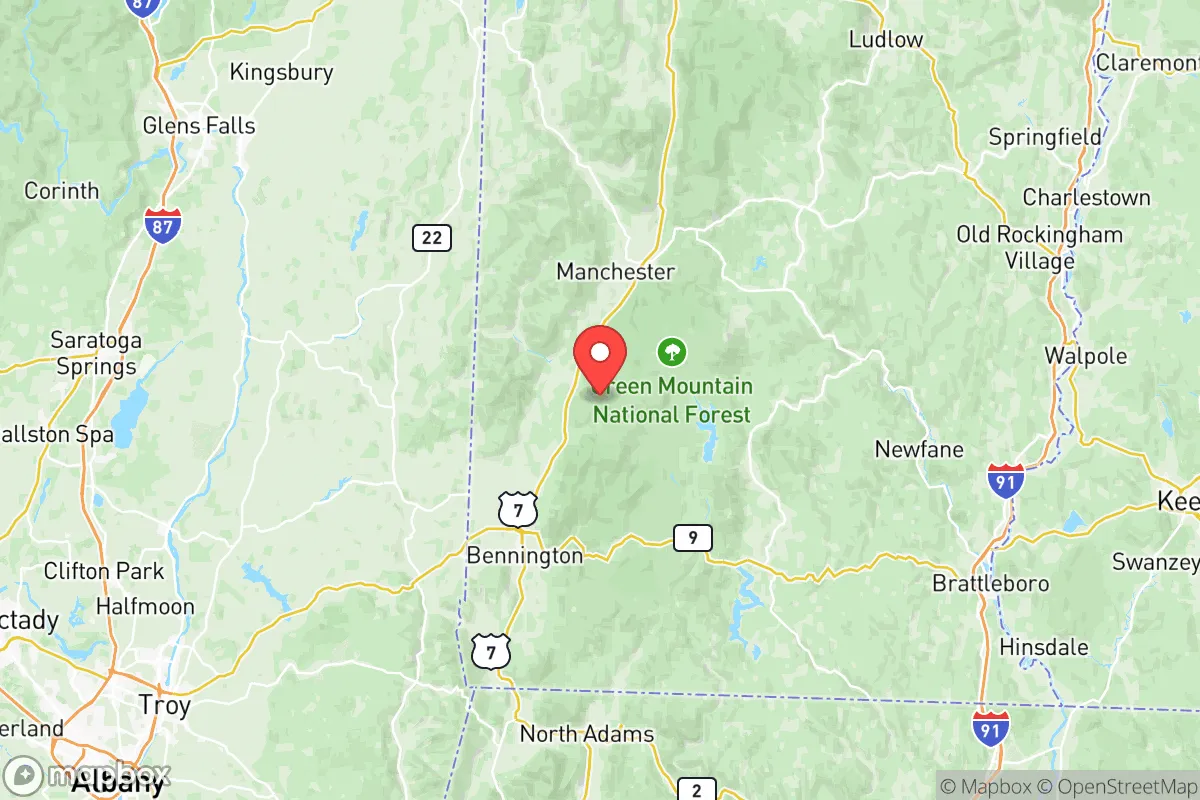
Photo: Wikipedia
Personal Sovereignty in Bennington County
Moderate friction. Expect trade-offs in some aspect of personal liberty and independence.
What does Personal Sovereignty tell us?
Personal Sovereignty measures your capacity for self-reliance and independence with minimal government friction. Higher scores mean fewer barriers between you and the way you want to live... but it assumes you have the space you need and good neighbors.
What does this tell us?
Personal Sovereignty measures your capacity for self-reliance and independence with minimal government friction. Higher scores mean fewer barriers between you and the way you want to live... but it assumes you have the space you need and good neighbors.
State Policy
Energy independence: Importer (15% of energy produced in-state)
Personal Liberty
Homesteading

Personal Liberty Analysis
Bennington County offers a notably high degree of personal sovereignty compared to many areas of the Northeast, driven by Vermont’s traditionally libertarian-leaning political culture and the county’s rural, self-reliant character. While Vermont as a state imposes certain progressive mandates—such as a statewide single-payer healthcare system in name and strict environmental regulations—Bennington County’s local governance is generally light-touch, with towns like Arlington, Manchester, and Dorset operating with minimal zoning enforcement and a strong presumption of individual autonomy. The county’s small population (roughly 37,000) and low population density (about 40 people per square mile) mean that daily life is largely free from the bureaucratic friction found in more urbanized parts of New England. For a relocation-minded individual or family prioritizing personal freedom, Bennington County represents a pragmatic balance: state-level guardrails exist, but local enforcement is often deferential to individual choice, particularly in the county’s more rural towns.
Tax burden and regulatory posture for residents and property owners
Vermont’s tax burden is among the highest in the nation—ranking 4th highest in combined state and local taxes as of 2025—but Bennington County offers some relief relative to Chittenden County (Burlington area). Property taxes in Bennington County average around 1.8% of assessed value, slightly below the state average of 2.0%, with towns like Pownal and Readsboro often seeing rates closer to 1.5% due to lower municipal spending. The state’s income tax is progressive, topping out at 8.75% for income over $213,150 (2025 brackets), which is a meaningful consideration for higher-earning remote workers. Regulatory posture is mixed: Vermont has strict Act 250 land-use permitting for developments over 10 acres, but Bennington County’s local zoning is often minimal or nonexistent in unincorporated areas. For example, Stamford and Woodford have no formal zoning bylaws, allowing property owners to build, renovate, or operate home businesses with little municipal oversight. The state’s sales tax is 6%, with no local add-ons, and there is no tax on Social Security benefits—a plus for retirees. Overall, the tax burden is real but predictable, and the regulatory environment is lightest in the county’s hill towns, where local officials tend to prioritize property rights over planning codes.
Self-defense rights and gun law specifics in Vermont
Vermont is one of the most gun-friendly states in the Northeast, and Bennington County reflects that culture strongly. The state has no permit requirement for concealed or open carry of handguns or long guns—a constitutional carry regime in place since 2018. There is no state-level firearm registry, no waiting period for purchases, and no magazine capacity restrictions. However, Vermont does have a red-flag law (Extreme Risk Protection Order) enacted in 2020, which allows law enforcement to petition a court to temporarily remove firearms from individuals deemed a risk. This law is used sparingly in Bennington County, where sheriff’s offices in towns like Bennington and Manchester are known for a pro-Second Amendment stance. The county has a strong hunting and sport-shooting culture, with multiple public ranges and private clubs. For self-defense, the legal framework is straightforward: use of deadly force is justified if a person reasonably believes it is necessary to prevent imminent death or great bodily harm to themselves or another, with no duty to retreat in one’s home (castle doctrine). Stand-your-ground is not explicitly codified, but Vermont courts have generally interpreted self-defense broadly. For a relocation-minded individual, Bennington County offers essentially the same gun freedoms as states like Texas or Arizona, but within a New England context—meaning fewer gun stores and ranges, but no legal barriers to ownership or carry.
Self-reliance and homesteading viability across the county
Bennington County is one of the most viable areas in the Northeast for self-reliant living, particularly in its rural towns. Lot sizes vary dramatically: in Dorset and Rupert, minimum lot sizes in agricultural zones are often 10 acres or more, while Pownal and Readsboro have no minimum lot size for single-family homes in many areas. Zoning for homesteading activities is generally permissive—raising chickens, goats, or even pigs is allowed without permits in most towns, provided the property is zoned residential-agricultural. Off-grid feasibility is high: Vermont has no state law requiring grid connection, and many properties in Bennington County rely on private wells, septic systems, and solar power. The county receives about 40 inches of rain annually, making rainwater catchment a practical supplement. Wood heat is common, with abundant firewood available from local forests. However, Vermont’s building code (the Residential Building Energy Standards) applies to new construction, requiring minimum insulation and efficiency levels—a modest regulatory hurdle for off-grid builders. The county’s agricultural soils are thin and rocky, so market gardening is more viable than row crops, but the growing season (120–140 days) supports vegetables, berries, and apples. For a family seeking to reduce reliance on supply chains, Bennington County offers a realistic path, especially in towns like Stamford and Woodford, where local officials are known to look the other way on minor code enforcement for homesteaders.
Personal liberties: parental rights, medical autonomy, speech, and property
Vermont’s legal framework generally supports personal liberties, though with some progressive exceptions. Parental rights are strong: Vermont has no mandatory vaccination law for school attendance (only a requirement to submit a signed exemption form), and parents can opt children out of sex education or any curriculum they find objectionable. Homeschooling is legal with minimal oversight—parents must submit an annual enrollment notice but no curriculum approval is required. Medical autonomy is mixed: Vermont legalized assisted suicide in 2013 (Patient Choice and Control at End of Life), and medical marijuana has been legal since 2004, with recreational cannabis legal since 2018. However, the state has a strict vaccine mandate for healthcare workers and long-term care facility employees, which may affect some professions. Free speech is robustly protected under the Vermont Constitution, which has its own free speech clause interpreted more broadly than the First Amendment in some cases. Property rights are generally respected, but Vermont’s Act 250 can be a hurdle for large-scale development or subdivision. In Bennington County, property disputes are rare, and towns like Manchester and Arlington have a strong tradition of neighborly non-interference. For a conservative-leaning individual, the county’s culture of “live and let live” often outweighs the state’s progressive policies, particularly in daily life where enforcement is minimal.
Overall, Bennington County offers a level of personal sovereignty that is rare in the Northeast, comparable to rural areas of New Hampshire or upstate New York, but with a more permissive regulatory culture in practice. The tax burden is higher than in Sun Belt states, but the trade-off is a low-crime environment, excellent public schools in towns like Manchester and Dorset, and a community ethos that values individual responsibility. For a relocation-minded individual or family who prioritizes autonomy—especially in self-defense, homesteading, and daily life—Bennington County is a strong contender, particularly if you choose a town like Readsboro, Stamford, or Pownal over the more regulated village centers of Bennington or Manchester. The key is to align your specific priorities with the town’s local culture: for maximum freedom, head to the hill towns; for a balance of services and liberty, the valley towns work well.

* Values derived from national, state, county, city and local statistics and may differ in a specific area. Last updated: 2026-07-09T01:42:30.000Z
Narrative content on this page is AI-generated and may contain mistakes. Verify any details that matter before acting on them.
ReloMaps may earn a commission from affiliate links at no extra cost to you.

