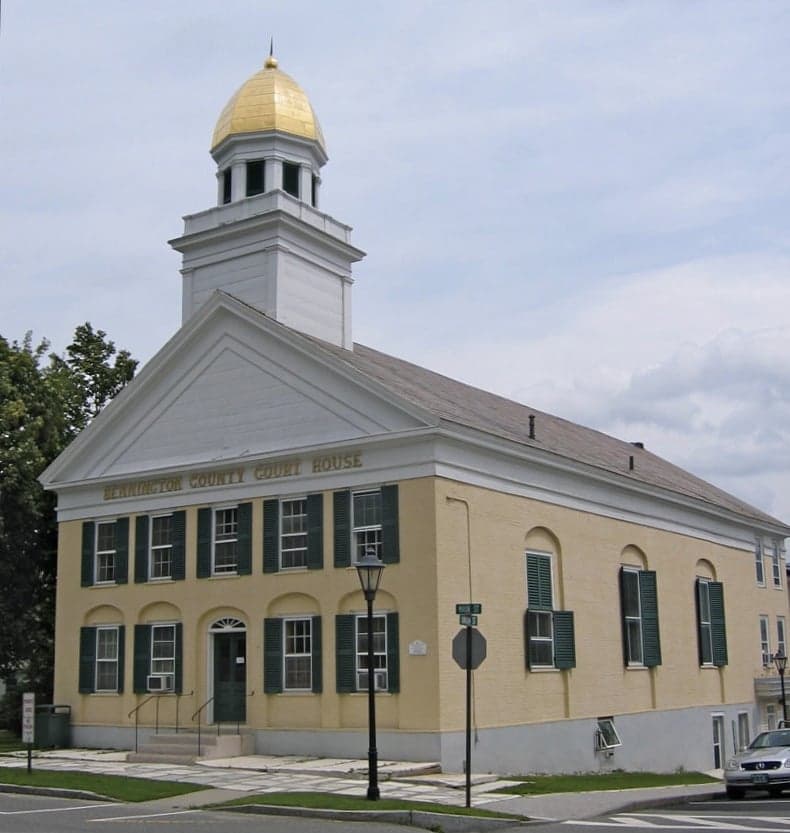
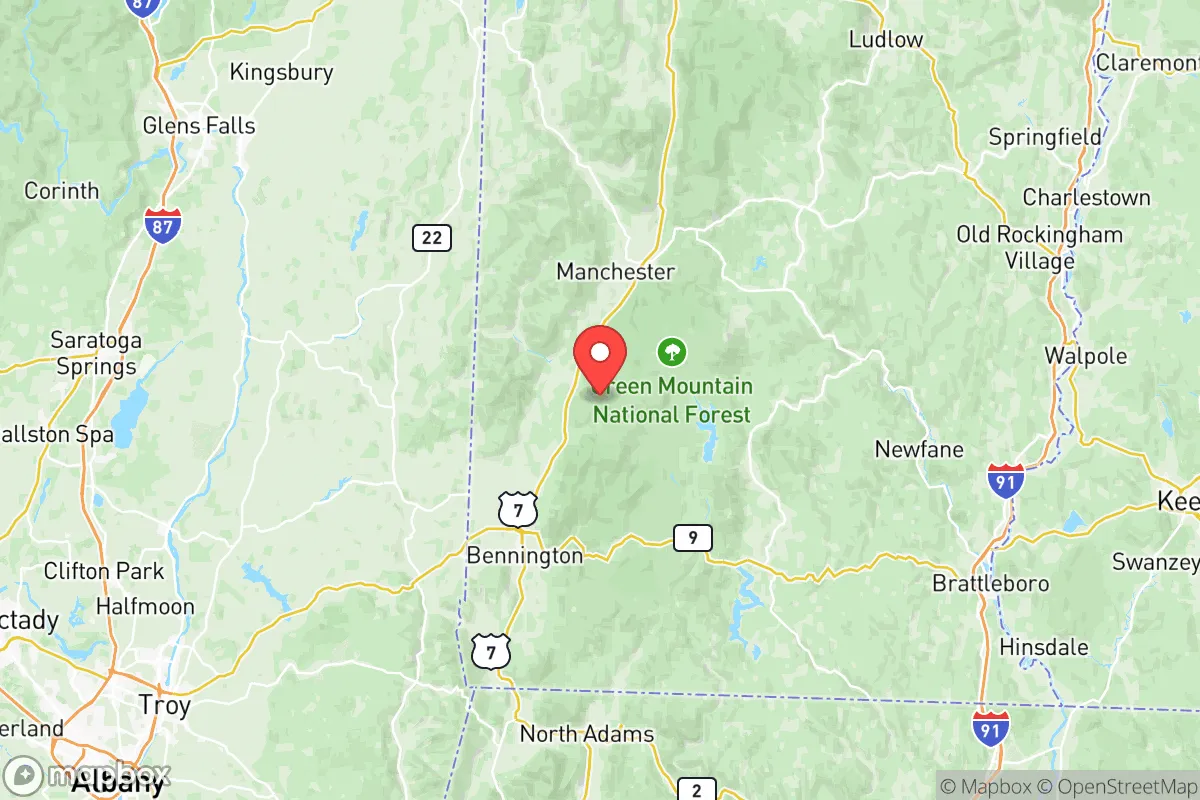
Photo: Wikipedia
Demographics of Bennington County
Affluence Level in Bennington County
A middle-class area roughly in line with national averages across income, home values, education, and employment.
People of Bennington County
Bennington County, Vermont, is home to 37,312 residents who form one of the most ethnically homogeneous populations in New England, with 91.6% of the population identifying as white and only 1.0% foreign-born. The county’s character is defined by its historic mill towns, rural villages, and a strong Yankee and French-Canadian heritage, with a notable concentration of college-educated residents at 41.2%. Unlike many rural counties, Bennington County has a distinctive identity shaped by its role as a borderland between New England and New York, its early industrial history, and a recent stability that has resisted the rapid demographic changes seen elsewhere in the state.
Settlement & growth (pre-1960)
The original inhabitants of the region now known as Bennington County were the Mahican people, an Algonquian-speaking nation who occupied the Hoosic River valley and the surrounding uplands. The Mahican were largely displaced or absorbed by the Mohawk of the Iroquois Confederacy during the 17th century, and by the time European settlers arrived in force, the area was a contested hunting ground between the Mohawk and the Abenaki. The first permanent European settlement began in the 1760s, when the New Hampshire Grants—land grants issued by colonial Governor Benning Wentworth—attracted settlers from Connecticut, Massachusetts, and Rhode Island. The town of Bennington, chartered in 1749, became the first organized community, and its location along the Walloomsac River made it a natural hub for the region’s early agrarian economy.
The American Revolution cemented Bennington County’s place in history. The Battle of Bennington in 1777, a decisive victory for American forces, was fought largely by New Hampshire and Massachusetts militiamen, many of whom later settled in the area. After the war, the county’s population grew steadily through the early 19th century, driven by the expansion of sheep farming and the woolen industry. The arrival of the railroad in the 1850s transformed the economy, connecting Bennington and North Bennington to markets in Albany and Boston. This period also saw the first significant wave of non-English immigrants: Irish laborers arrived to build the railroads and work in the mills, settling primarily in Bennington village and Manchester.
The late 19th and early 20th centuries brought a second major wave: French-Canadian immigrants from Quebec, who were drawn by jobs in the region’s textile mills, paper mills, and marble quarries. By 1900, French-Canadians made up a substantial portion of the population in Bennington, North Bennington, and Pownal, where they formed tight-knit Catholic communities centered on parishes like Sacred Heart St. Francis de Sales in Bennington. A smaller number of Italian immigrants arrived during the same period, working in the marble industry in Dorset and Danby, where the Vermont Marble Company operated some of the largest quarries in the nation. The county’s population peaked at around 36,000 in the 1950s, as the postwar manufacturing boom sustained employment at mills and factories in Bennington, Manchester, and Arlington.
Modern era (post-1965)
The 1965 Hart-Cellar Act, which reshaped U.S. immigration policy, had a minimal direct impact on Bennington County. Unlike urban areas or Sun Belt suburbs, the county did not experience a wave of new immigrant communities. The foreign-born population remains at just 1.0%, one of the lowest rates in Vermont and the nation. Instead, the county’s modern demographic story is one of domestic migration and suburbanization. Beginning in the 1970s, the decline of the textile and paper industries led to population stagnation and outmigration, particularly from the mill towns of Bennington and Pownal. At the same time, the rise of the ski industry and second-home tourism brought an influx of affluent, often seasonal residents to Manchester and Dorset, transforming those towns into resort communities with a distinctly different character from the county’s industrial core.
The racial and ethnic composition of Bennington County has remained remarkably stable since 1965. The white population, at 91.6%, is slightly higher than Vermont’s state average of 89.1%. The Hispanic population, at 2.7%, is the largest minority group, concentrated primarily in Bennington and Pownal, where a small but growing number of Mexican and Central American immigrants have arrived since the 1990s to work in agriculture, landscaping, and the service industry. The Black population, at 1.0%, is largely concentrated in Bennington, with a smaller presence in Manchester. East and Southeast Asian communities (0.6%) and Indian-subcontinent residents (0.3%) are scattered across the county, with no distinct enclaves. The county’s college-educated population, at 41.2%, is notably high for a rural area, driven by the presence of Bennington College in North Bennington and the concentration of affluent retirees and telecommuters in Manchester and Arlington.
Suburbanization in Bennington County has been modest compared to other regions. The county lacks a major urban center, and development has largely followed the historic pattern of village centers surrounded by rural countryside. The most notable suburban growth has occurred along the Route 7 corridor between Bennington and Manchester, where new housing developments and commercial strips have attracted families seeking a rural lifestyle with access to amenities. However, the county’s population has remained essentially flat since 2010, hovering around 37,000, as outmigration of young adults seeking jobs in larger cities has offset any growth from in-migration.
The future
Bennington County’s population is projected to remain stable or decline slightly over the next 10-20 years, with an aging demographic profile. The county’s median age, already above the state average, is likely to rise further as younger residents continue to leave for employment opportunities in Burlington, Albany, and Boston. The Hispanic population is expected to grow modestly, potentially reaching 4-5% by 2040, driven by continued immigration and higher birth rates, but the county will remain overwhelmingly white. The foreign-born population is unlikely to exceed 2%, as the county lacks the economic magnets—large employers, universities, or refugee resettlement programs—that attract international migrants to other parts of Vermont.
The cultural identity of Bennington County is evolving slowly. The historic divide between the industrial towns of the south (Bennington, Pownal) and the resort towns of the north (Manchester, Dorset) is deepening, as the latter attract affluent newcomers while the former struggle with economic stagnation. The county’s Yankee and French-Canadian heritage remains strong, but it is increasingly blended with a liberal-leaning, environmentally conscious ethos brought by second-home owners and telecommuters from New York and Boston. The county is becoming more politically polarized, with Manchester and Arlington trending Democratic while Bennington and Pownal remain more conservative.
For someone moving to Bennington County now, the region offers a stable, safe, and scenic environment with a strong sense of local history. The population is not diversifying rapidly, and the county’s cultural identity remains rooted in its rural, small-town character. New residents, particularly those from out of state, will find a welcoming but insular community where integration requires active participation in local institutions—schools, churches, and town meetings. The county is not a destination for those seeking ethnic diversity or a dynamic urban scene, but for families and individuals who value quiet, natural beauty, and a slower pace of life, it remains one of the most authentic corners of New England.

* Values derived from national, state, county, city and local statistics and may differ in a specific area. Last updated: 2026-07-09T01:42:30.000Z
Narrative content on this page is AI-generated and may contain mistakes. Verify any details that matter before acting on them.
ReloMaps may earn a commission from affiliate links at no extra cost to you.

