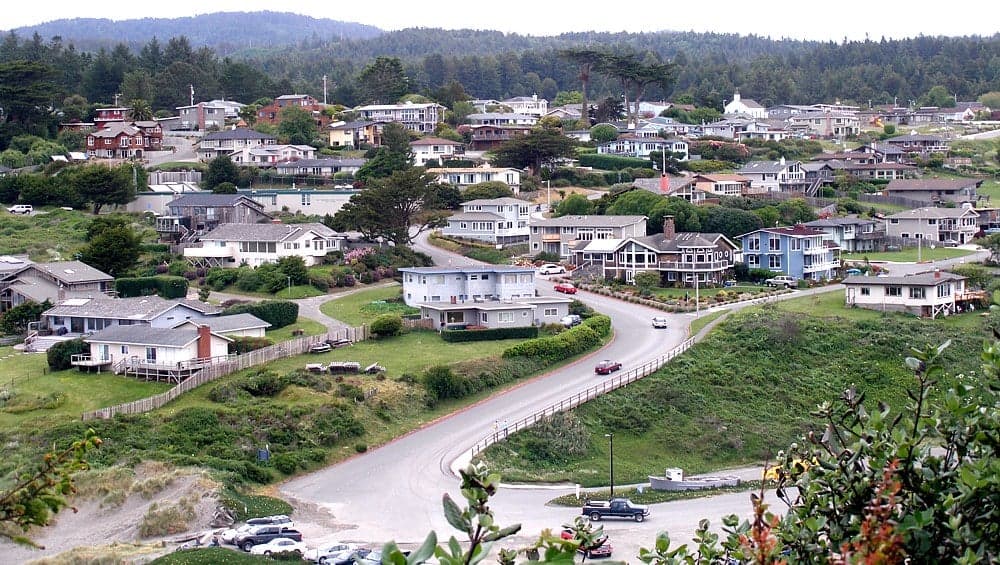
Photo: Wikipedia
Political ClimatePolitical Climate in Trinidad, CA
District shown is the primary district for this city’s centroid. Cities may span multiple districts.
Inherited from parent state — no local data available.
Local Political AnalysisPolitical Analysis of Trinidad, CA
Trinidad, California, is a small coastal town in Humboldt County that leans heavily Democratic, reflecting the broader political character of the region. In the 2020 presidential election, Humboldt County voted for Joe Biden by a margin of roughly 66% to 30%, and Trinidad itself, with its population of under 400, is even more consistently blue. The area has a long history of environmental activism and progressive politics, shaped by the nearby university town of Arcata and the general counterculture influence that has defined the North Coast for decades. While the political trajectory here has been stable—liberal and environmentally focused—there's a growing tension between long-time residents who value the area's isolation and newer arrivals seeking a more affordable alternative to the Bay Area.
How it compares
Compared to California as a whole, Trinidad is a political outlier even within a blue state. While California's Cook PVI is unknown, the state overall is solidly Democratic, but Trinidad sits in a region that is more intensely progressive than the state average, particularly on environmental and land-use issues. The contrast with nearby towns is stark: drive 20 miles east to the rural community of Willow Creek, and you'll find a much more conservative, libertarian-leaning population, with Trump signs still common on fences. Even Eureka, the county seat just 20 miles south, is more moderate, with a mix of working-class Democrats and Republicans. Trinidad, by contrast, is a place where local politics often revolve around coastal access, timber management, and tribal sovereignty—issues that draw a clear line between the town's liberal consensus and the more mixed views of the surrounding county.
What this means for residents
For liberal residents, Trinidad's political climate feels natural and supportive. Local government is generally aligned with their values on environmental protection, public land use, and social services. You'll find community events that emphasize sustainability, and the local school district reflects a progressive ethos. For conservative residents, life here can be isolating politically, but it's not hostile. Most people keep their politics private, and the small-town culture means neighborly relationships often transcend party lines. The practical impact is that conservative viewpoints are rarely represented in local decision-making—zoning laws, for example, tend to prioritize conservation over development—but there's no active suppression of dissent. The real friction point is economic: the area's high cost of living, driven by limited housing and tourism, affects everyone, and political debates often circle back to how to balance preservation with affordability.
One key cultural distinction is the strong influence of the Yurok Tribe, whose reservation borders Trinidad. Tribal sovereignty and co-management of natural resources are central to local politics, creating a dynamic that is unique even by California standards. This means that issues like fishing rights, coastal access, and timber harvesting are negotiated between the tribe, the county, and the state, often with Trinidad residents acting as vocal advocates for tribal perspectives. Looking ahead, the political climate here is likely to remain stable, but the influx of remote workers from the Bay Area could shift the balance slightly toward more moderate, tech-oriented liberalism. For now, Trinidad remains a place where the political conversation is earnest, local, and deeply tied to the land—a small-town echo of California's progressive wing, but with its own distinct rhythm.

State Political ClimatePolitical Climate in California
State Political AnalysisPolitical Environment in the State
California is a deeply blue state where Democrats hold every statewide office and supermajorities in both legislative chambers, but the reality on the ground is far more nuanced than the national headlines suggest. The state’s overall partisan lean has been solidly Democratic for three decades, with the last Republican presidential candidate to carry it being George H.W. Bush in 1988. However, the 2024 election saw a notable rightward shift in many working-class and inland areas, with Donald Trump improving his vote share by roughly 5 points compared to 2020, even as Kamala Harris won the state by a comfortable 20-point margin. For a conservative-leaning relocator, the key takeaway is that California is not a monolith—your experience will vary dramatically depending on whether you settle in coastal Los Angeles, inland Bakersfield, or the suburban Inland Empire.
Urban vs. rural divide
The political map of California is essentially a tale of two states. The coastal metros—San Francisco, Los Angeles, Oakland, and San Jose—are the engine of the Democratic supermajority, delivering margins of 70-85% for Democratic candidates. In contrast, the Central Valley and inland regions are reliably Republican: Bakersfield (Kern County) voted +22 for Trump in 2024, while Redding (Shasta County) went +35. The Inland Empire, particularly San Bernardino and Riverside counties, has become a critical swing region—these areas voted for Biden in 2020 but shifted right in 2024, with Trump winning Riverside County by 2 points. Orange County, once a Republican stronghold, has trended purple; it voted for Biden in 2020 and Harris in 2024, but by narrower margins than the Bay Area. Suburbs like Simi Valley (Ventura County) and Murrieta (Riverside County) remain conservative-leaning enclaves, while Fresno is a classic bellwether—its urban core votes blue, but the surrounding agricultural areas are deep red.
Policy environment
California’s policy environment is defined by high taxes, heavy regulation, and a progressive social agenda that can feel jarring for a conservative relocator. The state has a progressive income tax with a top marginal rate of 13.3% (the highest in the nation), a state sales tax of 7.25% (with local add-ons pushing it to 10.25% in some cities), and property taxes capped at 1% of assessed value under Proposition 13. Education policy is centralized in Sacramento, with a strong teachers’ union influence and a recent push for ethnic studies requirements in high schools. Healthcare is heavily regulated, with the state operating its own insurance exchange (Covered California) and expanding Medi-Cal to all low-income adults regardless of immigration status. Election laws are among the most liberal in the country: all registered voters receive a mail-in ballot automatically, same-day registration is available, and non-citizens can vote in school board elections in some cities (like San Francisco).
Recent policy direction
The last five years have seen California double down on its progressive identity through a series of specific laws that a relocator should understand. On gun rights, the state passed SB 2 (2023), which effectively bans carrying firearms in most public places, including parks, hospitals, and public transit—a law currently tied up in federal court. On parental rights, AB 1955 (2024) prohibits school districts from requiring parental notification when a child changes their gender identity, a direct response to conservative school boards in places like Temecula and Chino Hills that had passed parental notification policies. On speech, the state’s AB 587 (2022) requires social media platforms to report their content moderation policies, while AB 1078 (2023) restricts book bans in school libraries. Medical and bodily autonomy is fully protected: abortion remains legal up to viability, and the state has spent $200 million to fund travel for out-of-state patients. Property rights are constrained by rent control laws (AB 1482 caps annual rent increases at 5% plus inflation) and the California Environmental Quality Act (CEQA), which can delay construction for years. On taxes, Proposition 19 (2020) limited property tax benefits for inherited homes, meaning children who inherit a parent’s house may face a reassessment. Voting access expanded with AB 37 (2021), which requires every county to mail a ballot to every active registered voter.
Civil unrest & political movements
California has been a flashpoint for political movements on both sides. The 2020 George Floyd protests in Los Angeles and Oakland were among the largest and most destructive in the nation, with over $1 billion in damages. The state’s sanctuary law (SB 54, 2017) limits local law enforcement cooperation with federal immigration authorities, creating ongoing tension with ICE. The secession movement—Calexit—fizzled after a 2018 poll showed only 32% support, but the idea of a “State of Jefferson” in the rural north (including Yreka and Redding) remains a symbolic protest against Sacramento’s dominance. Election integrity controversies flared in 2020 and 2022, particularly in Shasta County, where the Board of Supervisors voted to hand-count ballots (later blocked by the state). More recently, the 2024 election saw scattered reports of ballot drop box tampering in Los Angeles County, though no widespread fraud was found. A new resident will notice the constant presence of homelessness encampments in cities like San Francisco and Los Angeles, which have become a visible symbol of the state’s policy challenges.
Projection
Over the next 5-10 years, California’s political trajectory points toward a slow but steady moderation on economic issues, even as social policy remains firmly progressive. The state is losing population—roughly 500,000 residents between 2020 and 2024—with many moving to Texas, Arizona, and Nevada, and those leaving tend to be moderate and conservative-leaning. This out-migration is reshaping the electorate: the remaining population is younger, more diverse, and more liberal, which will likely keep the state blue for the foreseeable future. However, the shift rightward in the Inland Empire and Central Valley suggests that the Democratic supermajority could narrow in the state legislature, particularly if housing costs continue to push moderate families inland. The biggest wildcard is the housing crisis: if the state actually builds its way out (as recent legislation like SB 9 and SB 10 attempts to allow), it could attract new residents who might shift the political balance. For a conservative moving in now, expect to live in a state where your vote for president won’t matter, but your local school board and city council races will be fiercely contested and increasingly polarized.
For a conservative relocator, the bottom line is that California offers a high degree of personal freedom in some areas (medical autonomy, privacy, environmental quality) but heavy restrictions in others (gun rights, parental control over education, property development). If you choose to move here, your best bet is to target a politically compatible community—like Simi Valley, Murrieta, or Bakersfield—where your values align with the local majority. Just know that state-level policies will still affect your daily life, from your tax bill to your children’s curriculum, and that the political climate is unlikely to shift dramatically in your favor anytime soon.
* Values derived from national, state, county, city and local statistics and may differ in a specific area. Last updated: 2026-10-29T04:50:54.000Z
Narrative content on this page is AI-generated and may contain mistakes. Verify any details that matter before acting on them.
ReloMaps may earn a commission from affiliate links at no extra cost to you.

