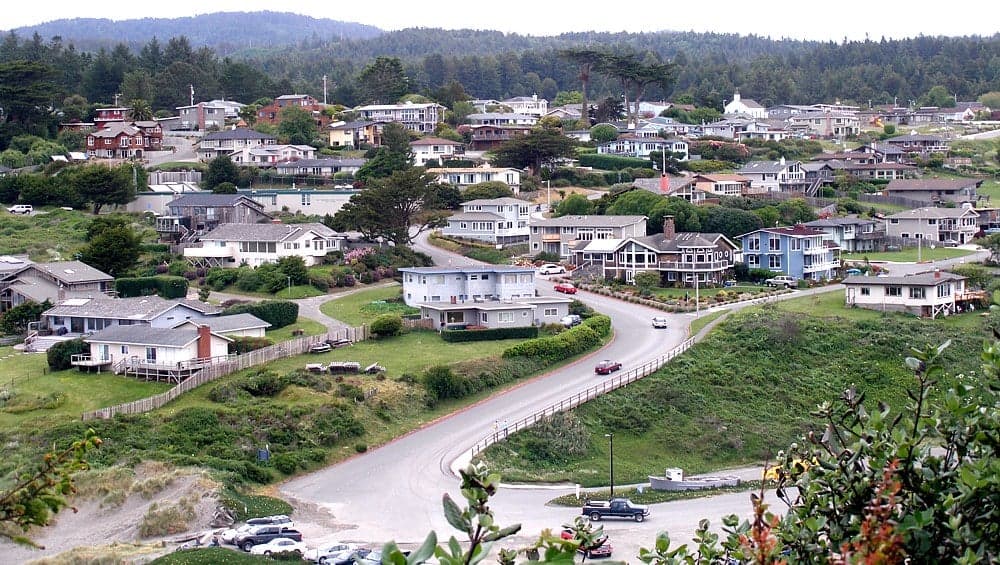
Photo: Wikipedia
Personal Sovereignty in Trinidad, CA
Viable for self-reliance. Generally workable, though some barriers may limit total independence.
What does Personal Sovereignty tell us?
Personal Sovereignty measures your capacity for self-reliance and independence with minimal government friction. Higher scores mean fewer barriers between you and the way you want to live... but it assumes you have the space you need and good neighbors.
What does this tell us?
Personal Sovereignty measures your capacity for self-reliance and independence with minimal government friction. Higher scores mean fewer barriers between you and the way you want to live... but it assumes you have the space you need and good neighbors.
State Policy
Energy independence: Importer (33% of energy produced in-state)
Personal Liberty
Homesteading

Personal Liberty Analysis
Trinidad, California offers a mixed sovereignty picture: the town itself is tiny and lightly governed, but residents operate under some of the most restrictive state-level laws in the nation. For a freedom-minded individual or family, the real question isn't whether Trinidad is free — it's whether the state's heavy hand leaves enough room to live on your own terms. The answer depends heavily on which slice of autonomy you care about most: taxes, self-defense, land use, or personal liberties.
Tax burden and regulatory posture in Humboldt County
California's tax climate is the first hurdle. The state levies a top marginal income tax rate of 13.3%, the highest in the country, and applies it to income over roughly $1 million — but even middle-class earners face rates around 9-10%. Sales tax in Trinidad sits at 7.25% base plus local add-ons, typically landing near 8.5%. Property taxes are the one bright spot: Proposition 13 caps annual increases at 2% and bases assessments on purchase price, so a home bought today won't see its tax bill spiral with rising values. For a new buyer, expect an effective rate around 1.1-1.2% of purchase price annually.
Regulatory posture is where California diverges sharply from lighter-touch states. The California Environmental Quality Act (CEQA) applies to virtually any development project, and Humboldt County's coastal zoning adds another layer. Trinidad's Local Coastal Program restricts new construction within the coastal zone, requiring coastal development permits for most alterations — even some fences and driveways. Permitting a new home can take 12-24 months and cost $10,000-$30,000 in fees and studies. For comparison, a similar build in rural Nevada or Idaho might clear permitting in 60-90 days. The regulatory burden is real, but it's not uniformly hostile: once you're built, the county largely leaves you alone, and there's no personal income tax on capital gains from selling a primary residence after two years of ownership (up to $250,000 single / $500,000 married).
Self-defense and gun law specifics in Trinidad, CA
California is a "may issue" state for concealed carry, but in practice Humboldt County is more permissive than urban counties. The sheriff's office issues CCW permits to applicants who complete a training course and demonstrate good cause — which in this rural county typically means self-defense is accepted as sufficient. Wait times run 3-6 months, and permits cost roughly $300-$400 including training. Open carry of handguns is illegal in incorporated areas, and unloaded open carry is restricted in most public spaces. Long guns can be carried openly in unincorporated areas, though it draws attention.
State law imposes a 11% excise tax on firearms and ammunition, plus a $37.19 background check fee per transaction. Magazine capacity is capped at 10 rounds, and "assault weapon" regulations ban many popular rifle configurations. Ammunition purchases require a background check and are recorded in a state database. Self-defense law itself is favorable: California's Castle Doctrine allows use of deadly force inside your home without a duty to retreat, and the "stand your ground" standard applies outside the home if you're in a place you have a right to be. However, the state's strict liability for negligent storage (a 2019 law) means firearms must be locked when not in your immediate control — a factor for families with children.
Homesteading and off-grid viability: lot sizes, zoning, and reality
Trinidad proper is a compact coastal village with lots typically 5,000-10,000 square feet — not homestead territory. But the surrounding unincorporated areas of Humboldt County offer genuine acreage. Properties in the nearby McKinleyville and Fieldbrook corridors range from 1-40 acres, with prices from $80,000 for raw land to $400,000+ for improved parcels. Zoning is predominantly Agricultural Residential (AR), which permits livestock, gardens, and accessory structures without special use permits — as long as you stay under county building thresholds.
Off-grid feasibility is genuinely viable here, with caveats. Humboldt County allows permanent off-grid living if you obtain a septic permit and a water source (well or catchment); solar is legal and net-metering is available, though the state's recent NEM 3.0 rules reduced export credits. The catch: the California Building Standards Code requires structural compliance even for off-grid cabins, and the county enforces it. A permitted 400-square-foot "accessory dwelling unit" (ADU) can be built for $50,000-$80,000, but you'll need engineered plans and inspections. Unpermitted structures are common in the area — estimates suggest 10-20% of rural Humboldt dwellings lack final permits — but they create risk: discovery can trigger fines, retrofitting costs, or even abatement orders. The practical advice: buy land with an existing permitted structure, or budget for the full permitting process.
Personal liberties: parental rights, medical autonomy, speech, and property
Parental rights in California are comparatively constrained. The state mandates school attendance from age 6, and homeschooling requires filing a Private School Affidavit (R-4 form) with the state — a simple annual filing, but one that puts you on a state registry. California has no parental bill of rights law, and school districts can adopt LGBTQ-inclusive curricula without parental opt-out. Vaccination requirements for school attendance are among the strictest nationally — no personal belief exemptions, only medical ones. For families prioritizing educational or medical autonomy, this is a significant factor.
Medical autonomy is similarly limited. California mandates health insurance coverage (individual mandate penalty applies), and medical marijuana is legal but tightly regulated — Humboldt County is a cannabis epicenter, and local dispensaries operate openly. However, alternative medicine faces more scrutiny than in states like Texas or Florida; the Medical Board actively pursues unlicensed practitioners. Speech and property rights are stronger: California has robust protections for political speech, and property owners have strong rights against government takings — though CEQA gives neighbors broad standing to challenge developments, which can effectively veto your plans through litigation.
Overall sovereignty verdict for Trinidad
Trinidad offers a paradox: a remote, low-crime coastal community where you can own land, carry a concealed weapon (with effort), and live largely undisturbed — but under a state government that taxes heavily, regulates building strictly, and limits parental and medical autonomy. Compared to freedom-friendly states like Idaho, Montana, or New Hampshire, California ranks near the bottom on tax burden and regulatory freedom, but Humboldt County's rural character and permissive local enforcement soften the edges. For a single individual or family willing to navigate the permitting process and absorb the tax costs, Trinidad delivers genuine self-reliance — but it's self-reliance within a system, not outside it. If your priority is maximum sovereignty with minimal state interface, you'll find more room in the Mountain West or South. If you value coastal beauty, a like-minded rural community, and can work within California's rules, Trinidad remains a viable — if demanding — place to build an independent life.

* Values derived from national, state, county, city and local statistics and may differ in a specific area. Last updated: 2026-10-29T04:50:54.000Z
Narrative content on this page is AI-generated and may contain mistakes. Verify any details that matter before acting on them.
ReloMaps may earn a commission from affiliate links at no extra cost to you.

